Facts
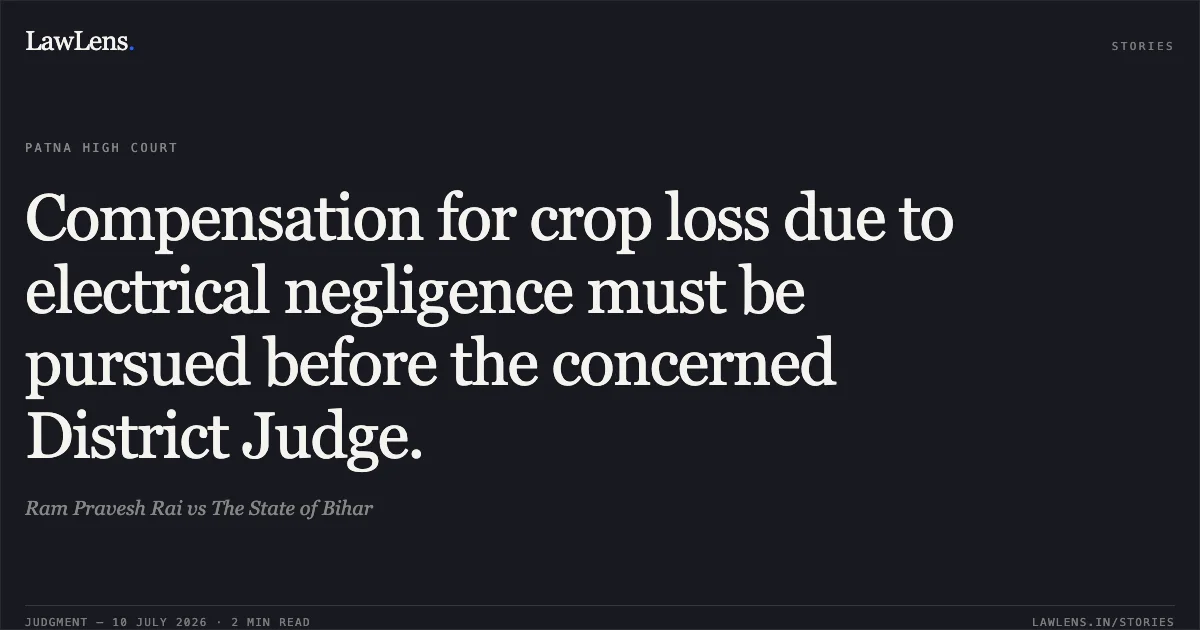
The petitioners filed a writ petition seeking a writ of mandamus to direct the respondent authorities to grant compensation for the destruction of wheat crops across 14 Bighas of land
Source reference: p. 2The petitioners alleged that the crops, estimated at 238 quintals with a market value of ₹3,88,416, were burnt due to the snapping of an 11,000-voltage electric wire overhead
Source reference: p. 2The respondents contended that the matter was covered by existing judicial precedents involving the State of Bihar
Source reference: p. 2Issues
Whether the High Court under Article 226 of the Constitution should directly adjudicate and award compensation for crop damage caused by electrical accidents or relegate the petitioners to a specialized forum
Source reference: p. 3 / para. 4-5Law Applied
The Court applied the principles established by the Hon’ble Supreme Court in Power Grid Corporation of India Ltd. v. Ram Naresh Singh and Others, reported in 2017(2) PLJR (SC) 152, which clarifies the appropriate forum and procedure for seeking compensation against power utilities
Source reference: p. 3 / para. 5It further relied on its own previous coordinate bench judgment in Pramod Nath Tiwary v. The State of Bihar & Ors. (CWJC No. 17834 of 2016), which mandates that such writ petitions be disposed of with liberty to approach the District Judge
Source reference: p. 2 / para. 3Reasoning
The Court observed that the relief sought—compensation for factual loss due to electrical negligence—is not best addressed through the summary proceedings of a writ petition when a specific legal framework for compensation exists
Source reference: p. 2-3Following the precedent in Power Grid Corporation of India Ltd., the Court determined that the appropriate remedy for the petitioners is to approach the concerned District Judge
Source reference: p. 3 / para. 5By disposing of the writ in terms of the aforementioned judgment, the Court balanced the petitioners' right to seek damages with the procedural requirement of presenting evidence before a forum capable of factual adjudication
Source reference: p. 3Holding
The High Court disposed of the writ petition without granting direct compensation, instead granting the petitioners liberty to approach the concerned District Judge for appropriate relief
The Court directed that if such a petition is filed within four weeks, the lower court shall examine the merits and dispose of the case expeditiously, preferably within four months
Source reference: p. 3 / para. 5All pending interlocutory applications were also disposed of
Source reference: p. 4 / para. 7Acts & Sections Cited
1 provisions across 1 statute referred to in this judgment. Each provision opens on LawLens.
Indian Telegraph Act, 18851
Original Court PDF
Ram Pravesh RaivsThe State of Bihar
Click to open original judgment
Original judgment, available to read, download and summarize on LawLens.in