Facts
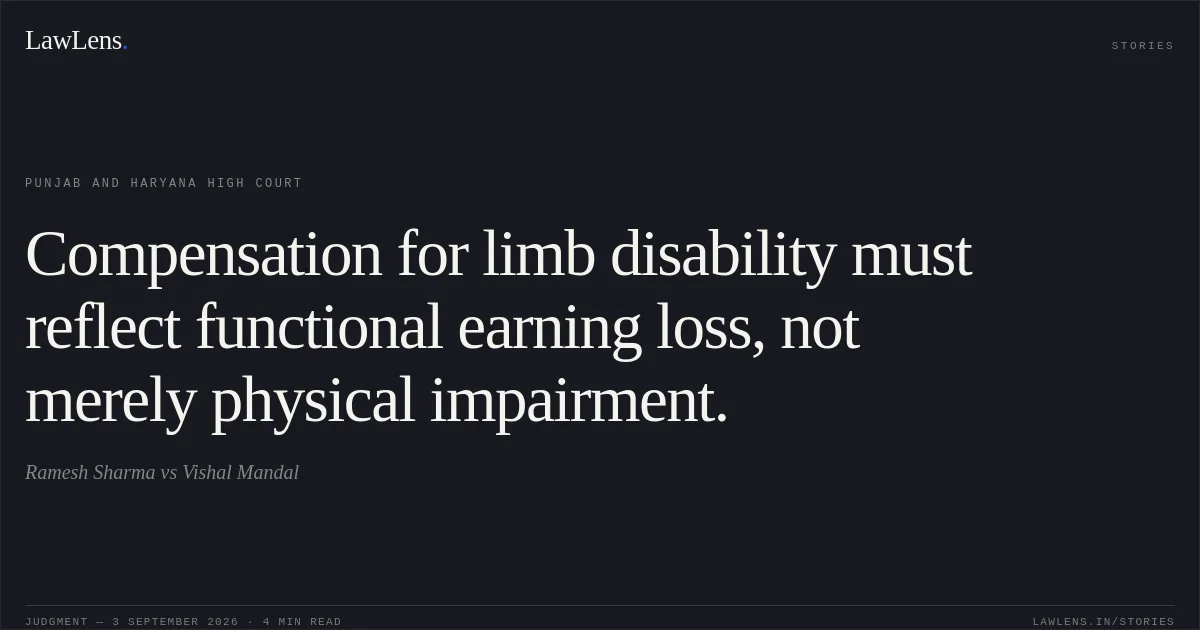
The claimant sustained grievous injuries in a motor-vehicle accident on 27 March 2000, caused by the rash and negligent driving of Maruti Car No. PCF-3399 by respondent No.1.
Source reference: para. 1The vehicle was owned by respondent No.2 and insured with respondent No.3.
Source reference: para. 1The Motor Accident Claims Tribunal, Ludhiana, awarded ₹2,00,000 with interest at 9% per annum, holding the driver, owner and insurer jointly and severally liable.
Source reference: para. 2The claimant appealed seeking enhancement.
Source reference: para. 2The High Court noted that the appeal and Tribunal records had been destroyed in a fire and therefore decided the matter on the basis of the facts and evidence recorded in the impugned award.
Source reference: paras. 1–3, 6–8The claimant had suffered a fracture of the femur requiring interlocking nailing, restricted movement of the hip and left knee, and 38% permanent disability in the left limb.
Source reference: para. 13Issues
Whether the claimant was entitled to enhancement of compensation beyond the ₹2,00,000 awarded by the Tribunal for injuries suffered in the accident.
Source reference: paras. 7–9Whether compensation was required to be reassessed under the appropriate pecuniary and non-pecuniary heads, including permanent disability, treatment expenses, pain and suffering, loss of amenities, attendant charges and transportation expenses.
Source reference: paras. 11–12Whether the Tribunal had correctly assessed the claimant’s functional disability, income and loss of future earning capacity.
Source reference: paras. 14–16Law Applied
The Court applied Section 166 of the Motor Vehicles Act, 1988, under which an injured claimant is entitled to “just compensation” for injuries caused by the use of a motor vehicle.
Source reference: para. 3Compensation in personal-injury claims must be fair, reasonable and equitable, and must be assessed under both pecuniary and non-pecuniary heads.
Source reference: para. 12Relying on G. Ravindranath @ R. Chowdary v. E. Srinivas, the Court recognised treatment expenses, loss of earnings during treatment, loss of future earnings due to permanent disability, future medical expenses, pain and suffering, loss of amenities and loss of expectation of life as relevant heads of compensation.
Source reference: para. 12The Court relied on Sanjay Verma v. Haryana Roadways and National Insurance Co. Ltd. v. Pranay Sethi for future prospects, and Sarla Verma v. DTC for the multiplier method.
Source reference: paras. 9, 15–16It relied on Yadava Kumar v. Divisional Manager, National Insurance Co. Ltd. for assessing loss of earning capacity by applying the percentage of functional disability and an appropriate multiplier.
Source reference: para. 16Under R.D. Hattangadi v. Pest Control (India) Pvt. Ltd., National Insurance Co. v. Saloni Dargan and Vimla Devi v. National Insurance Co. Ltd., proceedings before a Motor Accident Claims Tribunal are summary in nature and strict rules of proof should not defeat a beneficial claim for compensation.
Source reference: para. 18Reasoning
The finding that the accident resulted from the respondent-driver’s rash and negligent driving was affirmed because it had not been challenged by the respondents through an appeal or cross-objections.
Source reference: para. 8The Court found ₹10,000 for pain and suffering inadequate in view of the fracture, surgery, implant and prolonged recovery, and enhanced it to ₹30,000.
Source reference: para. 13Although the claimant’s asserted U.S. salary was not proved, the Court assessed her income at ₹12,000 per month, also recognising her services as a homemaker.
Source reference: para. 14After adding 10% for future prospects, the monthly income became ₹13,200.
Source reference: para. 15The medical evidence established 38% disability of the left limb; the Court converted this into 20% functional disability of the whole person for purposes of earning capacity.
Source reference: para. 16Applying the 20% disability, annual loss of income of ₹31,680 and multiplier 11, it awarded ₹3,48,480 for loss of future income.
Source reference: para. 16The Court further enhanced compensation for loss of amenities and related non-pecuniary losses, accepted treatment expenses in India and the United States on a liberal assessment appropriate to summary proceedings, and increased nursing, attendant and transportation expenses.
Source reference: paras. 17–20Holding
The appeal was partly allowed with costs.
The total compensation was enhanced from ₹2,00,000 to ₹5,93,500, comprising ₹30,000 for pain and suffering, ₹3,48,480 for loss of income due to permanent disability, ₹50,000 for loss of amenities and associated non-pecuniary losses, ₹1,25,000 for treatment expenses, ₹20,000 for nursing and attendant charges, ₹10,000 for transportation, and ₹10,000 for loss of income during treatment.
Source reference: para. 22The claimant was accordingly awarded enhanced compensation of ₹3,93,500 over and above the Tribunal’s award, payable by respondents No.1 to 3 jointly and severally, with interest at 9% per annum from 20 April 2001, the date of filing of the claim petition, until realization.
Source reference: para. 23The Registry was directed to email the authenticated judgment to the insurer in accordance with the Supreme Court’s directions in Bajaj Allianz General Insurance Co. Ltd. v. Union of India.
Source reference: para. 24Acts & Sections Cited
1 provisions across 1 statute referred to in this judgment. Each provision opens on LawLens.
Motor Vehicles Act, 19881
Original Court PDF
Ramesh SharmavsVishal Mandal
Click to open original judgment
Original judgment, available to read, download and summarize on LawLens.in