Facts
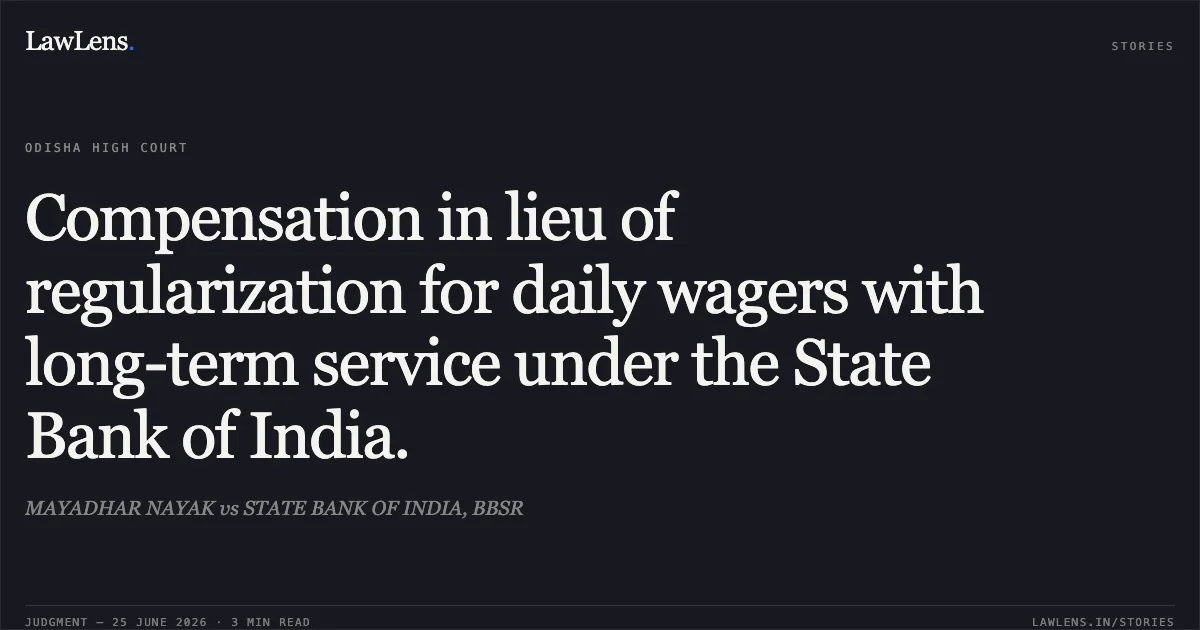
The Appellants, members of the Scheduled Castes, served as daily-wage sweepers/cleaners at the State Bank of India (SBI) for approximately 30 years.
Source reference: p. 2, 10They previously filed OJC No. 13193 of 1999 and W.P.(C) No. 8906 of 2007 seeking regularization and parity in wages.
Source reference: p. 2Earlier court orders directed the Bank to pay minimum wages and consider them for future vacancies, provided work was available.
Source reference: p. 2-3However, the Bank adopted an outsourcing policy for such roles due to IT developments.
Source reference: p. 6In 2025, during the pendency of a subsequent writ petition for temporary status/bonus, the Bank retrenched the Appellants under Section 25F of the Industrial Disputes Act, 1947, paying approximately ₹3.30 lakhs each.
Source reference: p. 4A learned Single Judge dismissed the Appellants' writs on 20.06.2025, leading to these intra-court appeals.
Source reference: p. 4Issues
1. Whether the Appellants are entitled to regularization or enhanced compensation in lieu of service given their 30-year tenure and the findings in previous litigations.
Source reference: p. 4-5/para. 52. Whether the lump-sum compensation offered by the Bank during conciliation was adequate under the principles of justice and equity.
Source reference: p. 8-10/para. 7.2.2Law Applied
The Court relied on the evolving "march of law" regarding the regularization of daily wagers as established in Dharwad Distt. P.W.D. Literate Daily Wage Employees v. State of Karnataka (1990) and more recently in Jaggo v. Union of India (2024) and Shripal v. Nagar Nigam (2025).
Source reference: p. 4, 6, 9The Court also considered the principle of res judicata regarding prior orders that limited the Appellants' relief to minimum wages.
Source reference: p. 5The Court applied the doctrine of "Complete Justice" similar to the exercise of powers under Article 142 of the Constitution, citing the precedent of State Bank of India v. Shyam Sundar Adhikari (2023) and the High Court’s own approach in Secretary, Berhampur Cooperative Central Bank Ltd. v. Bhaba Sundar Dalai (2026) regarding lump-sum compensation in lieu of reinstatement.
Source reference: p. 9-10Reasoning
The Court observed that while the Appellants had a "spotless service" of three decades, the previous judicial orders (from 2007 and 2008) created a barrier of res judicata against an absolute right to regularization, as those orders only directed payment of minimum wages and consideration for vacancies.
Source reference: p. 6, 9The Court found the Bank's offer of ₹5 lakh as compensation "too frugal" considering the current cost of living and the Appellants' age, social status, and limited future employability.
Source reference: p. 10The Court reasoned that since the Appellants were near superannuation and had dedicated their "life blood" to menial labor for the Bank, the compensation must reflect a "solid yardstick" of justice.
Source reference: p. 10-11It distinguished the present case from the Shyam Sundar Adhikari case on the basis of the Appellants' longer, continuous tenure compared to that of the workman in the cited precedent.
Source reference: p. 9Holding
The Court held that while regularization was not feasible due to policy shifts and prior litigation constraints, the Appellants were entitled to substantial secondary relief.
The Court partly allowed the appeals, set aside the Single Judge's order, and ordered the Respondent-Bank to pay a lump-sum compensation of ₹20,00,000/- (Rupees Twenty Lakh) to each Appellant within eight weeks.
Source reference: p. 11Failure to pay within the stipulated time would attract interest at 1% per month for the first month and 2% thereafter, which the Bank may recover from the personal salaries of erring officials.
Source reference: p. 11Acts & Sections Cited
2 provisions across 2 statutes referred to in this judgment. Linked provisions open on LawLens.
Letters Patent of Patna High Court1
Industrial Disputes Act, 19471
Original Court PDF
MAYADHAR NAYAKvsSTATE BANK OF INDIA, BBSR
Click to open original judgment
Original judgment, available to read, download and summarize on LawLens.in