Facts
The petitioners were former Safai Karamcharis engaged at Pragati Maidan, New Delhi.
Source reference: no citationThey claimed that they had continuously performed sweeping and cleaning duties since 1996 through M/s Sulabh International Delhi, which had been engaged by the India Trade Promotion Organization (ITPO), and that they were paid approximately Rs.2,700 per month.
Source reference: no citationThey alleged that their services were terminated on 15 or 31 January 2002 without notice, charge-sheet, or payment of statutory dues after they raised a dispute seeking parity of wages with ITPO’s permanent employees.
Source reference: para. 4ITPO denied any employer–employee relationship and stated that conservancy services had been entrusted to Sulabh International under yearly agreements.
Source reference: para. 5Sulabh contended that the petitioners were voluntary social workers and that it was not an “industry” under Section 2(j) of the Industrial Disputes Act, 1947 (“ID Act”).
Source reference: para. 5The Labour Court held that no direct employer–employee relationship existed between the petitioners and ITPO, but found Sulabh International to be an “industry” and the petitioners to be “workmen” under the ID Act.
Source reference: paras. 6–7It further held that their termination violated Section 25F of the ID Act.
Source reference: paras. 6–7Instead of reinstatement and back wages, the Labour Court awarded varying lump-sum compensation, together with litigation costs of Rs.10,000 to each workman.
Source reference: para. 8The petitioners challenged the denial of reinstatement, full back wages, bonus, and leave benefits before the High Court.
Source reference: paras. 2, 9Issues
Whether the Labour Court erred in finding that the petitioners had failed to establish a direct employer–employee relationship with ITPO.
Source reference: para. 11Whether Sulabh International was an “industry” and the petitioners were “workmen” under the ID Act, and whether their termination violated Section 25F of the ID Act.
Source reference: paras. 5–7, 12Whether, despite the finding of illegal termination, the petitioners were entitled as of right to reinstatement with full back wages and other consequential benefits, or whether monetary compensation could properly be awarded instead.
Source reference: paras. 2, 9, 13–15Whether the Labour Court’s award of lump-sum compensation was perverse, arbitrary, or otherwise liable to interference in writ jurisdiction under Articles 226 and 227 of the Constitution.
Source reference: para. 10Law Applied
The Court applied Section 2(j) of the ID Act, under which an undertaking satisfying the statutory definition of “industry” may be subject to the Act, and Section 2(s), which defines “workman”; it accepted the Labour Court’s finding that Sulabh International was an industry and that the petitioners were workmen.
Source reference: paras. 5–7, 12Section 25F of the ID Act requires compliance with prescribed notice and retrenchment-compensation requirements before retrenchment; non-compliance renders the termination illegal.
Source reference: para. 12The Court reiterated that writ jurisdiction under Articles 226 and 227 is supervisory and not appellate, and interference is warranted where the decision is without jurisdiction, perverse, or contrary to natural justice, relying on Syed Yakoob v. K.S. Radhakrishnan, International Airport Authority of India v. International Air Cargo Workers’ Union, and Ritz Theatre Pvt. Ltd. v. Ramesh Chandra.
Source reference: para. 10It further applied Jagbir Singh v. Haryana State Agriculture Marketing Board, which holds that reinstatement with full back wages does not automatically follow an illegal termination, and Bharat Sanchar Nigam Limited v. Bhurumal, which recognises monetary compensation in lieu of reinstatement in cases involving daily-wage workers whose termination is illegal solely for procedural non-compliance under Section 25F, subject to exceptional cases such as unfair labour practice or violation of the “last come, first go” principle.
Source reference: paras. 13–14Reasoning
The High Court found no basis to disturb the Labour Court’s conclusion that the petitioners were deployed by Sulabh International and had failed to plead or prove that the contracts between Sulabh International and ITPO were sham or bogus; therefore, no direct employer–employee relationship with ITPO was established.
Source reference: para. 11The Labour Court’s finding that the petitioners worked fixed eight-hour shifts, wore uniforms, and received monthly wages linked to minimum wages supported their status as workmen, while Sulabh International was correctly treated as an industry.
Source reference: para. 12Although the termination was illegal for non-compliance with Section 25F, the Court held that reinstatement was not automatic.
Source reference: paras. 13–15The disputes arose from engagements dating between 1996 and 2002, and more than two decades had elapsed since termination.
Source reference: paras. 13–15Considering the nature of the engagement, the petitioners’ ages, and their length of service, the Labour Court was justified in substituting reinstatement and back wages with monetary compensation.
Source reference: paras. 13–15The compensation awarded was neither perverse nor arbitrary, particularly in the absence of circumstances such as unfair labour practice, victimisation, or retention or regularisation of juniors that would ordinarily favour reinstatement.
Source reference: paras. 13–15Holding
The Court held that the petitioners failed to establish a direct employer–employee relationship with ITPO, while Sulabh International was their relevant employer and was an “industry” under the ID Act.
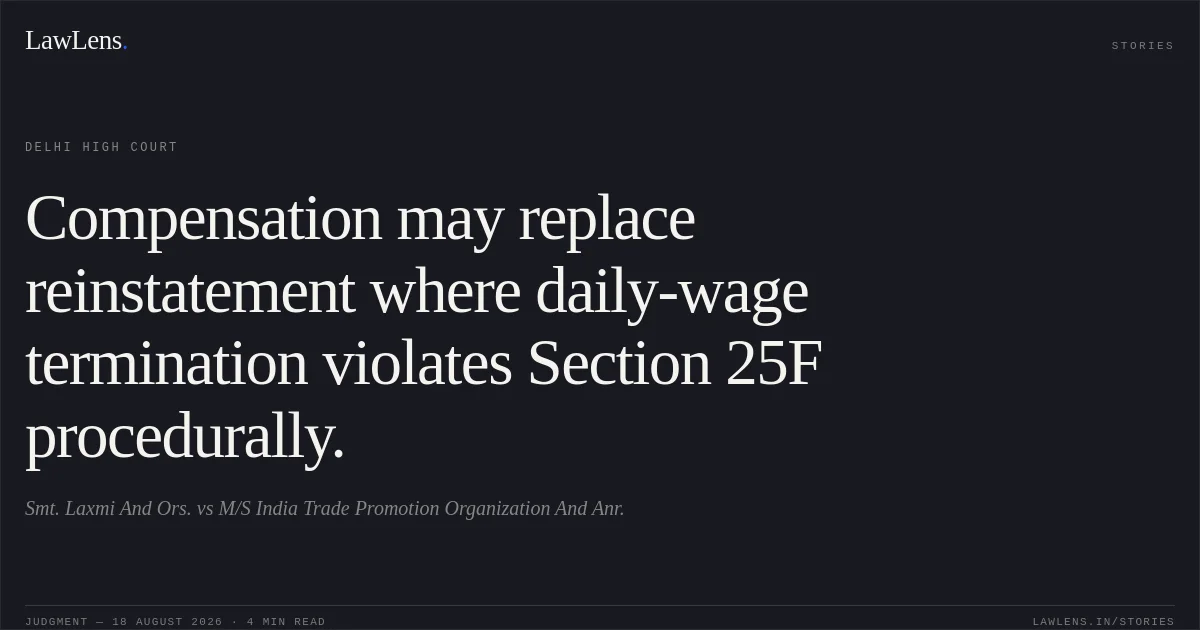
Their termination was illegal for violation of Section 25F, but reinstatement with full back wages was not an automatic remedy in the circumstances.
Source reference: paras. 11–15The compensation awarded by the Labour Court, along with litigation costs, was found to be just, fair, and reasonable and did not warrant interference under Articles 226 or 227.
Source reference: paras. 11–15Accordingly, all three writ petitions were dismissed.
Source reference: para. 16Acts & Sections Cited
2 provisions across 1 statute referred to in this judgment. Linked provisions open on LawLens.
Industrial Disputes Act, 19472
Original Court PDF
Smt. Laxmi And Ors.vsM/S India Trade Promotion Organization And Anr.
Click to open original judgment
Original judgment, available to read, download and summarize on LawLens.in