Facts
The appellant (original complainant) filed a criminal appeal under Section 378 of the Code of Criminal Procedure, 1973 (CrPC) [now Section 419 of the Bharatiya Nagrik Suraksha Sanhita, 2023 (BNSS)] challenging the judgment and order dated 28.03.2018 passed by the 5th Additional Chief Judicial Magistrate, Vadodara
Source reference: p. 1The Trial Court had acquitted the respondent (accused) of the offence under Section 138 of the Negotiable Instruments Act, 1881 (NI Act)
Source reference: p. 1-2The matter was brought before the High Court of Gujarat to determine the appropriate forum for the appeal in light of evolving precedents
Source reference: p. 2Issues
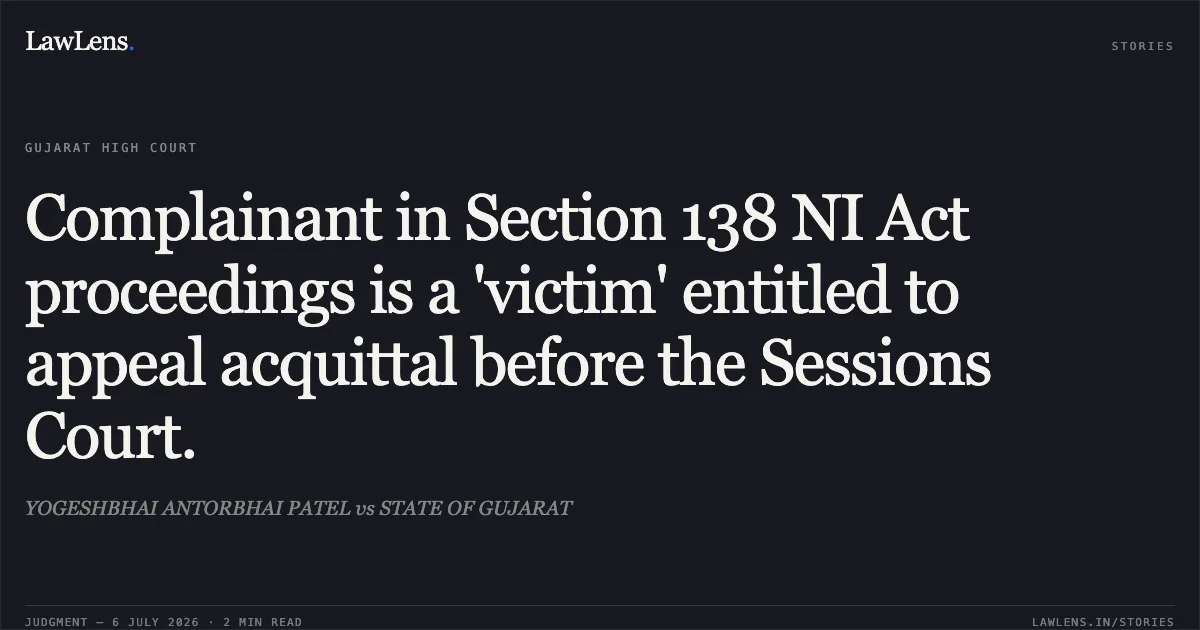
1. Whether the original complainant in a Section 138 NI Act proceeding is considered a "victim" entitled to file an appeal against acquittal before the Sessions Court under the proviso to Section 372 of the CrPC
Source reference: p. 2 / para. 32. Whether the High Court should retain the appeal or transfer it to the Sessions Court based on recent judicial pronouncements
Source reference: p. 2 / para. 4, 8Law Applied
The Court primarily relied on the Supreme Court decision in Celestium Financial v. A. Gnanasekaran [2025 (3) GLH 747], which established that a complainant under Section 138 of the NI Act is a "victim" as defined under Section 2(wa) of the CrPC and possesses a statutory right to appeal against acquittal under the proviso to Section 372 of the CrPC (now Section 413 of the BNSS) to the Court immediately superior in hierarchy, i.e., the Sessions Court
Source reference: para. 3, 7.8It further referred to the High Court’s own ruling in Thakar Hariprasad Dalsukhram v. State of Gujarat [2026 SCC OnLine Guj 569], reaffirming the transfer of such appeals to the appropriate lower appellate forum
Source reference: para. 8Reasoning
The Court observed that the Supreme Court in Celestium Financial clarified that a victim’s right to appeal is absolute and not circumscribed by the requirement of seeking "leave to appeal" under Section 378(4) of the CrPC
Source reference: para. 7.9, 7.12The Court reasoned that since the complainant in a cheque dishonour case is the one who suffers the impact of the offence, they occupy the status of a "victim"
Source reference: para. 7.12Consequently, the proper forum for an appeal against a Magistrate’s order of acquittal in a Section 138 case is the Sessions Court, not the High Court
Source reference: para. 4Although it was noted that a reference for a larger Bench is pending in the Supreme Court (SLP Crl. No. 12350/2024), the Court determined that the matter must currently be governed by the existing authoritative pronouncements and thus be transferred to the Sessions Court for adjudication on merits
Source reference: para. 6, 8Holding
The High Court held that the appeal was maintainable before the Sessions Court under the proviso to Section 372 of the CrPC / Section 413 of the BNSS
The Court disposed of the appeal by directing the Registry to transfer the entire record and proceedings to the concerned Sessions Court at Vadodara for expedited disposal
Source reference: para. 8, 9The Sessions Court was directed to treat the matter as a fresh appeal, issue notices to the parties, and decide the case without being influenced by the High Court's transfer order
Source reference: para. 8, 9Acts & Sections Cited
9 provisions across 3 statutes referred to in this judgment. Each provision opens on LawLens.
Code of Criminal Procedure, 19735
Bharatiya Nagarik Suraksha Sanhita, 20232
Negotiable Instruments Act, 18812
Original Court PDF
YOGESHBHAI ANTORBHAI PATELvsSTATE OF GUJARAT
Click to open original judgment
Original judgment, available to read, download and summarize on LawLens.in


