Facts
The appellant (original complainant) filed an appeal under Section 378 of the Code of Criminal Procedure, 1973 (CrPC) / Section 419 of the Bharatiya Nagrik Suraksha Sanhita, 2023 (BNSS).
Source reference: p. 1The appeal challenged the judgment and order dated 17.04.2018 passed by the 4th Additional Chief Judicial Magistrate, Anand, which acquitted the respondent-accused of an offence under Section 138 of the Negotiable Instruments Act, 1881 (NI Act).
Source reference: p. 1During the pendency of the appeal, the High Court examined whether the complainant should instead prefer an appeal before the Sessions Court as a "victim".
Source reference: p. 2Issues
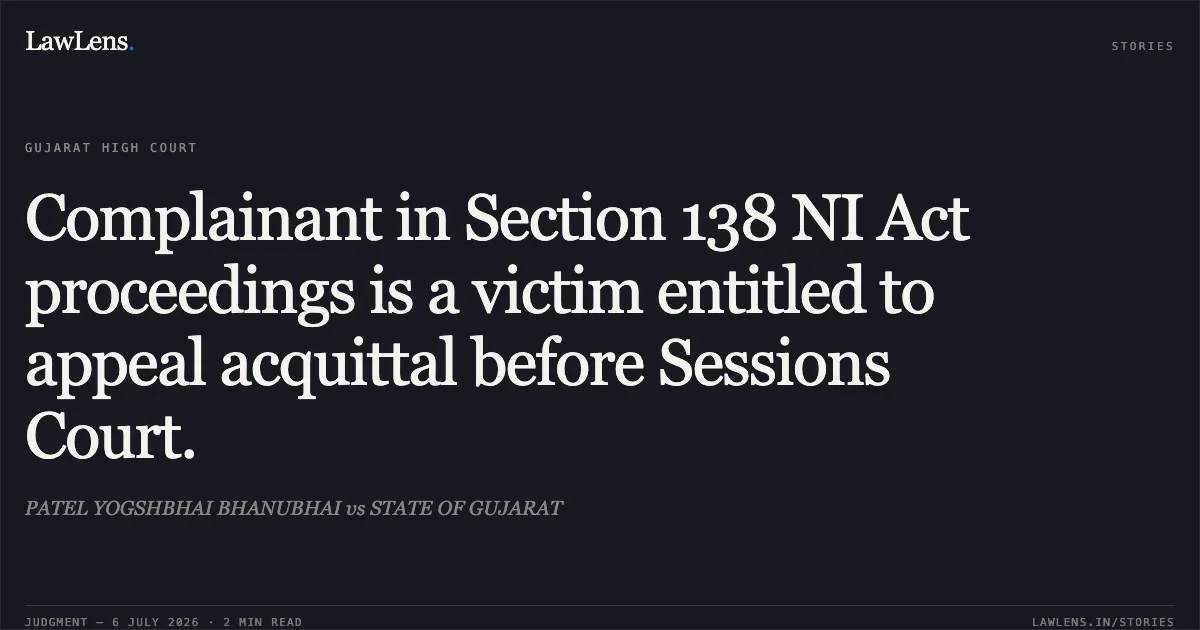
1. Whether the complainant in a Section 138 NI Act proceeding is considered a "victim" entitled to file an appeal against acquittal before the Sessions Court under the proviso to Section 372 of the CrPC / Section 413 of the BNSS.
Source reference: p. 2-32. Whether the current appeal pending before the High Court should be transferred to the concerned Sessions Court for adjudication.
Source reference: p. 5Law Applied
Proviso to Section 372 of the CrPC (corresponding to Section 413 of the BNSS), which grants a victim the right to prefer an appeal against an order of acquittal.
Source reference: p. 2, 5A complainant in a Section 138 NI Act case is a "victim" under Section 2(wa) of the CrPC because they suffer loss due to the dishonor of a cheque.
Source reference: para. 7.8, 7.9Procedural shift that such appeals lie to the court to which an appeal ordinarily lies against a conviction (the Sessions Court), rather than requiring special leave from the High Court under Section 378(4).
Source reference: para. 7.12Reasoning
The Court observed that under the prevailing legal framework as interpreted in Celestium Financial, there is no distinction between a victim of a penal offence and a victim of a "deemed offence" under Section 138 of the NI Act.
Source reference: para. 7.9The High Court reasoned that since the complainant and the victim are the same person in cheque bounce cases, the absolute right to appeal under Section 372 CrPC applies.
Source reference: para. 7.12The Court found that forcing a victim to seek "special leave" under Section 378(4) would contradict the parliamentary intent of the 2009 amendment to Section 372.
Source reference: para. 7.12Following Shivsinh Ganpatsinh Solanki v. State of Gujarat and Thakar Hariprasad Dalsukhram v. State of Gujarat, the Court determined that the appropriate forum for the appeal is the Sessions Court.
Source reference: p. 2, 5Holding
The High Court held that the complainant is a victim entitled to appeal under the proviso to Section 372 of the CrPC / Section 413 of the BNSS.
The Court disposed of the appeal by directing the Registry to transfer the entire record and proceedings to the concerned Sessions Court at Anand.
Source reference: p. 5The Sessions Court was directed to treat the matter as an appeal under Section 372/413, issue notices to the parties, and make an endeavor to dispose of the matter expeditiously.
Source reference: p. 5-6The Court clarified that it did not express any opinion on the merits of the case.
Source reference: p. 6Acts & Sections Cited
9 provisions across 3 statutes referred to in this judgment. Each provision opens on LawLens.
Code of Criminal Procedure, 19735
Bharatiya Nagarik Suraksha Sanhita, 20232
Negotiable Instruments Act, 18812
Original Court PDF
PATEL YOGSHBHAI BHANUBHAIvsSTATE OF GUJARAT
Click to open original judgment
Original judgment, available to read, download and summarize on LawLens.in


