Facts
The Petitioner, a resident and owner of two floors in West Patel Nagar, filed complaints regarding unauthorized construction carried out by Respondents No. 2 and 3 on the 4th and 5th floors of the subject property
Source reference: para 2.1–2.2Following a previous writ petition (W.P.(C) 10712/2023) and subsequent contempt proceedings, the Municipal Corporation of Delhi (MCD) issued a demolition order on February 5, 2024, for the 4th floor
Source reference: para 2.3–2.6The private respondents challenged this order before the Appellate Tribunal, MCD (ATMCD). The Petitioner sought impleadment in that appeal under Order I Rule 10 of the CPC.
Source reference: para 4The ATMCD dismissed the impleadment application but granted the Petitioner liberty to file documents and argue at the final stage
Source reference: para 4The Petitioner challenged this dismissal under Article 227 of the Constitution of India
Source reference: para 1Issues
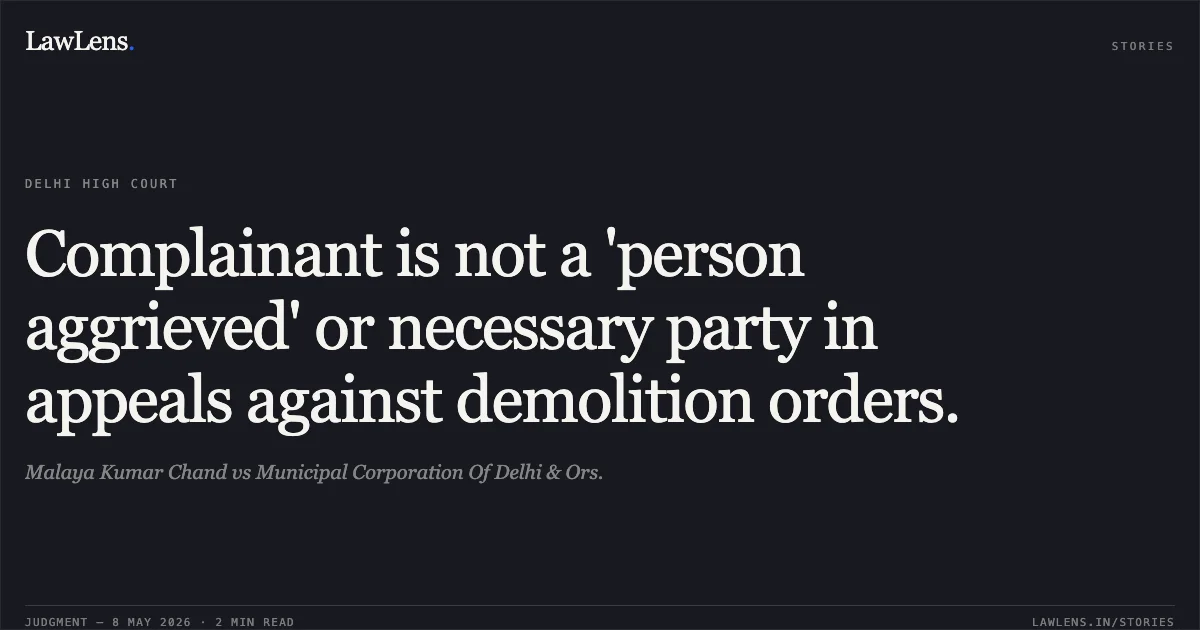
1. Whether a complainant, whose information led to a demolition order, is a "person aggrieved" or a necessary/proper party under the DMC Act to be impleaded in an appeal filed by the owner against said demolition order?
Source reference: para 5, 8Law Applied
Section 343 and Section 347B of the Delhi Municipal Corporation Act, 1957, which govern demolition orders and appeals
Source reference: para 7Hardayal Singh Mehta Anr. v. MCD Ors., which established that demolition proceedings are not adversarial contests between a complainant and an owner, but between the MCD and the owner
Source reference: para 8Meena Sharma v. Seema and Ors. (where impleadment was allowed due to specific prior court directions) and ANZ Grindlays Bank Plc. v. MCD, which defined "person aggrieved" as one whose possessory or proprietary interests are prejudicially affected by the demolition itself
Source reference: para 9–11Reasoning
The Court reasoned that under the scheme of the DMC Act, the Petitioner does not qualify as an "aggrieved person" because he supports the demolition rather than being adversely affected by it
Source reference: para 4, 11Following Hardayal Singh, the Court noted that the MCD Commissioner's exercise of power is a quasi-judicial act where the contest is strictly between the authority and the person whose building is at risk
Source reference: para 8The Petitioner's role is limited to that of an informant or witness
Source reference: para 8The Court observed that unlike the Meena Sharma case, there were no prior judicial observations in this matter designating the Petitioner as a "necessary party"
Source reference: para 10Furthermore, since the Petitioner is not a tenant or occupier whose rights would be harmed by the demolition, he does not meet the "aggrieved" threshold established in Grindlays Bank
Source reference: para 11The Court found the ATMCD’s order balanced, as it protected the Petitioner’s interest by allowing him to submit documents and arguments without granting him full party status
Source reference: para 12Holding
The Court held that a complainant does not acquire the status of a necessary or proper party in a demolition appeal merely by furnishing information
The petition was dismissed, and the Court declined to interfere with the ATMCD’s order under Article 227, affirming that the Petitioner’s rights were sufficiently protected by the liberty to assist the Tribunal at the final stage
Source reference: para 13Acts & Sections Cited
3 provisions across 1 statute referred to in this judgment. Each provision opens on LawLens.
Delhi Municipal Corporation Act, 19573
Original Court PDF
Malaya Kumar ChandvsMunicipal Corporation Of Delhi & Ors.
Click to open original judgment
Original judgment, available to read, download and summarize on LawLens.in