01Facts
The second respondent alleged that the petitioner and others threatened him and his wife at a hotel on 12 May 2025, then locked the hotel shutter from outside the following morning while people remained inside.
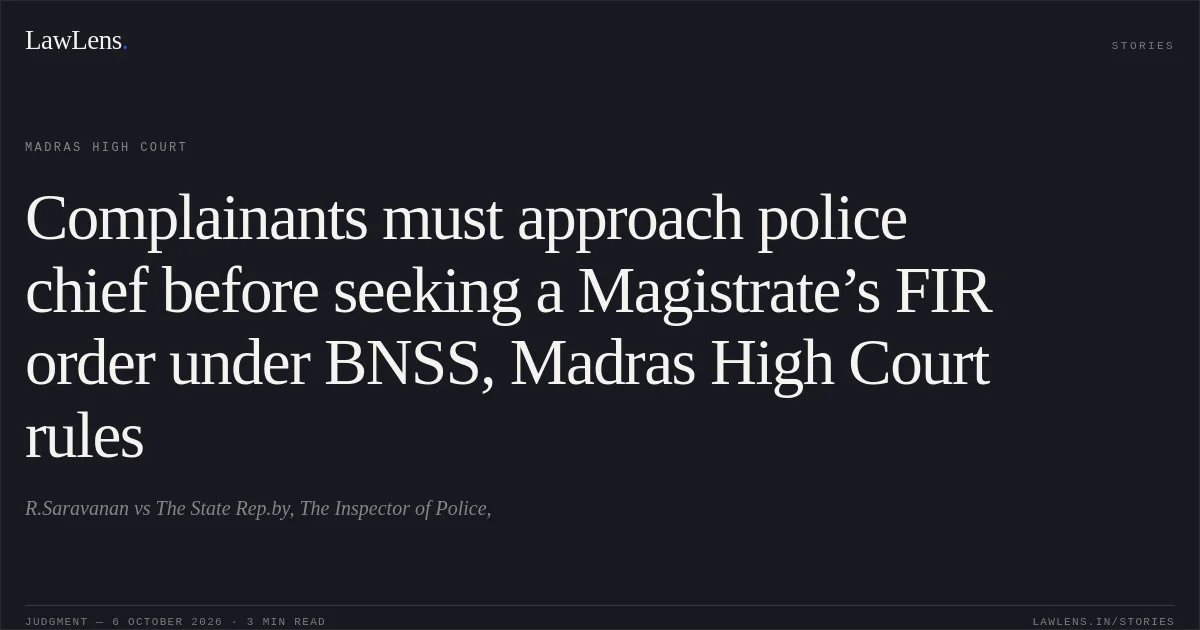
pp. 2–4After police did not register an FIR on his complaint, he applied to the Judicial Magistrate under Section 175(3) of the BNSS.
pp. 2–4The Magistrate directed registration of an FIR.
pp. 2–4The petitioner challenged that order by criminal revision, arguing, among other things, that the dispute was civil and that the second respondent had not first sent a complaint to the Superintendent of Police as required by Section 173(4) of the BNSS.
pp. 2–402Issues
i.Whether a criminal revision is maintainable against a Magistrate’s order directing registration of an FIR.
pp. 7–9ii.Whether the Magistrate could direct registration under Section 175(3) of the BNSS when the complainant had not first approached the Superintendent of Police under Section 173(4), and the supporting affidavit included allegations unrelated to the complaint.
pp. 10–1203Law Applied
Section 173(4) of the BNSS requires a complainant, following refusal by the officer in charge of a police station to register an FIR, to send the substance of the complaint in writing to the Superintendent of Police; Section 175(3) requires the complainant seeking a Magistrate’s direction to furnish a copy of that application, supported by an affidavit, and empowers the Magistrate to conduct such inquiry as considered necessary and to consider the police officer’s submissions.
pp. 10–12In Om Prakash Ambadkar v. State of Maharashtra, [2025] 1 SCR 1469, the Supreme Court identified these requirements as significant procedural changes under the BNSS.
p. 11The Court also relied on Arun P. Gidh v. Chandraprakash Singh, WP No. 2517 of 2022 (Bombay High Court, Full Bench, 10 April 2024), and Karthick v. Inspector of Police, Crl. R.C. (MD) No. 46 of 2025 (Madras High Court, 14 March 2025), for the proposition that an order directing investigation is subject to revisional jurisdiction.
pp. 7–9Provisions in the judgment · 5 · Linked ones open on LawLens
Bharatiya Nagarik Suraksha Sanhita, 2023 Section 438Section 442Section 175Section 173
Code of Criminal Procedure, 1973 Section 156
04Reasoning
The Court held that the revision was maintainable, following the authorities recognising revisional jurisdiction over an order directing registration of an FIR.
pp. 7–9On the merits, the supporting affidavit contained extensive allegations about past incidents and a monetary dispute that were not relevant to the two occurrences forming the subject of the complaint.
p. 10Further, the complainant had admittedly not sent the complaint to the Superintendent of Police before approaching the Magistrate.
pp. 10–12The Magistrate’s permission to send it while the application was pending could not cure that failure to comply with the statutory procedure.
pp. 10–12The Court therefore found the Magistrate’s order procedurally unsustainable, while directing that the specific allegations concerning 12 and 13 May 2025 be considered by the Superintendent of Police.
pp. 12–1305Holding
The Court held that the revision was maintainable and set aside the Magistrate’s order directing registration of an FIR.
pp. 12–13To secure the ends of justice, it directed the Superintendent of Police, Dharmapuri, to investigate the complaint or have it investigated by a subordinate officer, limited to the alleged occurrences of 12 and 13 May 2025.
pp. 12–13If the inquiry disclosed a cognizable offence, an FIR could be directed; otherwise, a report was to be filed before the Magistrate.
pp. 12–13The revision was disposed of with these directions, and the connected miscellaneous petition was closed.
pp. 12–13Original Court PDF
R.SaravananvsThe State Rep.by, The Inspector of Police,
Click to open original judgment
Original judgment, available to read, download and summarize on LawLens.in