01Facts
The petitioner, mother of the detenu Sri Vignesh (aged 26), challenged his detention under Section 2(f) of the Tamil Nadu Preventive Detention Act, 1982 as a "Goonda." The detention order No. 368/BBCDEFGISSSV/2026, dated 31.07.2026, was passed by the Commissioner of Police, Greater Chennai City (the second respondent). The detenu was held at Central Prison, Puzhal
¶ 1 · p. 2The petition was filed as a habeas corpus petition under Article 226 of the Constitution. The Court heard both sides and perused the detaining authority's records
¶ 2 · p. 3Although several grounds were raised, the petitioner's principal submission was that the detenu was furnished with an improper translated copy of a vital document at Page 27 of the booklet. This deprived him of an effective representation
¶ 3 · p. 3The Court found that the document at Page 27 is partly in Tamil and partly in English, and that a proper vernacular translation was not furnished to the detenu
¶ 4 · p. 302Issues
i.1. Whether the non-furnishing of a proper translated copy, in a language understood by the detenu, of a partly English document relied upon by the detaining authority vitiates the detention order
¶ 3–4 · pp. 3–4ii.2. Whether such non-furnishing impairs the detenu's constitutional right under Article 22(5) to make an effective representation against the detention order, warranting its quashing
¶ 5–6 · pp. 4–603Law Applied
The Court relied on Article 22(5) of the Constitution, which guarantees a detenu the right to be communicated the grounds of detention and the earliest opportunity to make an effective representation
¶ 6 · p. 5It applied Section 2(f) of the Tamil Nadu Preventive Detention Act, 1982, under which the impugned "Goonda" classification was made
¶ 1 · p. 2The principal authority was Powanammal v. State of Tamil Nadu, (1999) 2 SCC 413
¶ 5 · pp. 3–5Under Powanammal, non-supply of a document relied upon in the grounds of detention is fatal to continued detention without the detenu showing prejudice. By contrast, a document that merely finds reference in the order requires proof of prejudice. The same principle extends to a translated copy, in a language known to the detenu, where the document is in a different language
¶ 5 · pp. 4–5Non-supply of the Tamil version of an English document renders continued detention illegal
¶ 5 · p. 5Provisions in the judgment · 1
Tamil Nadu Preventive Detention Act, 1982 Section 2
04Reasoning
The Court first identified the impugned document (Page 27) as one relied upon by the detaining authority, and found that the copy furnished was partly English and not translated into Tamil
¶ 4 · p. 3Applying Powanammal, the Court held that the case was "on all fours" with that decision
¶ 6 · p. 5It reasoned that the detenu's inability to understand the material in the language furnished impaired his right to make an effective representation, which is a constitutional safeguard under Article 22(5)
¶ 6 · pp. 5–6Because the document was treated as a relied-upon document, the Court did not separately examine prejudice. It rested its finding on the defect in translation alone. The Court therefore held that the defect vitiated the detention order without requiring the other grounds raised to be addressed
¶ 3 · p. 3 · ¶ 6 · p. 605Holding
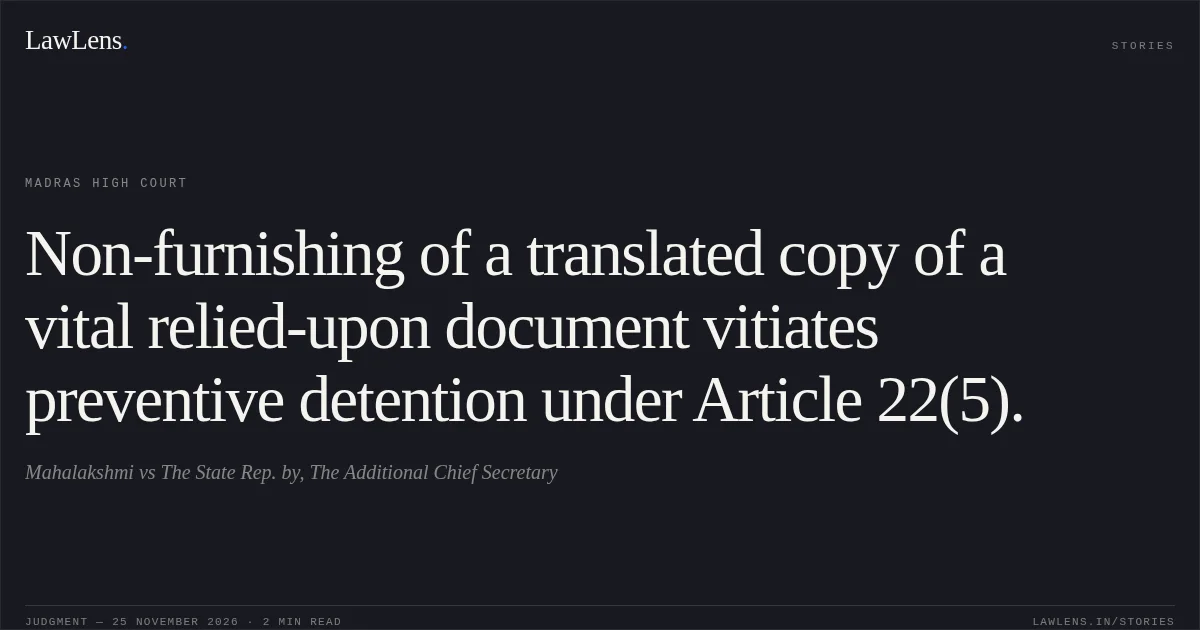
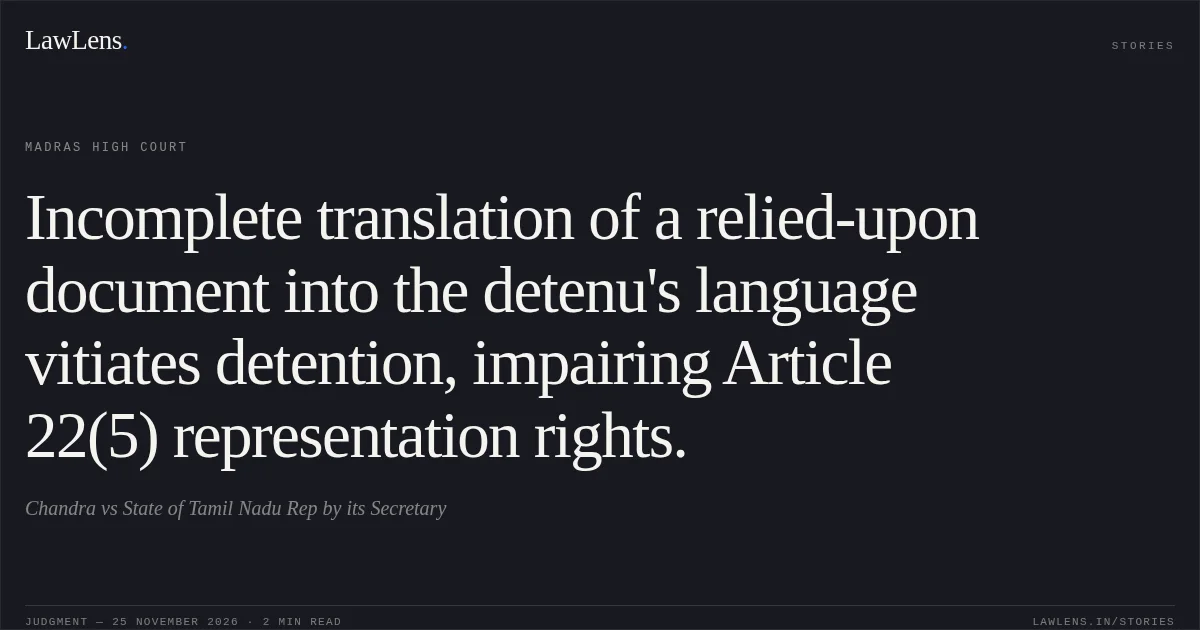
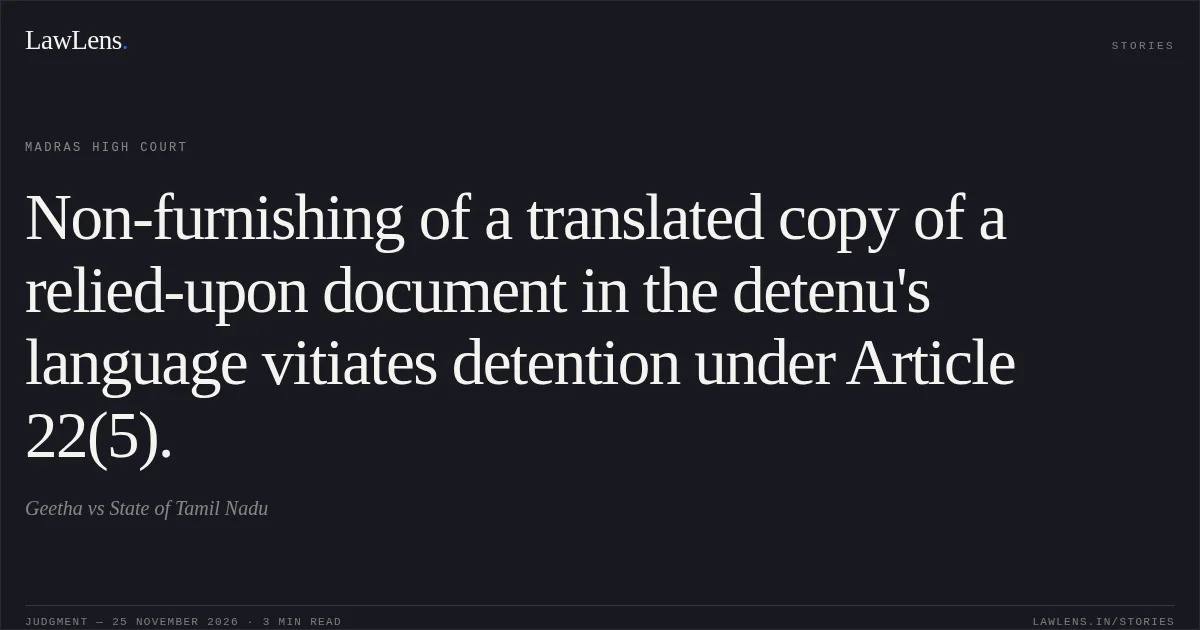
The Court held that non-furnishing of a properly translated vernacular copy of the vital document at Page 27, relied upon by the detaining authority, vitiates the detention order and impairs the detenu's Article 22(5) right to an effective representation
¶ 6 · pp. 5–6The Habeas Corpus Petition was allowed. Order No. 368/BBCDEFGISSSV/2026 dated 31.07.2026 was set aside, and the detenu, Sri Vignesh, was directed to be released forthwith unless required in connection with any other case
¶ 7 · p. 6Original Court PDF
R.SulochanavsState of Tamil Nadu represented by Secretary to Go
Click to open original judgment
Original judgment, available to read, download and summarize on LawLens.in