01Facts
The original writ petitioner, Govindasamy, claimed to have purchased 5.50 acres in Survey No. 54/2B, Kuberapattinam Village, Thandarampattu Taluk, through Document No. 822/1961 dated 23.03.1961, and contended that the land was acquired under the Tamil Nadu Occupants of Kudiyiruppu (Conferment of Ownership) Act, 1971 ("1971 Act") without payment of compensation.
¶ 5 · p. 4He applied to the authorities for compensation, and the request was rejected by order dated 08.08.2022.
¶ 6 · p. 5A Tahsildar's enquiry recorded that Govindasamy had sold 1.94 acres to third parties, which was sub-divided as Survey No. 54/2B1, and that the balance (0.24 acres and 3.32 acres) was sub-divided as Survey No. 54/2B2, which stands in government records and is now occupied by a highway, road, temple, water tank and PDS shop.
¶ 7 · p. 5Govindasamy never challenged this classification.
¶ 8 · pp. 5–6Despite opportunities, he produced no record showing that the land was acquired, and counsel could not produce any notice under the 1971 Act before the Court.
¶ 9 · p. 6The writ petition (W.P. No. 28984 of 2022) was dismissed on 22.08.2023, with the petitioner relegated to the civil court.
¶ 1 · p. 3After his death, his legal heirs filed this writ appeal under Clause 15 of the Letters Patent.
¶ 2 · p. 3 · Prayer · p. 202Issues
i.1. Whether the learned Single Judge erred in relegating the petitioner to the civil court, where the claim of acquisition and non-payment of compensation involved disputed questions of fact unsuited to writ jurisdiction under Article 226.
¶ 3 · pp. 3–4 · ¶ 10 · pp. 6–7ii.2. Whether the appellants established, through records, that the land was acquired from Govindasamy under the 1971 Act, such that compensation was payable.
¶ 9 · p. 6 · ¶ 11 · p. 703Law Applied
The Court's reasoning rests on the Tamil Nadu Occupants of Kudiyiruppu (Conferment of Ownership) Act, 1971, which the appellants invoked as the statutory basis of acquisition and of the compensation claim, though the judgment does not quote or analyse its provisions.
¶ 3 · p. 3 · ¶ 5 · p. 4Writ jurisdiction under Article 226 of the Constitution of India is not an appropriate forum for adjudicating disputed questions of fact, so such disputes must be pursued before the competent civil court.
¶ 10 · pp. 6–7Clause 15 of the Letters Patent governed the intra-court appeal.
Prayer · p. 2The judgment cites no precedent for these propositions.
04Reasoning
The Court found the appellants' acquisition claim unsupported by the record. The Tahsildar's enquiry showed that Govindasamy himself sold 1.94 acres, that the residual land was sub-divided and recorded as government land, and that he never contested this classification.
¶ 7–8 · pp. 5–6Neither the petitioner nor counsel could produce any notice or record showing acquisition under the 1971 Act.
¶ 9 · p. 6The Court treated the factual conflict over title, sale, sub-division, and acquisition as one that required evidence, which a writ court could not adequately decide. On that basis it held that the Single Judge had correctly relegated the petitioner to a civil remedy.
¶ 10 · pp. 6–7The appellants' argument that the Single Judge overlooked the purchase and the 1971 Act acquisition was therefore not accepted, because the foundational fact of acquisition was never established.
¶ 11 · p. 705Holding
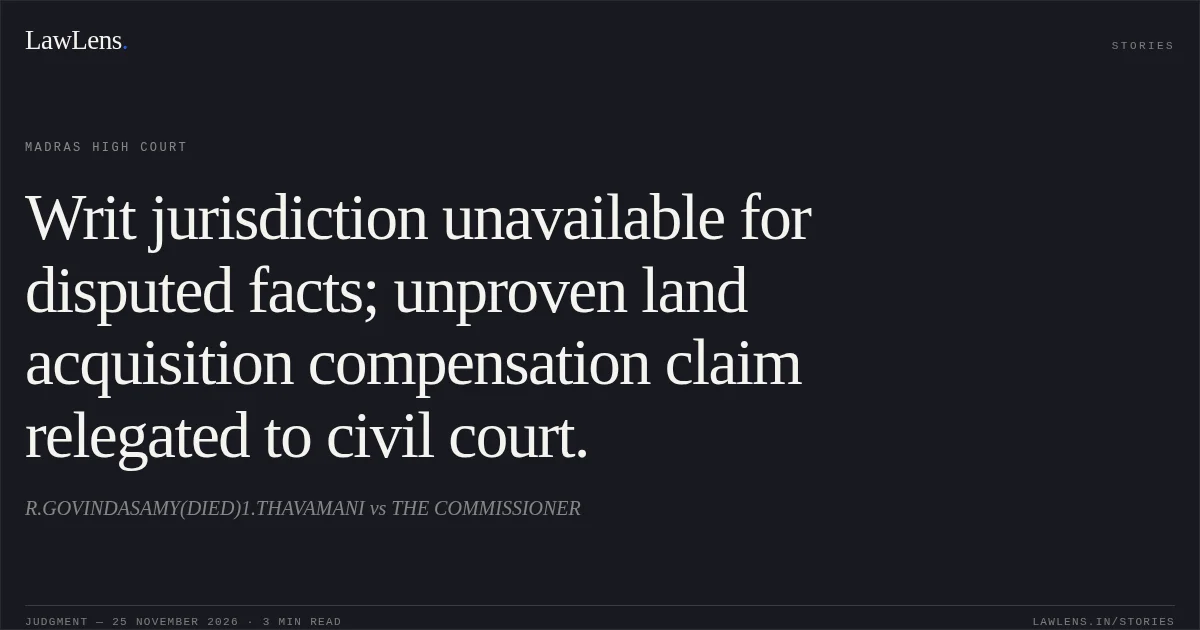
The Court held that no error existed in the Single Judge's findings and that the disputed questions of fact could not be resolved in writ proceedings.
¶ 11 · p. 7The writ appeal is dismissed with no order as to costs, and the appellants are left free to pursue the remedy, before the civil court, as the Single Judge directed.
¶ 11 · p. 7Original Court PDF
R.GOVINDASAMY(DIED)1.THAVAMANIvsTHE COMMISSIONER
Click to open original judgment
Original judgment, available to read, download and summarize on LawLens.in