Facts
The petitioner filed a private complaint alleging that the respondents induced her to hand over original title documents for property verification, which they subsequently misused to obtain a bank loan by creating a mortgage
Source reference: p. 1-2The petitioner sought prosecution under Sections 420, 467, 468, and 120-B of the IPC
Source reference: p. 1Following an examination of the complainant and witnesses under Section 202 of the Cr.P.C., the Judicial Magistrate First Class dismissed the complaint under Section 203 of the Cr.P.C. on October 14, 2023, finding insufficient grounds to proceed
Source reference: p. 2This dismissal was upheld by the Sessions Judge in a criminal revision on April 18, 2024
Source reference: p. 1-2The petitioner subsequently challenged these orders before the High Court under Section 482 of the Cr.P.C.
Source reference: p. 1Issues
1. Whether the Magistrate was legally justified in dismissing the complaint under Section 203 Cr.P.C. for lack of sufficient grounds?
Source reference: p. 22. Whether the impugned orders of the lower courts suffer from perversity, illegality, or jurisdictional error warranting interference?
Source reference: p. 23. Whether the circumstances of the case warranted a direction for investigation under Section 156(3) Cr.P.C.?
Source reference: p. 2Law Applied
The court applied Section 203 of the Cr.P.C. regarding the dismissal of complaints and Section 482/revisional principles for interference in lower court orders
Source reference: p. 1-2It relied on Amit Kapoor v. Ramesh Chander (2012) and State of Rajasthan v. Fatehkaran Mehdu (2017) to establish that revisional jurisdiction is limited to patent defects or perversity and should not be used to re-appreciate evidence
Source reference: p. 2-3Regarding the threshold for summoning, the court cited Pepsi Foods Ltd. v. Special Judicial Magistrate (1998) and Mehmood Ul Rehman v. Khazir Mohammad Tunda (2015), emphasizing that summoning is a serious matter requiring the application of judicial mind
Source reference: p. 3For the charge of cheating, it applied Hridaya Ranjan Prasad Verma v. State of Bihar (2000), requiring fraudulent intent at the inception
Source reference: p. 3Finally, it invoked Indian Oil Corporation v. NEPC India Ltd. (2006) regarding the impermissibility of converting civil disputes into criminal cases, and Priyanka Srivastava v. State of Uttar Pradesh (2015) regarding the sparing use of Section 156(3) Cr.P.C.
Source reference: p. 4Reasoning
The court found that the petitioner failed to identify any specific forged documents or provide material indicating fabrication or a criminal conspiracy
Source reference: p. 3It noted a critical lack of primary evidence, such as the loan agreement, mortgage deed, or testimony from bank officials, rendering the allegations "bald"
Source reference: p. 4Applying the Hridaya Ranjan Prasad Verma principle, the court observed the complaint was silent on the requirement of dishonest intention existing from the very inception of the transaction
Source reference: p. 3Furthermore, the court highlighted that proceedings under the SARFAESI Act regarding the same property were already initiated, suggesting the dispute was predominantly civil/financial in nature
Source reference: p. 4Consequently, the court held that since the foundational material was absent, the Magistrate’s refusal to invoke Section 156(3) Cr.P.C. and the subsequent dismissal under Section 203 Cr.P.C. were appropriate and did not manifest any legal error or perversity
Source reference: p. 4-5Holding
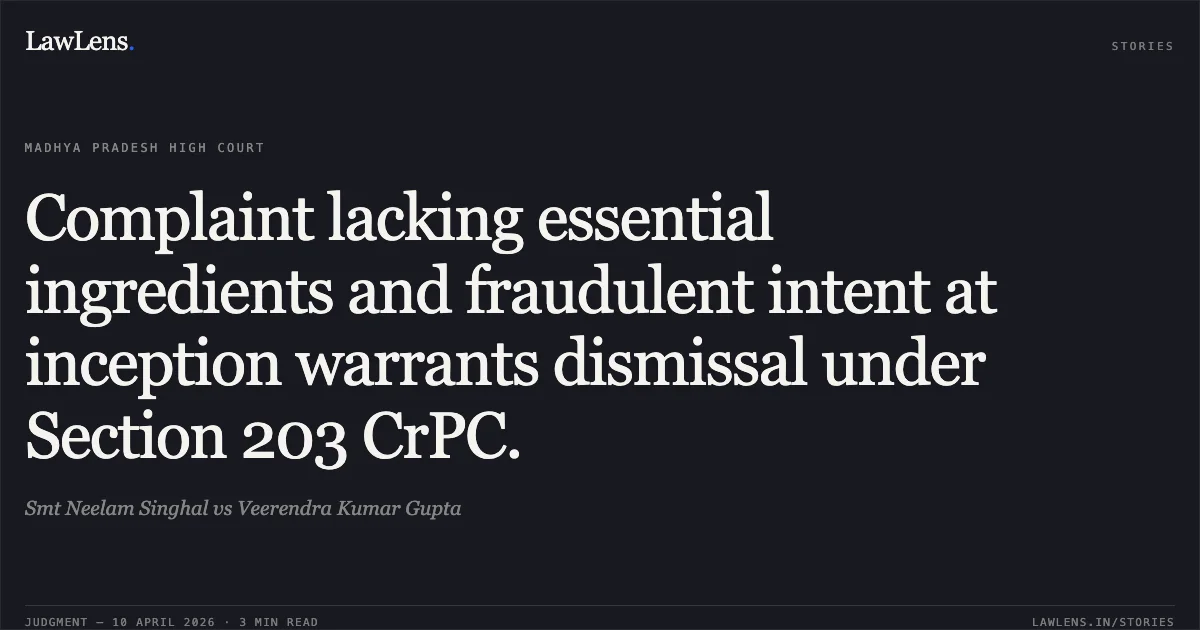
The High Court dismissed the petition, holding that the complaint lacked the essential ingredients of the alleged offences and was unsupported by documentary evidence
The court affirmed the orders of the Judicial Magistrate and the Sessions Judge, concluding that they reflected a proper application of mind
Source reference: p. 5The prayer for investigation under Section 156(3) Cr.P.C. was rejected as untenable in the absence of a prima facie case
Source reference: p. 4No order as to costs was made
Source reference: p. 5Acts & Sections Cited
9 provisions across 2 statutes referred to in this judgment. Each provision opens on LawLens.
Code of Criminal Procedure, 19736
Indian Penal Code, 18603
Original Court PDF
Smt Neelam SinghalvsVeerendra Kumar Gupta
Click to open original judgment
Original judgment, available to read, download and summarize on LawLens.in


