Facts
The applicant sought regular bail under Section 483 of the BNSS in FIR No. 0254/2026, registered at P.S. Bindapur under Sections 69 and 115(2) of the BNS.
Source reference: paras. 1–2, p. 1The complainant alleged that the applicant had sexual intercourse with her on a promise of marriage that he did not intend to fulfil and had voluntarily caused hurt.
Source reference: paras. 1–4, pp. 1–2The parties, aged 32 and 34, became professionally acquainted in December 2024; the complainant referred to encounters in Delhi and Varanasi.
Source reference: paras. 1–4, pp. 1–2The applicant disputed that he had made a false promise and relied, among other things, on their interactions and a settlement agreement dated 19 August 2025, which the complainant said she signed under pressure.
Source reference: paras. 1–4, pp. 1–2The applicant was arrested on 23 May 2026; the charge sheet, dated 2 June 2026, was filed on 10 June 2026.
Source reference: paras. 1–2, p. 1His earlier bail applications had been rejected by the Trial Court.
Source reference: paras. 1–2, p. 1Issues
1. Whether the applicant should be released on regular bail while the trial is pending, given the allegations and the circumstances of the case.
Source reference: paras. 3–8, pp. 1–42. Whether bail conditions could adequately secure the applicant’s attendance and protect the complainant, witnesses, and evidence.
Source reference: paras. 5–8, pp. 2–4Law Applied
The application was considered under Section 483 of the BNSS, which empowers the High Court to grant bail. The alleged offences were under Sections 69 and 115(2) of the BNS.
Source reference: para. 1, p. 1Relying on Shane Haider v. State of NCT of Delhi Through SHO PS Pahar Ganj, 2024 DHC 1115, and Sumit v. State (NCT of Delhi), the Court noted that whether a case involves a false promise of marriage or a subsequent breach of promise is ordinarily a matter for trial and does not, by itself, require custodial interrogation; appropriate conditions may secure the accused’s attendance and prevent interference with witnesses.
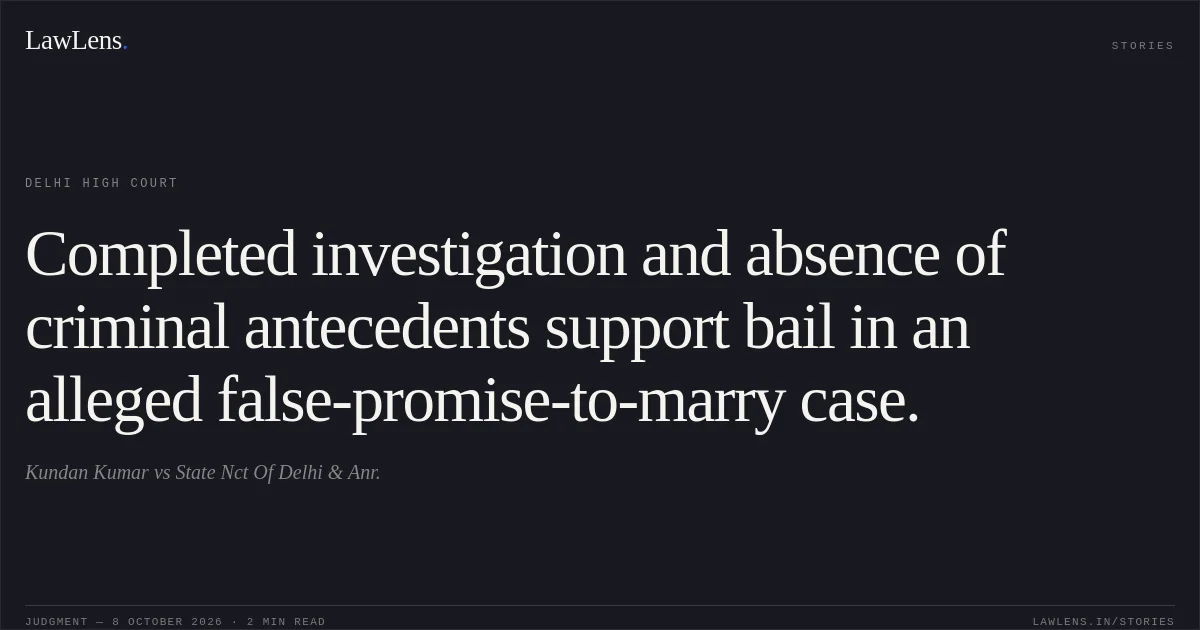
Source reference: paras. 5–6, pp. 2–4The Court also treated completion of the investigation and absence of prior criminal antecedents as relevant circumstances favouring bail.
Source reference: para. 7, p. 4Reasoning
The Court did not determine whether the promise of marriage was false or whether the settlement agreement was made under pressure, leaving those disputed matters for trial.
Source reference: paras. 3–4, pp. 1–2It considered that the investigation was complete and the charge sheet had been filed, and noted the applicant’s lack of previous criminal antecedents.
Source reference: paras. 1, 7, pp. 1, 4Applying the principles in Shane Haider and Sumit, the Court concluded that continued custody was not necessary on the circumstances presented and that conditions could address concerns about attendance, contact with the complainant or witnesses, and interference with evidence.
Source reference: paras. 5–8, pp. 2–4Holding
The Court granted the applicant regular bail on a personal bond of ₹25,000 with one surety for the like amount, to the satisfaction of the Trial Court.
Conditions included attending hearings, providing and updating residential details, keeping a mobile number available and sharing it with the investigating officer, reporting when called, refraining from contacting the complainant or prosecution witnesses or influencing them, avoiding criminal activity, and reporting to the concerned SHO on the first Monday of each month between 11:00 a.m. and 12:00 noon.
Source reference: para. 8, pp. 4–6The petition was disposed of, with the Court clarifying that its order was not an expression of opinion on the merits.
Source reference: para. 9, p. 6Acts & Sections Cited
3 provisions across 2 statutes referred to in this judgment. Each provision opens on LawLens.
Bharatiya Nagarik Suraksha Sanhita, 20231
Bharatiya Nyaya Sanhita, 20232
Original Court PDF
Kundan KumarvsState Nct Of Delhi & Anr.
Click to open original judgment
Original judgment, available to read, download and summarize on LawLens.in