Facts
The appellant-plaintiff agreed to purchase approximately five bighas of agricultural land near Agra for ₹20,000 and paid ₹5,000 as advance under a registered agreement to sell dated 16 June 1975.
Source reference: p.1The respondent-defendant alleged that the transaction was a loan secured by the agreement and that the agreement had not been read over to him; the Trial Court rejected these defences, finding the agreement proved through the plaintiff and attesting witnesses.
Source reference: pp.1–2The Trial Court decreed specific performance under Section 20 of the Specific Relief Act, 1963.
Source reference: no citationThe decree was executed through court on 7 June 1979, and the plaintiff claimed continuous possession thereafter.
Source reference: p.3The First Appellate Court reversed the decree on the ground that the plaintiff had not established readiness and willingness, directing refund of the advance with interest.
Source reference: p.3In second appeal, the High Court upheld the findings favourable to the plaintiff but directed payment of ₹15,00,000 as refund/interest to “maintain equity”.
Source reference: pp.3–4The plaintiff appealed to the Supreme Court.
Source reference: no citationIssues
1. Whether the First Appellate Court was justified in reversing the decree for specific performance solely on the ground that the plaintiff had not proved readiness and willingness, despite the Trial Court’s findings upholding the agreement and the plaintiff’s entitlement.
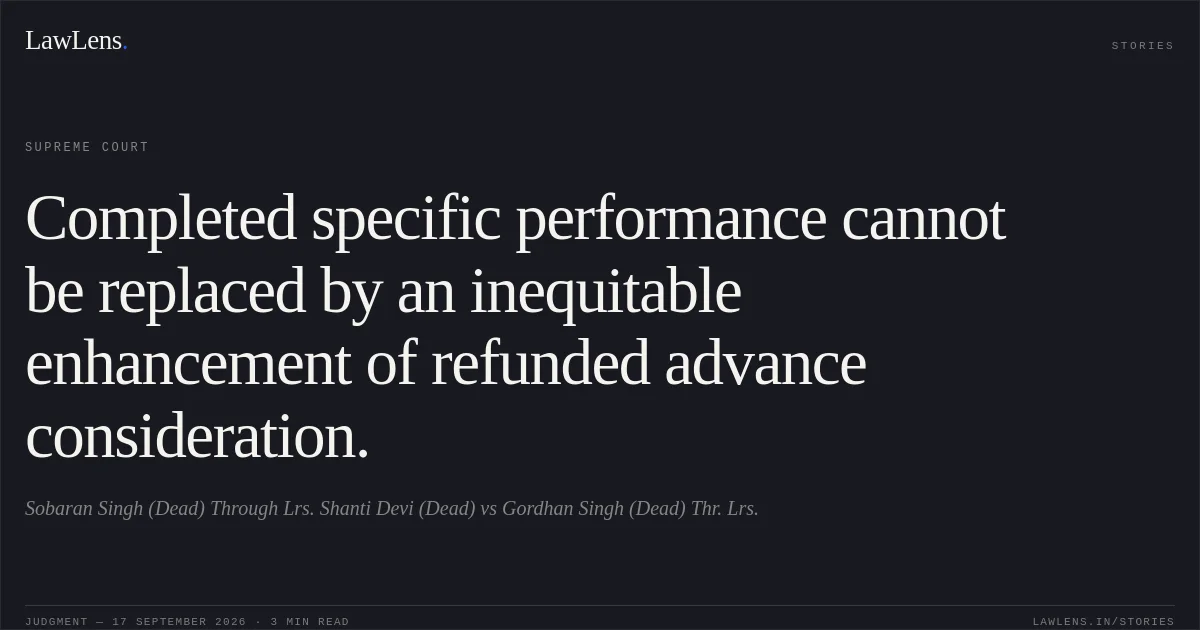
Source reference: p.32. Whether the High Court, while upholding the Trial Court’s findings and recognising the validity of the transaction, could substitute specific performance with a substantially enhanced monetary refund of ₹15,00,000 on equitable grounds.
Source reference: pp.3–43. Whether the Trial Court’s decree for specific performance, followed by court-executed sale and the plaintiff’s long-standing possession, was required to be restored.
Source reference: pp.4–5Law Applied
The Court applied Section 20 of the Specific Relief Act, 1963, concerning the discretionary grant of specific performance, holding that such discretion must be exercised judicially and in accordance with the equities arising from the established facts.
Source reference: p.2It relied on Pratap Lakshman Muchandi v. Shamlal Uddavadas Wadhwa, (2008) 12 SCC 67, where, considering the substantial lapse of time, the Court adjusted the monetary terms while permitting the sale to stand.
Source reference: p.4The Court further applied the principle that where the agreement is proved, the defence is found to be fabricated, specific performance has been decreed and the sale has subsequently been completed through court, equity should not be used to defeat the plaintiff’s accrued ownership and possession.
Source reference: pp.4–5Reasoning
The Supreme Court found that the Trial Court had accepted the registered agreement, the payment of advance, and the plaintiff’s evidence, while rejecting the defendant’s loan and non-reading defences.
Source reference: pp.1–2The First Appellate Court’s reversal was based merely on an alleged absence of proof of readiness and willingness, whereas the High Court itself found that the Trial Court had correctly decided in the plaintiff’s favour and that the defendant had raised a fabricated defence.
Source reference: p.3Having upheld those findings, the High Court could not displace the completed specific-performance transaction by directing an enhanced refund of ₹15,00,000.
Source reference: no citationThe plaintiff had parted with the consideration decades earlier, obtained a court-executed sale in 1979, and remained in possession; consequently, equity operated in his favour rather than in favour of the defendant.
Source reference: pp.4–5The High Court’s monetary adjustment was therefore inconsistent with the factual and equitable consequences of the decree already acted upon.
Source reference: no citationHolding
The appeal was allowed.
The Supreme Court reversed the judgments of the First Appellate Court and the High Court and restored the Trial Court’s decree for specific performance.
Source reference: p.5The plaintiff’s possession was protected from interference.
Source reference: no citationThe ₹15,00,000 deposited by the defendant pursuant to the High Court’s judgment was directed to be refunded to the defendant, together with any accrued interest, within one month.
Source reference: p.5Pending applications, if any, were rejected.
Source reference: p.6Acts & Sections Cited
1 provisions across 1 statute referred to in this judgment. Each provision opens on LawLens.
Specific Relief Act, 19631
Original Court PDF
Sobaran Singh (Dead) Through Lrs. Shanti Devi (Dead)vsGordhan Singh (Dead) Thr. Lrs.
Click to open original judgment
Original judgment, available to read, download and summarize on LawLens.in