Facts
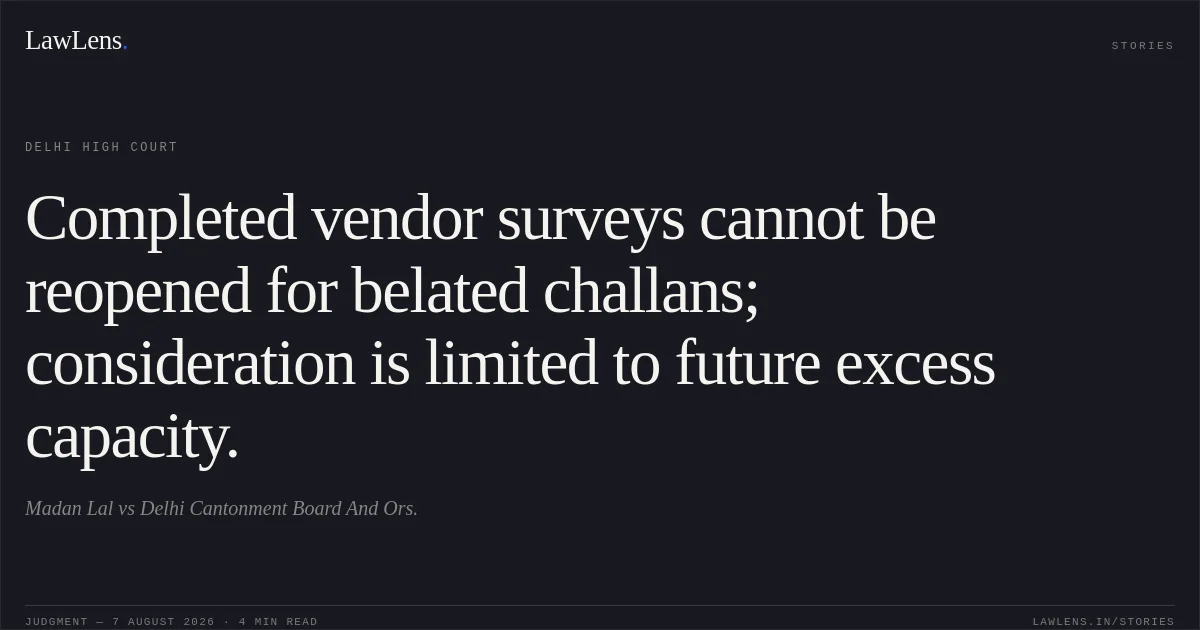
The Petitioner, Madan Lal, approached the Delhi High Court under Article 226 seeking permission to peacefully vend from the open space/footpath near DSOI Gate, Delhi Cantonment Board, and protection against alleged harassment by the authorities.
Source reference: p.1, para. 2He claimed to possess challans evidencing vending activity prior to the commencement of the Delhi Cantonment Board’s Town Vending Committee (“TVC”) survey on 27 October 2023.
Source reference: p.3, para. 4The TVC, by its minutes dated 15 January 2026, resolved that vendors producing at least three challans issued by the Delhi Cantonment Board before 27 October 2023 would be considered for inclusion in the list of street vendors, subject to the holding capacity determined by the TVC.
Source reference: p.5, para. 7This decision was subsequently confirmed by the Delhi Cantonment Board through Resolution No. 3 dated 27 January 2026.
Source reference: p.5, para. 8The Court noted that, pursuant to earlier orders, the DCB had scrutinised the challans and prepared a list of authorised vendors.
Source reference: p.10, para. 12The Petitioner had not submitted his challans during the relevant survey process and had approached the Court belatedly.
Source reference: p.11, para. 14He had, however, submitted a representation dated 10 July 2026 to the Chairman of the TVC.
Source reference: p.11, para. 16Issues
1. Whether the Petitioner, having failed to submit his alleged pre-27 October 2023 challans during the survey, could seek reopening of the completed survey and immediate permission to vend at the disputed site?
Source reference: p.11, para. 142. Whether the Petitioner’s belated representation should nevertheless be considered by the TVC in accordance with the DCB’s policy regarding vendors possessing at least three qualifying challans?
Source reference: p.11, para. 15–163. Whether any permission or licence to vend could be granted without complying with the Supreme Court’s directions concerning sites falling within highway safety zones?
Source reference: p.11, para. 174. Whether the DCB and local police retained power to take action against unauthorised vendors or vendors violating the conditions of their provisional Certificates of Vending?
Source reference: p.11–12, paras. 18–19Law Applied
The Court exercised its jurisdiction under Article 226 of the Constitution of India to review the DCB’s treatment of the Petitioner’s claim and to issue appropriate directions.
Source reference: p.1, para. 2It applied the DCB TVC’s policy contained in the minutes dated 15 January 2026 and Resolution No. 3 dated 27 January 2026, under which vendors producing at least three DCB-issued challans prior to 27 October 2023 could be considered for inclusion in the list of street vendors, subject to available holding capacity.
Source reference: p.5–6, paras. 7–9The Court also followed its earlier decisions, including Danveer Yadav v. Delhi Cantonment Board and Gyan Chand v. Delhi Cantonment Board, which required the DCB/TVC to examine qualifying vendors’ claims and communicate its decision within a specified period.
Source reference: p.6–9, paras. 10–11Further, the Court applied the Supreme Court’s directions in In Re: Phalodi Accident v. National Highways Authority of India, including the requirement that no authority grant or renew a licence, NOC or trade approval for a site within a highway safety zone without prior NHAI/PWD clearance.
Source reference: p.4–5, paras. 5–6The DCB also retained authority to regulate vending, prevent encroachment, and act against unauthorised vendors or violations of provisional Certificates of Vending.
Source reference: p.11–12, paras. 18–19Reasoning
The Court held that the completed survey could not be reopened merely because the Petitioner belatedly produced or claimed to possess the requisite challans.
Source reference: p.11, para. 14Although the DCB’s policy recognised vendors with at least three qualifying challans, that policy operated within the survey and verification process and was subject to the TVC’s holding capacity.
Source reference: p.5–6, paras. 7–9Since the Petitioner had not submitted his documents during the relevant survey and the authorised-vendor list had already been prepared, he could not claim immediate inclusion or an unrestricted right to vend at the site.
Source reference: p.11, para. 14Nevertheless, the Court preserved a limited opportunity for consideration: if the TVC finalised the vending plan and excess capacity remained, the Petitioner could be considered in the next survey, particularly in light of his representation dated 10 July 2026.
Source reference: p.11, paras. 15–16Any such consideration had to comply with the Supreme Court’s highway-safety directions, and the DCB remained entitled to maintain discipline and remove vendors lacking a provisional Certificate of Vending or violating its terms.
Source reference: p.11–12, paras. 17–19Holding
The Court declined to reopen the completed survey or grant the Petitioner an immediate right to vend from the disputed site.
It directed the TVC to consider and dispose of the Petitioner’s representation dated 10 July 2026 in accordance with law and the DCB’s earlier minutes, while also considering the Supreme Court’s directions on highway safety zones.
Source reference: p.11, paras. 15–17The Petitioner could be considered in a subsequent survey if excess vending capacity became available.
Source reference: p.11, paras. 15–16The order did not restrain the DCB from taking lawful action against unauthorised vendors, encroachments, or violations by provisional Certificate of Vending holders.
Source reference: p.11–12, paras. 18–20The petition and pending applications were accordingly disposed of.
Source reference: p.12, para. 20Original Court PDF
Madan LalvsDelhi Cantonment Board And Ors.
Click to open original judgment
Original judgment, available to read, download and summarize on LawLens.in