Facts
The appellant was arrested on 4 June 2026 in Crime No. 60 of 2026, initially registered as a suspicious death case and later altered to include murder under Section 103(1) of the Bharatiya Nyaya Sanhita (BNS).
Source reference: p. 3; p. 4The prosecution alleged that the appellant killed Murugan following a quarrel over a mobile phone; the appellant maintained that the case rested on circumstantial evidence and had no direct eyewitness.
Source reference: p. 3A previous bail application was dismissed by the Sessions Court and an earlier application before the High Court was also dismissed; the High Court subsequently granted bail on 19 August 2026 for the BNS offence.
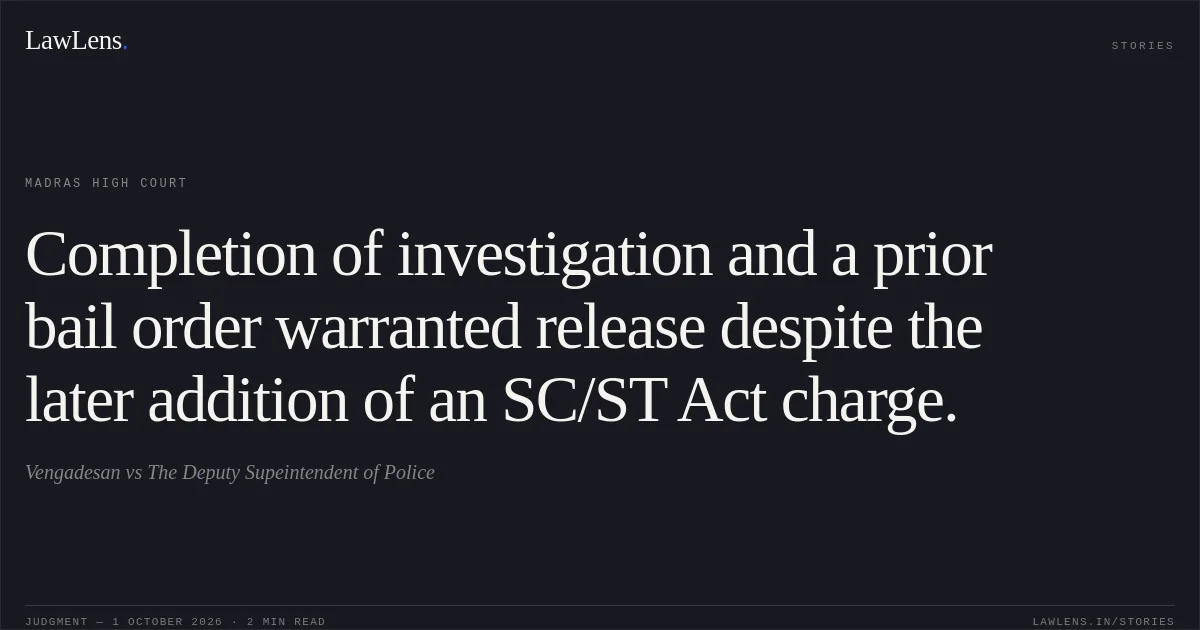
Source reference: p. 2The appellant could not execute sureties after Section 3(2)(v) of the Scheduled Castes and Scheduled Tribes (Prevention of Atrocities) Act, 1989 (SC/ST Act) was added on 21 August 2026. The investigation was complete and the charge sheet had been filed on 15 September 2026.
Source reference: p. 3; p. 5Issues
Whether the appellant should be granted bail after Section 3(2)(v) of the SC/ST Act was added and the previously granted bail could not be executed
Source reference: p. 5Whether the Special Court’s order refusing bail should be set aside in light of the completed investigation and filed charge sheet
Source reference: p. 5Law Applied
Section 14(A)(2) of the SC/ST Act provides the statutory basis for the appeal against the Special Court’s order.
Source reference: p. 1The alleged offences included Section 103(1) of the BNS and Section 3(2)(v) of the SC/ST Act.
Source reference: p. 4The Court also referred to P.K. Shaji v. State of Kerala, [(2005) AIR SCW 5560], in directing that the Trial Court may take appropriate action in accordance with law if the appellant breaches bail conditions.
Source reference: p. 6Reasoning
The Court considered that it had already granted the appellant bail for the BNS offence, but the appellant had been unable to furnish sureties because the SC/ST Act provision was subsequently added.
Source reference: p. 5It also noted that the investigation was complete and the charge sheet had been filed.
Source reference: p. 5In view of those circumstances, the Court concluded that bail was warranted, without setting out a separate assessment of the competing accounts or the evidence in detail.
Source reference: p. 5Holding
The High Court allowed the appeal, set aside the Special Court’s order dated 22 September 2026, and ordered the appellant’s release on bail.
Bail was subject to a bond of ₹5,000 with two sureties for the like sum, regular court appearances, and conditions prohibiting interference with the victim’s family, absconding, or tampering with evidence or witnesses; breach could result in appropriate action under law.
Source reference: pp. 5–6Acts & Sections Cited
3 provisions across 3 statutes referred to in this judgment. Each provision opens on LawLens.
Scheduled Castes and the Scheduled Tribes (Prevention of Atrocities) Act, 19891
Bharatiya Nagarik Suraksha Sanhita, 20231
Bharatiya Nyaya Sanhita, 20231
Original Court PDF
VengadesanvsThe Deputy Supeintendent of Police
Click to open original judgment
Original judgment, available to read, download and summarize on LawLens.in