Facts
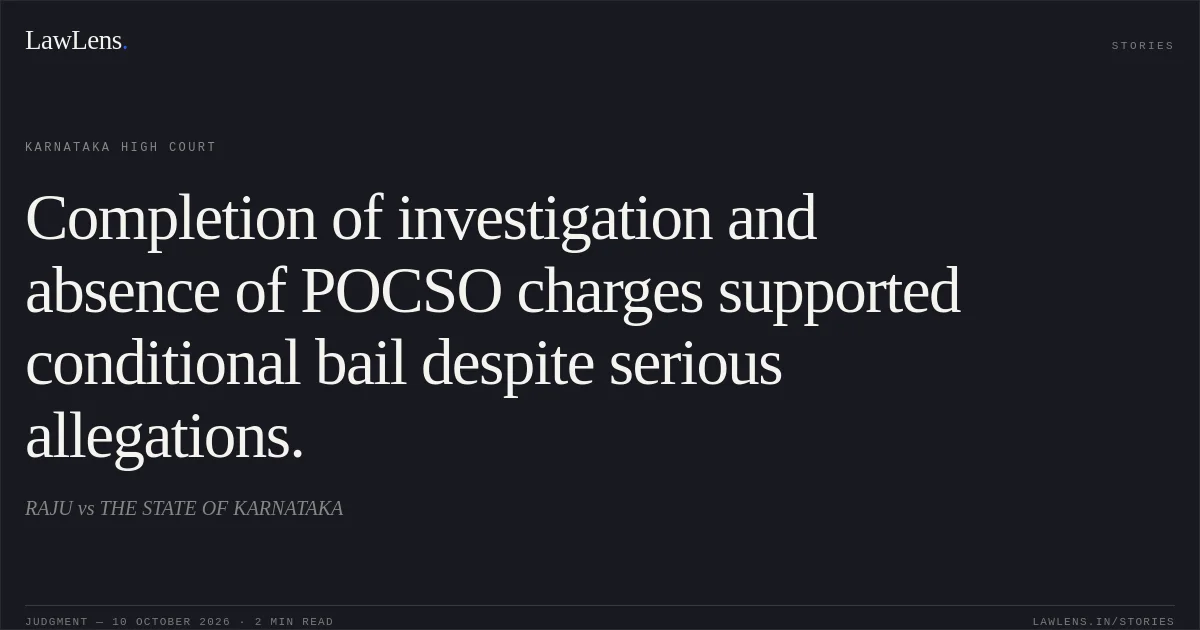
The petitioner, a teacher, was accused of forcibly embracing and kissing a student and attempting to rape her on 7 June 2026, while she was sitting a NEET test; he was also alleged to have threatened her.
Source reference: p. 3–4The case was initially registered under the Bharatiya Nyaya Sanhita (BNS) and the POCSO Act.
Source reference: p. 5–6The investigation established that the victim was born on 17 April 2008 and was over 18 on the incident date; the POCSO charges were therefore omitted from the charge sheet.
Source reference: p. 5–6After an earlier bail petition had been rejected, the petitioner renewed his application under Section 483 of the Bharatiya Nagarik Suraksha Sanhita (BNSS).
Source reference: p. 2, 6–7By then, the charge sheet had been filed and he had been in judicial custody for more than three and a half months.
Source reference: p. 2, 6–7Issues
Whether the petitioner should be enlarged on bail under Section 483 BNSS, given that the investigation was complete, the charge sheet had been filed, and the POCSO charges had been dropped.
Source reference: p. 6–8Whether the prosecution’s concerns about witness tampering and interference with the trial could be addressed through bail conditions.
Source reference: p. 3, 7–8Law Applied
The Court considered its power to grant bail under Section 483 BNSS and the offences charged under Sections 64 read with Sections 62, 75 and 351(2) of the BNS.
Source reference: p. 2, 8It applied the principle that “bail is the rule and jail is an exception” and that pre-trial detention should not operate as punishment for the alleged offence.
Source reference: p. 7The Court also treated the completion of investigation and filing of the charge sheet as relevant to whether further custodial interrogation was required.
Source reference: p. 6–7Reasoning
The Court noted that the earlier bail rejection had been made when the case included POCSO offences, but the subsequent investigation showed that the victim was over 18 and those offences were omitted from the charge sheet.
Source reference: p. 5–6Although the allegations remained serious and the prosecution raised concerns about the petitioner’s position as a teacher and the risk of witness tampering, the investigation was complete and custodial interrogation was no longer required.
Source reference: p. 3, 6–7The Court concluded that the identified risks could be addressed by stringent conditions, including a prohibition on contacting the victim.
Source reference: p. 7–9Holding
The Court allowed the petition and ordered the petitioner’s release on bail in Crime No. 186/2026 upon executing a personal bond of ₹2,00,000 with two sureties for the like amount.
Bail was subject to conditions requiring cooperation with the investigation and trial, non-interference with witnesses or the investigation, no contact with the victim, and no commission of similar or other offences while the case was pending; breach would result in cancellation of bail.
Source reference: p. 9–10Acts & Sections Cited
7 provisions across 3 statutes referred to in this judgment. Each provision opens on LawLens.
Bharatiya Nagarik Suraksha Sanhita, 20231
Bharatiya Nyaya Sanhita, 20234
Protection of Children from Sexual Offences Act, 20122
Original Court PDF
RAJUvsTHE STATE OF KARNATAKA
Click to open original judgment
Original judgment, available to read, download and summarize on LawLens.in