Facts
On January 10, 2024, police intercepted a vehicle in Village Veeram, recovering 1.465 kg of heroin from two co-accused persons after compliance with Section 50 of the NDPS Act.
Source reference: p. 2-3During investigation, the co-accused disclosed that the respondent, Balraj Singh @ Billa, oversaw the drug trafficking network via illegal mobile phones while lodged in Central Jail, Goindwal Sahib.
Source reference: p. 3The respondent was subsequently arrayed as an accused.
Source reference: p. 3While the Special Court, Tarn Taran, rejected his bail application on July 3, 2025, the High Court of Punjab and Haryana granted regular bail on October 15, 2025, citing the likely duration of the trial and the principle that criminal antecedents alone cannot justify bail refusal.
Source reference: p. 4, 7Issues
1. Whether the High Court erred in granting bail by failing to satisfy the mandatory twin conditions prescribed under Section 37(1)(b)(ii) of the NDPS Act for cases involving commercial quantities.
Source reference: para. 12, 172. Whether the respondent's incarceration of 1 year and 7 months constitutes "prolonged incarceration" justifying a departure from statutory restrictions under Article 21.
Source reference: para. 19, 20Law Applied
The Court applied Section 37 of the Narcotic Drugs and Psychotropic Substances (NDPS) Act, 1985, which mandates that for offences involving commercial quantities, bail can only be granted if the court is satisfied there are "reasonable grounds" to believe the accused is not guilty and is unlikely to commit further offences while on bail.
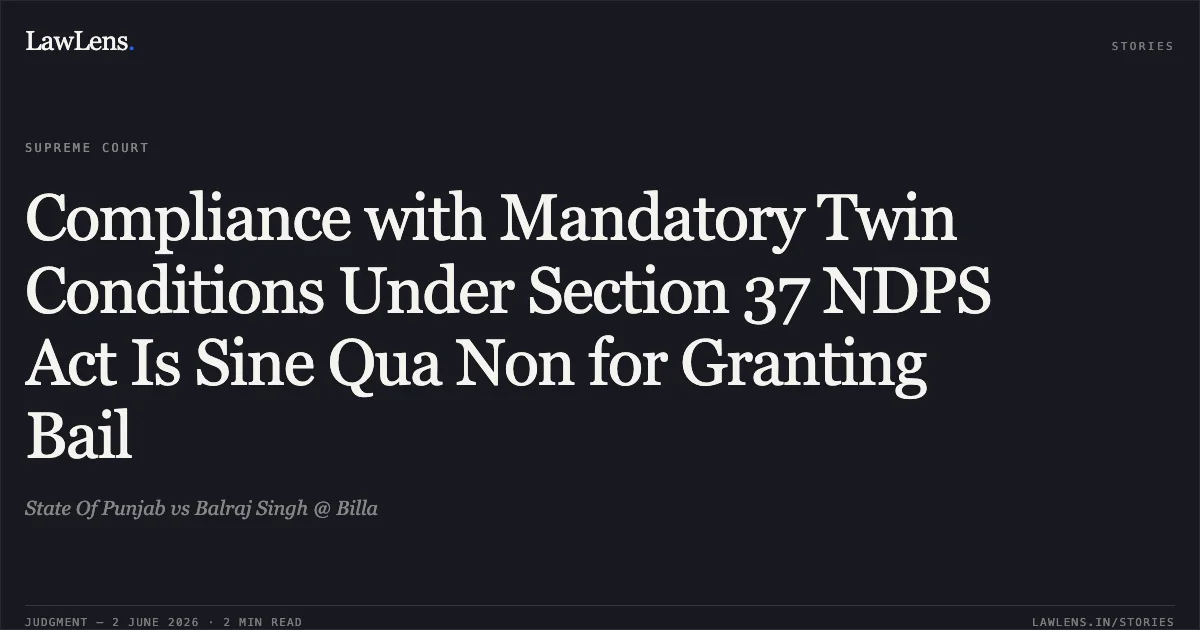
Source reference: para. 13The Court relied on State of Meghalaya v. Lalrintluanga Sailo [2024 SCC OnLine SC 1751], holding that recording these findings is sine qua non for granting bail.
Source reference: para. 14It further referenced Union of India v. Namdeo Ashruba Nakade [2025 SCC OnLine SC 3049] to establish that mandatory statutory requirements cannot be easily dispensed with even on grounds of incarceration duration.
Source reference: para. 16Reasoning
The Supreme Court observed that the High Court’s impugned order completely ignored the "twin conditions" of Section 37 of the NDPS Act despite the case involving a commercial quantity of heroin.
Source reference: para. 17The Bench noted that the respondent has three criminal antecedents of a similar nature, which negates the possibility of satisfying the second limb of Section 37—that he is "not likely to commit any offence while on bail".
Source reference: para. 18Regarding the High Court's reliance on the delay in trial, the Supreme Court reasoned that 1 year and 7 months of incarceration does not qualify as "unreasonably long" considering the potential twenty-year sentence, and thus does not trigger a bail grant based on Article 21.
Source reference: para. 19The Court emphasized that in matters involving drug trafficking, national security and public health interests must be balanced against personal liberty.
Source reference: para. 22Holding
The Supreme Court set aside the High Court’s order, holding that a liberal approach ignoring the mandate of Section 37 is impermissible.
The Court found that the respondent failed to meet the statutory criteria for bail due to his criminal history and the seriousness of the organized trafficking network operated from jail.
Source reference: para. 18-19The appeal was allowed, the bail was cancelled, and the respondent—having already surrendered pursuant to interim orders—is to remain in custody.
Source reference: para. 9, 23Acts & Sections Cited
10 provisions across 3 statutes referred to in this judgment. Each provision opens on LawLens.
Narcotic Drugs and Psychotropic Substances Act, 19858
Bharatiya Nagarik Suraksha Sanhita, 20231
Code of Criminal Procedure, 19731
Original Court PDF
State Of PunjabvsBalraj Singh @ Billa
Click to open original judgment
Original judgment, available to read, download and summarize on LawLens.in