Facts
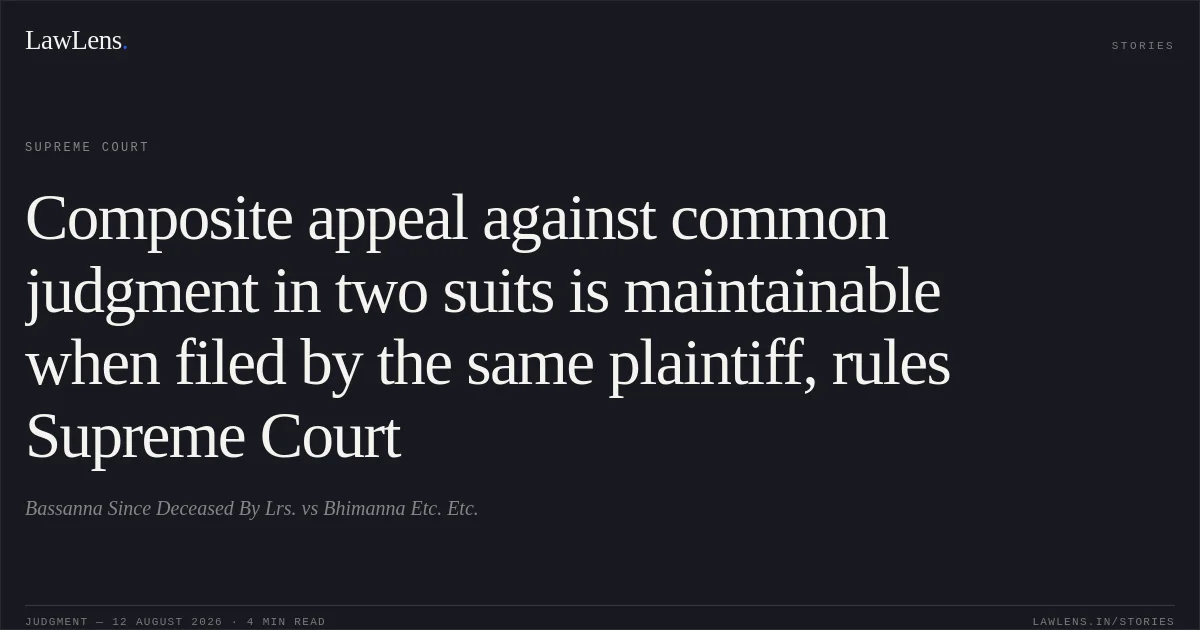
The plaintiff instituted two suits against the defendants: one seeking a declaration that a registered sale deed was null and void, and the other seeking a decree of perpetual injunction.
Source reference: paras. 2, 6; pp. 2, 5–7The suits were clubbed at the request of a common defendant, common evidence was recorded, and the trial court dismissed both suits by a common judgment dated 7 December 1990.
Source reference: paras. 2, 6; pp. 2, 5–7The plaintiff filed one composite appeal under Section 96 of the Code of Civil Procedure, 1908 (“CPC”), challenging the common judgment and both decrees.
Source reference: paras. 7–8; pp. 7–8The first appellate court allowed the composite appeal and decreed both suits. In second appeals, the High Court of Karnataka held that two separate appeals were mandatory merely because two suits had been instituted, set aside the first appellate court’s judgment, and dismissed both suits without adjudicating the merits.
Source reference: paras. 2, 9; pp. 2–3, 9Issues
Whether a composite appeal under Section 96 CPC is maintainable where two suits filed by the same plaintiff were clubbed, tried on common evidence, and decided by a common judgment, particularly when both decrees were challenged, requisite court fees were paid, and certified copies of both decrees were filed?
Source reference: paras. 1, 5, 20; pp. 1, 5, 20–21Whether the omission to file separate memoranda of appeal constitutes an incurable defect warranting dismissal of the appeal, or a curable procedural deficiency?
Source reference: paras. 13, 16; pp. 13–17Whether the circumstances required separate appeals, as in cases involving different plaintiffs or a suit and counter-claim, and whether the principle of res judicata affected maintainability?
Source reference: paras. 13–15; pp. 13–16Law Applied
Section 96 CPC confers a substantive right of first appeal against an original decree, while Order XLI Rule 1 CPC prescribes the procedural requirements for presenting an appeal; its proviso permits the appellate court to dispense with filing more than one copy of a common judgment when two or more suits have been tried together and decided by a common judgment.
Source reference: paras. 12, 16; pp. 11–17Consolidation or clubbing of suits may be directed under the court’s inherent powers under Section 151 CPC where the proceedings involve substantial similarity of parties or issues, primarily to avoid multiplicity, delay, and expense, as recognised in M/s Chitivalasa Jute Mills v. M/s Jaypee Rewa Cement.
Source reference: para. 11; pp. 10–11The Court relied on P.A. Oommen v. Moran Mar Baselios Marthoma for the object of dispensing with multiple copies of a common judgment, and on Narhari v. Shankar, which held that where there is one trial, one finding, and one decision, separate appeals are not necessarily required merely because separate decrees have been drawn.
Source reference: para. 12, pp. 11–12; para. 14, pp. 14–16The Court further applied the principle that procedural rules are handmaids of justice and that a defect of form, such as failure to file a separate memorandum, is curable where the substance of the appellate challenge is complete; Charan Singh v. Ram Saroop supported granting an opportunity to cure such a defect.
Source reference: para. 16; pp. 16–17Reasoning
The Court held that the substance of the plaintiff’s appellate challenge was complete. Both suits had been clubbed and tried on common evidence, the same plaintiff was aggrieved by the dismissal of both suits, and the common judgment was expressly challenged in respect of both decrees.
Source reference: paras. 6–8, 10; pp. 5–10The plaintiff had also filed certified copies of both decrees, sought dispensation of an additional copy of the common judgment, and paid the court fees applicable to separate appeals. Thus, the requirements of Section 96 read with Order XLI Rule 1 CPC were substantially satisfied; the only alleged deficiency was the absence of two separately numbered memoranda, which was a matter of form rather than substance.
Source reference: paras. 12–13; pp. 11–14The situations requiring separate appeals were distinguishable because the suits here had been filed by the same plaintiff, unlike cases involving separate plaintiffs, a plaintiff and defendant suing each other, or a suit and counter-claim requiring independent challenges.
Source reference: paras. 13, 17–19; pp. 13–20The High Court therefore erred by treating the procedural formality as fatal and by setting aside the first appellate court’s decision without giving the plaintiff an opportunity to cure the defect or deciding the second appeals on merits.
Source reference: para. 16; pp. 16–17Holding
The Supreme Court held that the composite appeal filed by the plaintiff under Section 96 CPC was maintainable in the circumstances of the case.
Since both suits had been filed by the same plaintiff, clubbed, tried together, and decided by a common judgment, and since both decrees were specifically challenged with requisite court fees and certified copies, the absence of separate memoranda of appeal was only a curable procedural defect.
Source reference: paras. 5, 12–13, 20; pp. 5, 11–14, 20–21The High Court’s judgment dated 2 September 2022 was set aside, and the two second appeals were restored to the High Court for adjudication on merits.
Source reference: para. 20; p. 21The Supreme Court clarified that it had not examined the parties’ respective merits and directed that the second appeals be decided independently.
Source reference: para. 20; p. 21The civil appeals were allowed, with parties directed to bear their own costs.
Source reference: para. 21; p. 21Acts & Sections Cited
7 provisions across 2 statutes referred to in this judgment. Each provision opens on LawLens.
Code of Civil Procedure, 19084
KARNATAKA COURT-FEE AND SUITS VALUATION ACT, 1958.3
Original Court PDF
Bassanna Since Deceased By Lrs.vsBhimanna Etc. Etc.
Click to open original judgment
Original judgment, available to read, download and summarize on LawLens.in