Facts
The petitioner was originally convicted for an offence under Section 138 of the Negotiable Instruments Act by the Fast Track Court No. II, Erode, in S.T.C. No. 695 of 2018 on 07.10.2021.
Source reference: p. 2The Trial Court sentenced the petitioner to six months of simple imprisonment and directed the payment of Rs. 8,01,990 as compensation.
Source reference: p. 2This judgment was subsequently confirmed on appeal by the II Additional District and Sessions Judge, Erode, in C.A. No. 157 of 2021 on 02.02.2026.
Source reference: p. 2The petitioner challenged these concurrent findings by filing a Criminal Revision Case under Section 438 read with Section 442 of the Bharatiya Nagarik Suraksha Sanhita (BNSS), 2023.
Source reference: p. 1During the pendency of the revision, the parties arrived at an amicable settlement and filed a Memo of Compromise dated 18.03.2026.
Source reference: p. 2Issues
1. Whether the Court should permit the compounding of the offence under Section 138 of the Negotiable Instruments Act in view of the Memo of Compromise filed by the parties during revision proceedings.
Source reference: p. 52. Whether the judgments of conviction and sentence passed by the Trial Court and the Appellate Court should be set aside following the settlement.
Source reference: p. 5Law Applied
The Court primarily applied Section 138 of the Negotiable Instruments Act, 1881, which governs the criminal liability for dishonour of cheques.
Source reference: p. 2It exercised revisional jurisdiction under Sections 438 and 442 of the Bharatiya Nagarik Suraksha Sanhita (BNSS), 2023.
Source reference: p. 1The Court relied on the legal principle of compounding of offences, which allows for the settlement of certain criminal matters (specifically those of a commercial or private nature) whereby the complainant agrees to drop charges, leading to the acquittal of the accused.
Source reference: p. 5Reasoning
The Court noted that the learned counsel for the petitioner submitted a Memo of Compromise dated 18.03.2026, indicating that the parties had settled the dispute entirely.
Source reference: p. 2To verify the settlement, the respondent/complainant appeared via video conferencing and affirmed that the dispute was fully resolved.
Source reference: p. 2The Court evaluated the nature of the offence under the Negotiable Instruments Act, which is essentially a regulatory offence aimed at ensuring the credibility of banking operations.
Source reference: p. 5Given the consensus between the parties and the fact that the complainant had been satisfied through the compromise, the Court found it appropriate to exercise its discretion to allow compounding at the revisional stage.
Source reference: p. 5By doing so, the Court effectively nullified the need for the execution of the sentence previously imposed.
Source reference: p. 5Holding
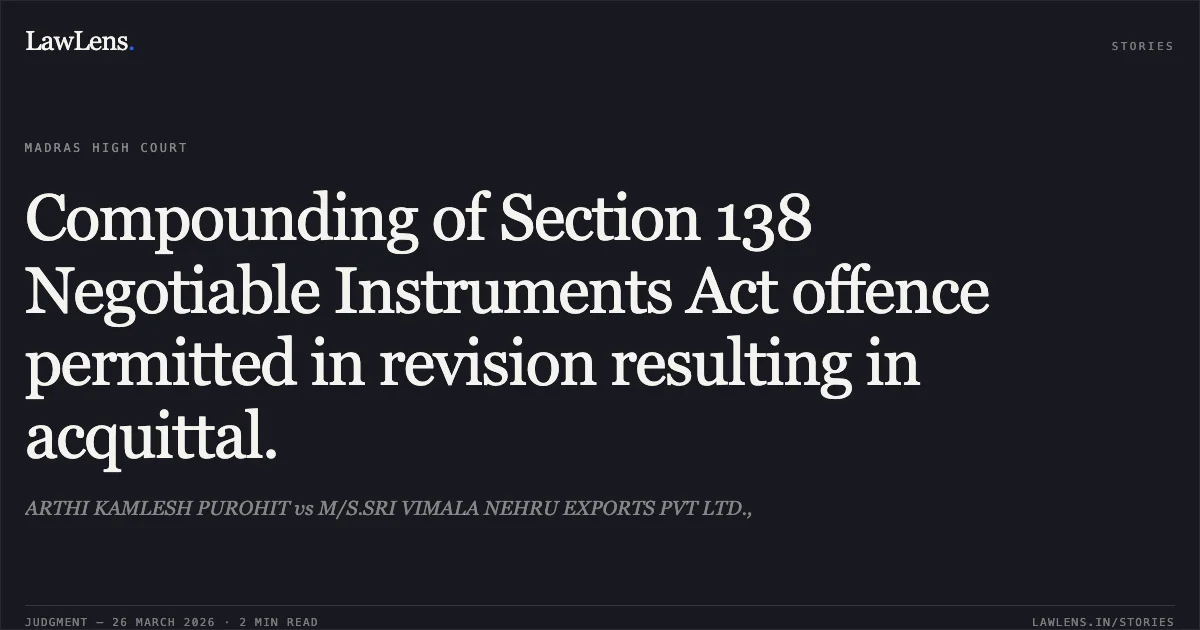
The High Court allowed the Criminal Revision Case and permitted the parties to compound the offence.
The Court set aside the judgment dated 02.02.2026 in C.A. No. 157 of 2021 and the Trial Court judgment dated 07.10.2021 in S.T.C. No. 695 of 2018. The petitioner was acquitted of all charges.
Source reference: p. 5The Court further directed that any fine amount paid by the petitioner be refunded and that bail bonds be discharged.
Source reference: p. 5Original Court PDF
ARTHI KAMLESH PUROHITvsM/S.SRI VIMALA NEHRU EXPORTS PVT LTD.,
Click to open original judgment
Original judgment, available to read, download and summarize on LawLens.in