Facts
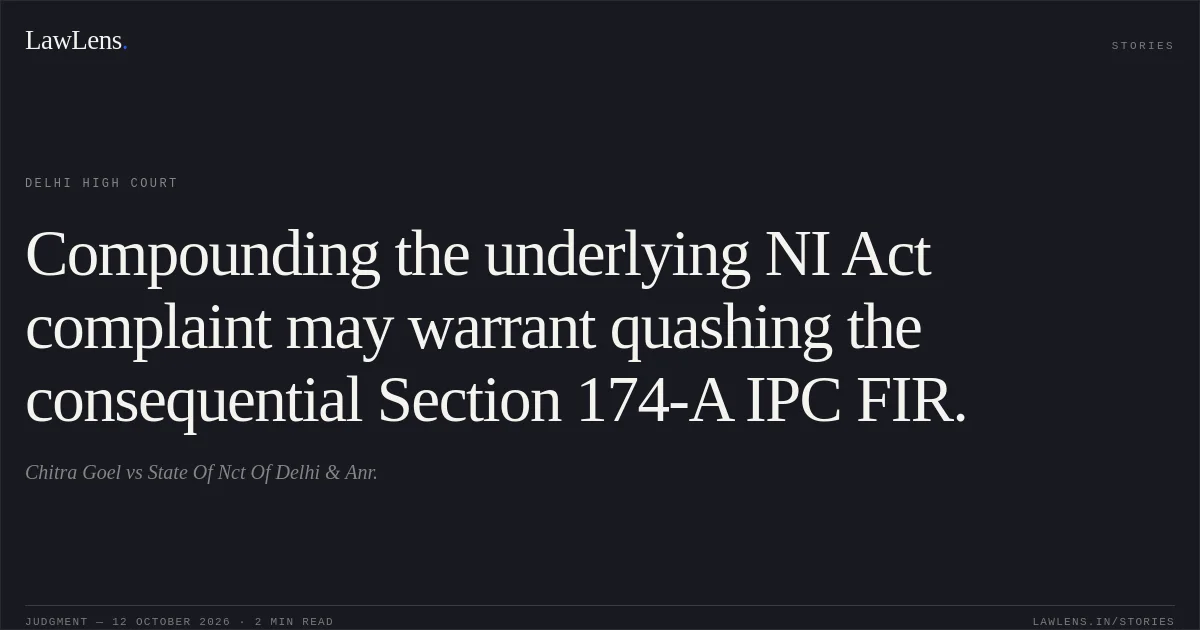
Central Bank of India had sanctioned the petitioner a housing loan of ₹35,00,000. After default, a cheque for ₹3,30,300 issued as security was presented and dishonoured, and the Bank filed a complaint under Section 138 of the Negotiable Instruments Act, 1881 (NI Act).
Source reference: paras. 2.1–2.4; pp. 1–2During that complaint, proceedings under Section 82 of the Code of Criminal Procedure, 1973 (CrPC) were initiated; the petitioner was declared a proclaimed offender on 26 July 2023, and an FIR under Section 174-A of the Indian Penal Code, 1860 (IPC) was registered.
Source reference: paras. 2.5–2.6; p. 2The petitioner later settled with the Bank, received a No Dues Certificate, and the Section 138 complaint was compounded and disposed of.
Source reference: paras. 2.7, 5–7; pp. 2–3She sought quashing of the FIR and consequential proceedings; the State opposed, arguing that Section 174-A IPC creates a separate offence.
Source reference: paras. 3, 8; pp. 2–3Issues
1. Whether the FIR under Section 174-A IPC could be quashed after the underlying Section 138 NI Act complaint had been compounded and disposed of.
Source reference: paras. 7–12; pp. 3–52. Whether quashing should be made subject to payment of costs, given the time taken by the petitioner’s acts and omissions.
Source reference: paras. 13–15; p. 5Law Applied
Section 82 CrPC is part of the statutory scheme for compelling a person’s appearance in an ongoing proceeding; a proclamation is connected to proceedings in which the person’s presence is sought.
Source reference: para. 11; p. 4The Supreme Court in Daljit Singh recognised that, although Section 174-A IPC creates a standalone offence, the court may take account of the subsequent outcome of the underlying case and close the Section 174-A proceedings where the circumstances warrant.
Source reference: para. 11; p. 4The High Court applied that principle to the settlement and compounding of the underlying Section 138 NI Act complaint.
Source reference: para. 12; p. 5Reasoning
The underlying Section 138 complaint, in connection with which the petitioner’s presence had been sought, was no longer pending because it had been compounded following settlement with the Bank.
Source reference: paras. 10, 12; pp. 3, 5Applying Daljit Singh, the Court held that this resolution of the underlying dispute warranted quashing the Section 174-A FIR notwithstanding the State’s submission that the offence was separate and independent.
Source reference: paras. 8, 11–12; pp. 3–5The Court nevertheless considered costs appropriate because the petitioner’s conduct had consumed police and court time.
Source reference: para. 13; p. 5Holding
The Court allowed the petition and quashed FIR No. 129/2024, registered at P.S. Lajpat Nagar under Section 174-A IPC, together with proceedings pursuant to it, subject to the petitioner paying ₹20,000 to Abhyanga Foundation within six weeks.
The petitioner was directed to file a compliance report with the Registry within eight weeks, and the petition was disposed of.
Source reference: paras. 15–16; p. 5Acts & Sections Cited
11 provisions across 3 statutes referred to in this judgment. Each provision opens on LawLens.
Indian Penal Code, 18601
Negotiable Instruments Act, 18811
Code of Criminal Procedure, 1973
Original Court PDF
Chitra GoelvsState Of Nct Of Delhi & Anr.
Click to open original judgment
Original judgment, available to read, download and summarize on LawLens.in