Facts
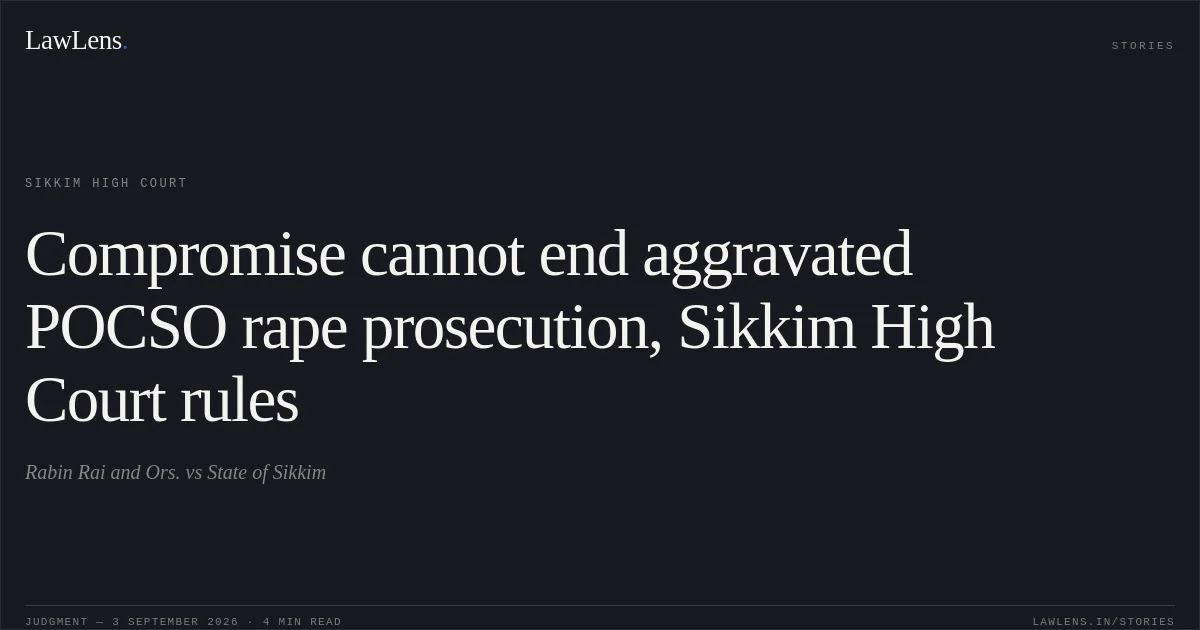
Petitioner No. 1, the accused, was prosecuted in FIR No. 113/2023 registered at Sadar Police Station, Gangtok, for offences under Sections 5(j)(ii)/6 of the Protection of Children from Sexual Offences Act, 2012 (“POCSO Act”) and Section 376 IPC.
Source reference: paras. 5, 11–13; pp. 4–6The alleged sexual intercourse occurred on 26 November 2022, when the survivor was approximately 17 years old and the accused was approximately 19 years old.
Source reference: paras. 5, 11–13; pp. 4–6The prosecution had concluded its evidence, including the survivor’s deposition recorded on 21 August 2024, and the accused’s examination under Section 313 CrPC was due.
Source reference: para. 6; p. 3On 3 August 2025, the parents of the survivor and the accused executed a deed of compromise. The survivor and accused signed the document but were not designated as parties to it; the petition for quashing, however, was jointly supported by affidavits of the accused, survivor and their respective parents.
Source reference: paras. 7–8, 12, 24; pp. 3–4, 6, 13The petitioners invoked Section 528 BNSS, which preserves the High Court’s inherent jurisdiction, seeking quashing of the FIR and the pending proceedings in S.T. (POCSO) Case No. 1 of 2024.
Source reference: para. 1; p. 1Issues
1. Whether a deed of compromise executed by the parents of the survivor and the accused could be acted upon as a compromise between the accused and the survivor, who had both attained majority by the time of consideration of the petition.
Source reference: para. 9(i); p. 42. Whether the High Court could exercise its inherent power under Section 528 BNSS to quash prosecution for aggravated penetrative sexual assault/rape under the POCSO Act and the IPC on the basis of a compromise.
Source reference: para. 9(ii); p. 4Law Applied
Section 528 BNSS, pari materia with Section 482 CrPC, preserves the High Court’s inherent power to prevent abuse of process and secure the ends of justice.
Source reference: paras. 2, 25; pp. 1, 14Section 2(d) POCSO defines a child as a person below 18 years, and consent of a child is legally immaterial; Section 5(j)(ii) concerns aggravated penetrative sexual assault resulting in pregnancy, punishable under Section 6 POCSO by a minimum of 20 years’ rigorous imprisonment.
Source reference: paras. 13–15; pp. 5–6In Gian Singh v. State of Punjab, (2012) 10 SCC 303, the Supreme Court held that serious offences such as rape and offences under special penal statutes cannot ordinarily be quashed merely because the offender and victim have settled the matter, unlike disputes having an overwhelmingly civil or matrimonial character.
Source reference: para. 18; pp. 8–10In Re: Right to Privacy of Adolescents, 2024 INSC 614, the Supreme Court held that even where the accused and a survivor who has subsequently attained majority reach a settlement, prosecution for offences under the POCSO Act and rape provisions cannot be quashed under Section 482 CrPC or Article 226; the Court also restored the conviction in that case.
Source reference: paras. 18–20; pp. 7–11The Court also noted the Supreme Court’s recognition in X v. Principal Secretary, Health and Family Welfare Department, Government of NCT of Delhi, 2022 SCC OnLine SC 1321, and Society for Enlightenment and Voluntary Action v. Union of India, 2024 INSC 790, that adolescents may engage in consensual activity, but factual consent does not alter the statutory prohibition under POCSO.
Source reference: paras. 16–17, 21–23; pp. 6–12Reasoning
The Court held that the deed of compromise, strictly construed, was not an agreement between the accused and the survivor because it had been executed by their respective parents; the survivor and accused had merely signed it and were not parties to the deed.
Source reference: para. 24; p. 13Nevertheless, the joint petition and supporting affidavits demonstrated their present intention to settle the dispute.
Source reference: paras. 12, 24; pp. 6, 13That intention could not, however, justify quashing. The alleged intercourse occurred when the survivor was below 18 years and therefore legally incapable of giving consent under POCSO, irrespective of the parties’ alleged romantic relationship or the accused’s age of approximately 19 years.
Source reference: paras. 5, 13–15; pp. 4–6Applying Re: Right to Privacy of Adolescents, the Court concluded that the gravity and statutory character of aggravated penetrative sexual assault resulting in pregnancy placed the case outside the category of offences that may be terminated on the basis of settlement.
Source reference: para. 20; p. 12The Court acknowledged the harshness of the possible sentence and the parties’ circumstances but held that such considerations could not override the binding Supreme Court position.
Source reference: para. 20; p. 12Holding
The Court answered the first issue by holding that the deed itself was not a compromise between the accused and the survivor, although the joint affidavits evidenced their intention to settle.
It answered the second issue in the negative: Section 528 BNSS could not be used to quash the FIR or pending prosecution for aggravated penetrative sexual assault/rape under the POCSO Act and IPC on the basis of compromise.
Source reference: para. 24; p. 13The petition was accordingly rejected, and a copy of the order was directed to be sent to the Special Judge (POCSO), Gangtok.
Source reference: para. 25; p. 14The parties were left at liberty, if so advised, to approach the Supreme Court for relief.
Source reference: para. 25; p. 14Acts & Sections Cited
12 provisions across 5 statutes referred to in this judgment. Each provision opens on LawLens.
Bharatiya Nagarik Suraksha Sanhita, 20231
Protection of Children from Sexual Offences Act, 20124
Indian Penal Code, 18604
Code of Criminal Procedure, 19732
Juvenile Justice (Care and Protection of Children) Act, 2015.1
Original Court PDF
Rabin Rai and Ors.vsState of Sikkim
Click to open original judgment
Original judgment, available to read, download and summarize on LawLens.in