Facts
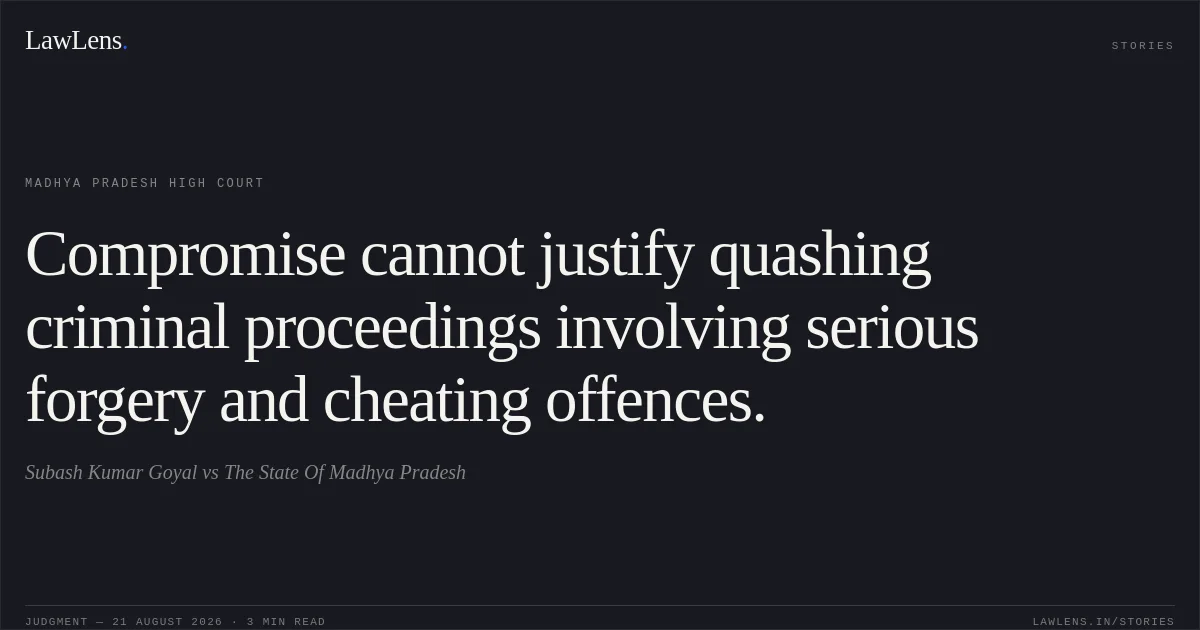
The petitioners invoked Section 528 of the Bharatiya Nagarik Suraksha Sanhita, 2023 (“BNSS”) seeking quashing of FIR Crime No. 481/2025 registered at Police Station Kotwali, Morena, for offences under Sections 336(3), 340(2), 318(4), 61(2) and 338 of the Bharatiya Nyaya Sanhita, 2023 (“BNS”), along with consequential proceedings, on the basis of a compromise.
Source reference: para. 1The complainant alleged that the accused misused ICICI Bank Cheque No. 000506, originally issued for ₹4,61,000, by filling in ₹1,40,18,700 and presenting it with the intention of causing wrongful loss to the complainant and his wife.
Source reference: para. 2The allegations further included business dealings, disputed investments, dishonoured cheques, and an alleged conspiracy among the accused family members to forge and misuse the cheque.
Source reference: para. 2During the proceedings, the parties filed compromise applications supported by affidavits.
Source reference: para. 3The Principal Registrar verified their identities, signatures, and the voluntariness of the compromise, and found no threat, inducement or coercion.
Source reference: paras. 3–4Issues
Whether the High Court should exercise its inherent jurisdiction under Section 528 of the BNSS to quash the FIR and consequential criminal proceedings solely on the basis of a compromise between the accused and the complainant?
Source reference: paras. 1, 5–12Whether the allegations of forgery, fabrication, cheating and conspiracy were sufficiently serious and had an element of public or criminal justice impact so as to preclude quashing despite the complainant’s consent to the compromise?
Source reference: paras. 9–12Law Applied
The Court applied Section 528 of the BNSS, which preserves the High Court’s inherent power to prevent abuse of the process of court and secure the ends of justice.
Source reference: para. 1It also considered the offences alleged under Sections 336(3), 340(2), 318(4), 61(2) and 338 of the BNS, relating, inter alia, to forgery, use or fabrication of documents, cheating and criminal conspiracy.
Source reference: para. 9The governing principle applied was that inherent jurisdiction must be exercised sparingly and that a compromise does not ordinarily justify quashing where the allegations disclose serious offences involving forgery, cheating or an element affecting the administration of criminal justice; the Court must consider the nature and gravity of the offence rather than merely the complainant’s subsequent consent.
Source reference: paras. 9–12Reasoning
The Court accepted that the compromise was voluntary and duly verified, but held that this factor was not decisive.
Source reference: paras. 3–4, 10The FIR disclosed allegations that a cheque issued for ₹4,61,000 had allegedly been altered to ₹1,40,18,700 and misused pursuant to a conspiracy, thereby prima facie indicating forgery, fabrication, cheating and cognizable offences under the BNS.
Source reference: paras. 2, 9, 11Since the allegations were not purely private or personal in character and involved conduct capable of undermining the administration of criminal justice, the Court declined to terminate the prosecution merely because the complainant had entered into a settlement.
Source reference: paras. 9–10The Court further noted that, at the quashing stage, it was not required to determine the truth or falsity of the allegations; the prima facie disclosure of cognizable offences warranted investigation and adjudication in accordance with law.
Source reference: para. 11Holding
The Court held that the compromise did not provide sufficient ground for exercising inherent jurisdiction under Section 528 of the BNSS because the FIR alleged serious offences involving forgery, fabrication, cheating and conspiracy.
The petition seeking quashing of the FIR and consequential proceedings was therefore dismissed, and compromise applications I.A. Nos. 8726/2026 and 8727/2026 were also dismissed.
Source reference: paras. 13–14The Court clarified that its observations were confined to the petition and would not prejudice the parties before the competent court, which must decide the case independently on the evidence and in accordance with law.
Source reference: para. 14Acts & Sections Cited
6 provisions across 2 statutes referred to in this judgment. Each provision opens on LawLens.
Bharatiya Nagarik Suraksha Sanhita, 20231
Bharatiya Nyaya Sanhita, 20235
Original Court PDF
Subash Kumar GoyalvsThe State Of Madhya Pradesh
Click to open original judgment
Original judgment, available to read, download and summarize on LawLens.in