Facts
The appellant was prosecuted on the allegation that he had abducted the prosecutrix pursuant to an FIR lodged by her father.
Source reference: no citationAfter investigation, a charge-sheet was filed, and the Special/Sessions Court, Seoni, convicted the appellant under Sections 363 and 506 of the Indian Penal Code, sentencing him to rigorous imprisonment for three years with a fine of ₹2,500 under Section 363 and rigorous imprisonment for two years with a fine of ₹2,000 under Section 506.
Source reference: para. 1, p. 1During the pendency of the appeal under Section 374(2) of the Code of Criminal Procedure, the appellant and the complainant filed joint applications seeking permission to compromise the matter.
Source reference: para. 4, p. 2The Registrar verified the compromise and recorded that it was voluntary and free from threat, coercion, or inducement.
Source reference: para. 5, p. 2The appellant had already undergone 11 days’ incarceration during trial and sought reduction of the sentence under Section 363 to the period already undergone.
Source reference: para. 7, p. 3Issues
Whether the conviction under Sections 363 and 506 of the IPC was sustainable on the evidence on record?
Source reference: para. 9, p. 3Whether the offence under Section 506 of the IPC could be compounded on the basis of the verified compromise between the parties?
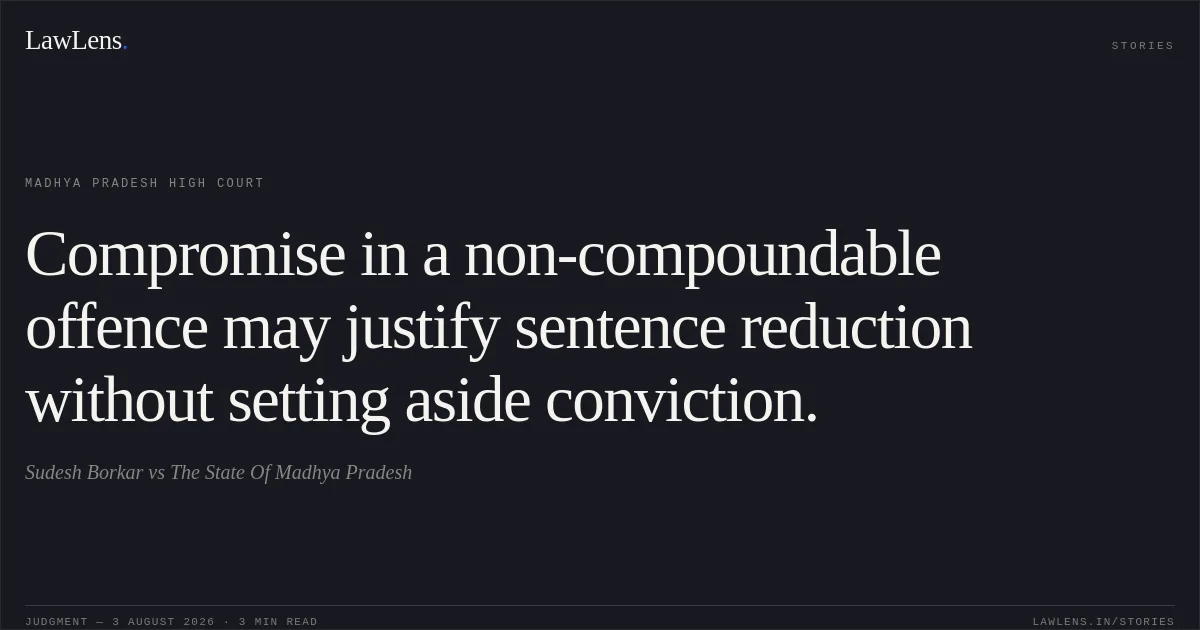
Source reference: para. 6, p. 2Whether, despite Section 363 of the IPC being non-compoundable, the compromise could be considered as a relevant circumstance for reducing the appellant’s sentence to the period already undergone?
Source reference: paras. 10–14, pp. 4–5Law Applied
The Court applied Section 374(2) of the CrPC governing appeals against conviction, Sections 363 and 506 of the IPC, and Section 320 of the CrPC concerning compounding of offences.
Source reference: no citationAn offence that is compoundable may be compounded upon a genuine and voluntary settlement; accordingly, the Court permitted compounding of the Section 506 offence.
Source reference: para. 6, p. 2Section 363 was treated as non-compoundable, so the conviction could not be set aside merely by permitting composition.
Source reference: paras. 10–12, pp. 4–5However, relying on Ishwar Singh v. State of Madhya Pradesh, AIR 2009 SC 675, Unnikrishnan alias Unnikuttan v. State of Kerala, AIR 2017 SC 1745, and Murali v. State, (2021) 1 SCC 726, the Court held that a compromise may nevertheless be considered while determining or reducing the sentence for a non-compoundable offence, even though it cannot be used to formally compound that offence.
Source reference: paras. 10–12, pp. 4–5Reasoning
The High Court independently scrutinised the trial court’s findings despite the appellant limiting his challenge primarily to sentence.
Source reference: no citationIt found that the prosecution evidence, including eyewitness testimony and supporting material, sufficiently established the conviction under Section 363 and disclosed no perversity or illegality warranting interference.
Source reference: para. 9, p. 3Since Section 506 was compoundable and the Registrar had verified the parties’ voluntary compromise, the Court set aside that conviction on the basis of composition.
Source reference: para. 6, p. 2In contrast, the Court declined to compound Section 363 because it was non-compoundable.
Source reference: no citationNevertheless, applying the principles in the cited Supreme Court authorities, it treated the voluntary settlement, the complainant’s lack of objection, the nature of the accusation, and the appellant’s 11 days of incarceration as relevant mitigating circumstances.
Source reference: paras. 13–14, p. 5It therefore maintained the conviction under Section 363 but reduced the substantive imprisonment to the period already undergone.
Source reference: paras. 13–14, p. 5Holding
The appeal was partly allowed.
The conviction under Section 506 of the IPC was set aside on the basis of the compromise, and the appellant was acquitted of that offence; any fine deposited in respect of Section 506 was directed to be returned.
Source reference: para. 6, p. 2The conviction under Section 363 of the IPC was affirmed, but the substantive sentence was reduced to the 11 days already undergone by the appellant.
Source reference: para. 15, p. 6As the appellant was on bail, his bail bonds were discharged, and the appeal was disposed of with directions to transmit the judgment to the trial court for compliance.
Source reference: paras. 15–17, p. 6Acts & Sections Cited
4 provisions across 2 statutes referred to in this judgment. Each provision opens on LawLens.
Code of Criminal Procedure, 19732
Indian Penal Code, 18602
Original Court PDF
Sudesh BorkarvsThe State Of Madhya Pradesh
Click to open original judgment
Original judgment, available to read, download and summarize on LawLens.in
![Relief is made contingent on the Supreme Court’s eventual determination in the analogous pending case.. Ashok Tolani vs REVENUE. CAT - ['Jaipur']. LawLens](/stories/thumbnails/relief-is-made-contingent-on-the-supreme-courts-eventual-determination-in-the-analogous-pe-0a05b6600e0644cf9facfda571d15955.webp)