Facts
The appellants were prosecuted before the 3rd Additional Sessions Judge, Bhopal, in Sessions Trial No. 317/2009 for an offence under Sections 307/34 of the Indian Penal Code, 1860 (IPC).
Source reference: para. 1After investigation and trial, the Trial Court convicted them by judgment dated 22 September 2010 and imposed a fine of ₹5,000 on each appellant, along with default stipulations and a sentence of imprisonment.
Source reference: para. 1The appellants challenged the conviction under Section 374(2) of the Code of Criminal Procedure, 1973 (CrPC).
Source reference: para. 1During the pendency of the appeal, the parties entered into a compromise.
Source reference: para. 4The Registrar (Judicial-II), pursuant to the High Court’s order dated 6 January 2026, recorded the parties’ statements and verified that the compromise was voluntary, genuine, and free from threat, inducement, or coercion.
Source reference: para. 4The appellants did not challenge the conviction on merits and sought reduction of their custodial sentence to the period already undergone, relying on the compromise and their respective periods of incarceration.
Source reference: para. 6Issues
1. Whether the conviction of the appellants under Sections 307/34 IPC was sustainable on the evidence on record?
Source reference: para. 82. Whether the compromise between the parties could be accepted or otherwise taken into account, notwithstanding that the offence under Section 307 IPC is non-compoundable under Section 320 CrPC?
Source reference: paras. 5, 9–123. Whether, in view of the compromise and the period of custody already undergone, the substantive sentence could be reduced to the period already undergone while maintaining the conviction?
Source reference: paras. 6, 12–14Law Applied
The Court exercised appellate jurisdiction under Section 374(2) CrPC and considered the conviction under Sections 307/34 IPC.
Source reference: para. 1Since an offence under Section 307 IPC is non-compoundable under Section 320 CrPC, the compromise could not be used to formally compound or set aside the offence.
Source reference: paras. 5, 12However, relying on Ishwar Singh v. State of Madhya Pradesh, AIR 2009 SC 675, the Court held that a compromise is a relevant circumstance while determining the substantive sentence, even where the offence is non-compoundable.
Source reference: para. 9Following Unnikrishnan alias Unnikuttan v. State of Kerala, AIR 2017 SC 1745, and Murali v. State, (2021) 1 SCC 726, the Court recognised that, in appropriate cases, an amicable settlement may justify reducing the sentence to the period already undergone while maintaining the conviction.
Source reference: paras. 10–11The Court also applied the settled principle that a compromise cannot override the statutory bar on compounding but may be considered in the interests of justice, social harmony, and sentencing discretion.
Source reference: para. 12Reasoning
The High Court independently examined the Trial Court’s judgment and the prosecution evidence, finding that the conviction was supported by cogent and reliable oral and documentary evidence and was not perverse, illegal, or otherwise infirm.
Source reference: para. 8Accordingly, the conviction under Sections 307/34 IPC was affirmed.
Source reference: para. 8Although the parties had voluntarily settled the dispute, the Court held that the settlement could not result in compounding the Section 307 IPC offence because of the statutory restriction under Section 320 CrPC.
Source reference: paras. 5, 12Nevertheless, applying the principles in Ishwar Singh, Unnikrishnan, and Murali, the Court treated the compromise, the complainant’s lack of objection, the nature of the accusation, and the periods of incarceration already undergone by the appellants as relevant mitigating circumstances for sentencing.
Source reference: paras. 12–13It therefore concluded that continued incarceration would serve no useful purpose and that the ends of justice would be met by reducing the custodial sentence to the period already undergone.
Source reference: para. 13Holding
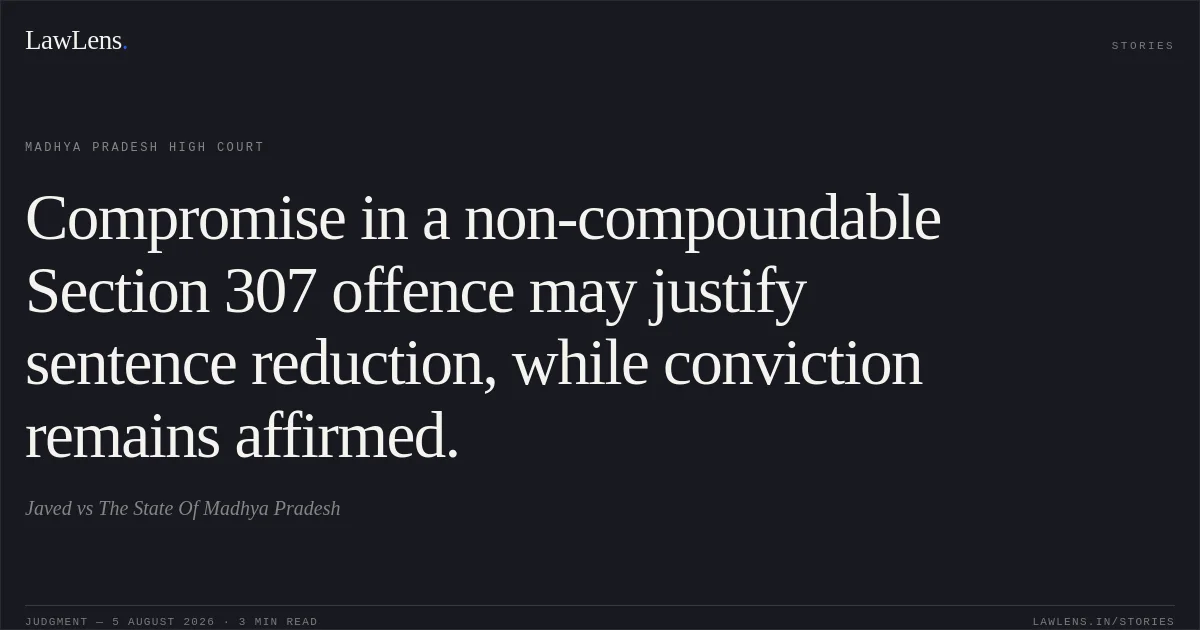
The appeal was partly allowed on the question of sentence.
The appellants’ conviction under Sections 307/34 IPC was affirmed, and the compromise was not treated as compounding the non-compoundable offence.
Source reference: para. 14However, the sentence of imprisonment was reduced to the period already undergone by each appellant.
Source reference: paras. 13–14The fine of ₹5,000 imposed on each appellant was maintained and, if unpaid, was required to be deposited within two months; failure to pay would attract the Trial Court’s default sentence.
Source reference: para. 14As the appellants were on bail, their bail bonds were discharged.
Source reference: para. 15Acts & Sections Cited
4 provisions across 2 statutes referred to in this judgment. Each provision opens on LawLens.
Code of Criminal Procedure, 19732
Indian Penal Code, 18602
Original Court PDF
JavedvsThe State Of Madhya Pradesh
Click to open original judgment
Original judgment, available to read, download and summarize on LawLens.in