Facts
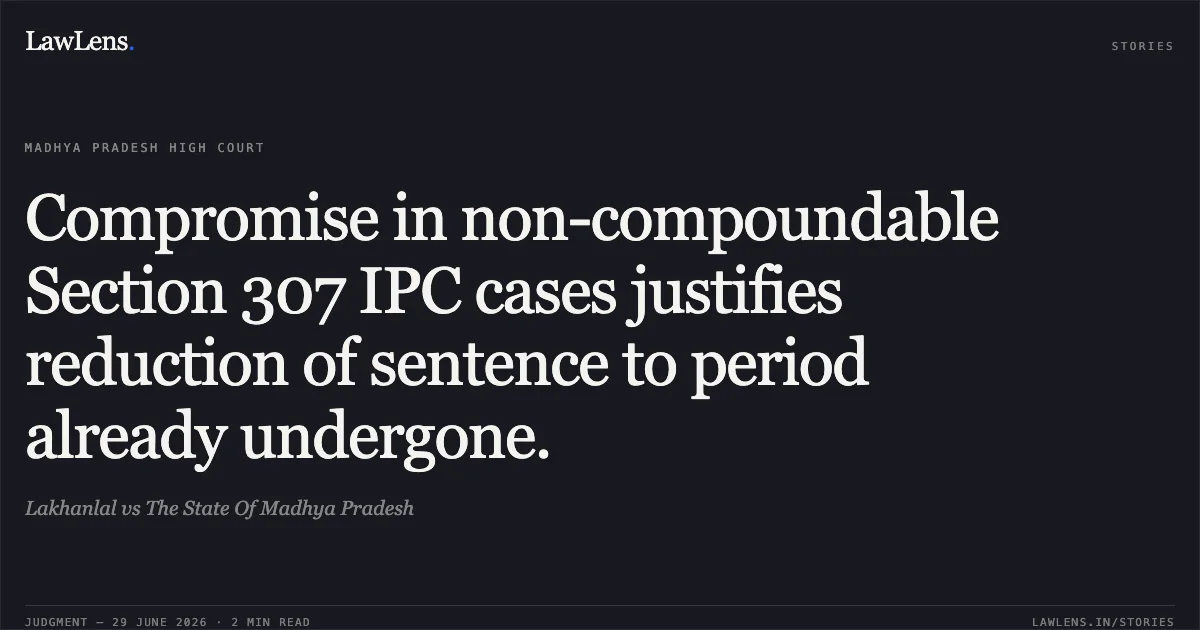
The appellants, Lakhanlal and Monu Kanojia, were convicted by the Fourth Additional Sessions Judge, Chhindwara, on 03.02.2021 for an offense under Section 307 (Attempt to Murder) of the IPC.
Source reference: para. 1On 05.05.2016, following a dispute over borrowed construction materials, the appellants allegedly assaulted the complainant and his father, Lalsingh Kanojia, with a wooden plank, causing a fracture in Lalsingh's head.
Source reference: para. 2The Trial Court sentenced them to 7 years R.I. and a fine of Rs. 1,000 each.
Source reference: para. 1During the pendency of the appeal, the parties entered into a compromise, moving applications under Section 359 of the BNSS, 2023 for compounding.
Source reference: para. 8The appellants had served approximately 9 months of their sentence at the time of the hearing.
Source reference: para. 10Issues
1. Whether an offense under Section 307 of the IPC, being non-compoundable, can be compounded on the basis of a settlement between parties.
Source reference: para. 92. Whether the factum of compromise between the parties can be considered as a mitigating factor to reduce the sentence of the appellants to the period already undergone.
Source reference: para. 10, 13Law Applied
The court applied Section 307 of the IPC regarding attempt to murder and Section 320 of the Cr.PC (analogous to provisions in the BNSS) regarding the non-compoundability of serious offenses.
Source reference: para. 1, 19It relied on the precedent of Narinder Singh v. State of Punjab (2014) to establish that offenses of a personal nature, even under Section 307, may be subject to settlement to secure justice.
Source reference: para. 14Further, relying on Ishwar Singh v. State of Madhya Pradesh and Unnikrishnan v. State of Kerala, the court applied the principle that while a non-compoundable offense cannot be legally compounded, a compromise is a relevant circumstance for the court to exercise discretion in reducing the substantive sentence.
Source reference: para. 15, 16Reasoning
The High Court affirmed the conviction, noting that the prosecution's case was well-supported by eyewitness accounts and medical evidence.
Source reference: para. 12However, regarding the sentence, the Court observed that the parties reside in the same society and have reached an amicable settlement of their own free will and volition.
Source reference: para. 8, 19The court reasoned that since there were no criminal antecedents and the parties wished to live in peace, further incarceration would serve no fruitful purpose.
Source reference: para. 19-20Applying the "combination of factors" approach from Bhagwan Narayan Gaikwad v. State of Maharashtra, the court held that proportionality and rehabilitation were better served by restoring family relations through sentence modification rather than strictly adhering to the original term.
Source reference: para. 18, 20Holding
The Court maintained the conviction under Section 307 IPC but modified the sentence.
The jail sentence was reduced to the period already undergone (approx. 9 months), and the fine was enhanced from Rs. 1,000 to Rs. 7,000 each.
Source reference: para. 21The court ordered the entire fine amount to be paid to the injured party as compensation under Section 395 of the BNSS, 2023.
Source reference: para. 21The appellants were ordered to be released forthwith, subject to the payment of the enhanced fine within 30 days.
Source reference: para. 23Acts & Sections Cited
16 provisions across 3 statutes referred to in this judgment. Each provision opens on LawLens.
Code of Criminal Procedure, 19735
Indian Penal Code, 1860
Bharatiya Nagarik Suraksha Sanhita, 20232
Original Court PDF
LakhanlalvsThe State Of Madhya Pradesh
Click to open original judgment
Original judgment, available to read, download and summarize on LawLens.in


