Facts
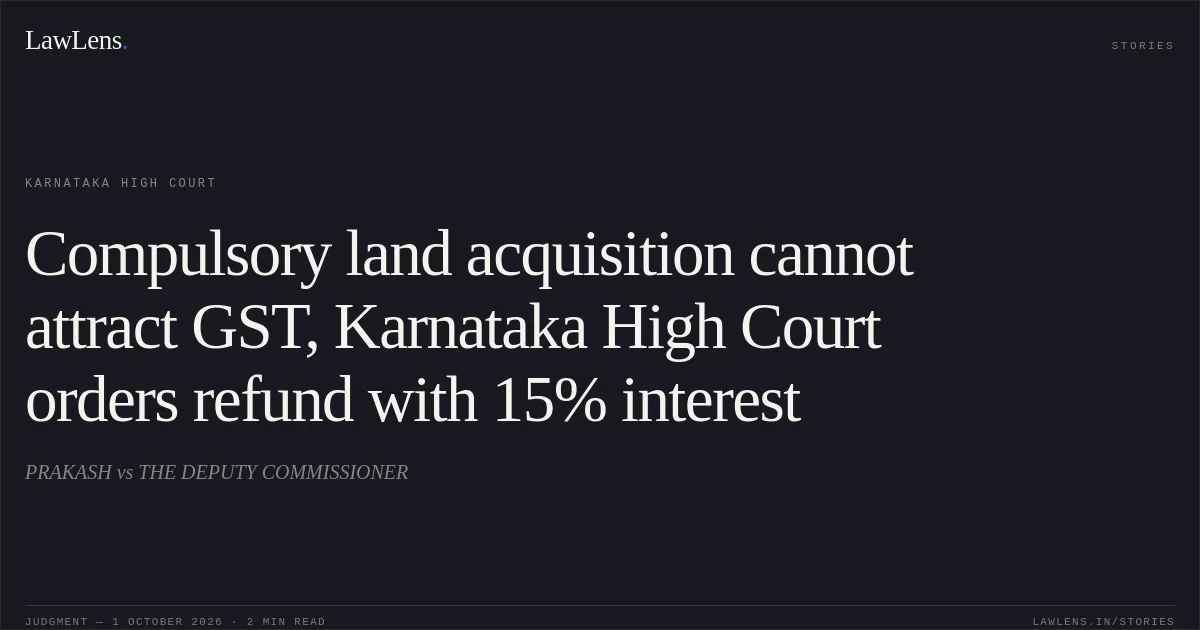
The petitioner’s land measuring 1,187 sq. metres in Survey No. 40, Mellahalli Village, was acquired for widening the Mysuru–Madikeri Highway.
Source reference: para. 1–4, 6The award dated 29 October 2024 determined compensation at ₹38,10,744.88, from which the authorities deducted ₹3,20,585.80 as GST.
Source reference: para. 1–4, 6The petitioner sought a direction for repayment with interest, contending that compulsory acquisition was neither a supply of goods nor a provision of services.
Source reference: para. 1–4, 6The respondents argued that GST applied to the structural component of the award.
Source reference: para. 1–4, 6Issues
1. Whether GST could lawfully be deducted from compensation awarded for land and structures compulsorily acquired for a public purpose
Source reference: para. 3–72. Whether the petitioner was entitled to repayment of the deducted amount with interest and other relief
Source reference: para. 8–10Law Applied
Article 366(12A) of the Constitution defines GST as a tax on the supply of goods or services or both. The Court applied the principle that immovable property, including buildings attached to land, is not “goods” for this purpose; it referred to the definition of immovable property in Section 3 of the Transfer of Property Act, 1882.
Source reference: para. 6It held that compulsory acquisition through the State’s power of eminent domain is neither a supply of goods nor a provision of services and therefore does not attract GST. The Court also referred to the Madras High Court’s decision in W.P. No. 3278 of 2024, concerning GST on acquisition compensation, and to its earlier decision concerning tax deducted at source from land-acquisition compensation.
Source reference: para. 7–8Reasoning
The Court found that the acquisition and deduction were undisputed, but the respondents identified no provision of the GST Act under which acquisition of land or structures amounted to a taxable supply.
Source reference: para. 6–7Because the petitioner had neither sold goods nor provided services, the compulsory transfer of the property to the State could not constitute a supply attracting GST, even if the award included a structural component. The Court therefore concluded that the deduction exceeded the respondents’ authority.
Source reference: para. 6–7, 9Holding
The Court quashed the award notice insofar as it authorised deduction of GST and directed respondent No. 2 to refund ₹3,20,585.80, with interest at 15% per annum from the award date until payment.
It ordered that the interest be recovered personally from respondent No. 2 and that respondent No. 2 pay the petitioner ₹50,000 in costs within one month. The petition was disposed of on those terms.
Source reference: para. 10–11Acts & Sections Cited
1 provisions across 1 statute referred to in this judgment. Each provision opens on LawLens.
Transfer of Property Act, 18821
Original Court PDF
PRAKASHvsTHE DEPUTY COMMISSIONER
Click to open original judgment
Original judgment, available to read, download and summarize on LawLens.in