Facts
The petitioner’s 450 sq. m. land in Sy. No. 107/2A1A1, Borehosahalli Village, was acquired for widening the Mysuru–Madikeri Highway.
Source reference: pp. 2–4The award fixed compensation at ₹24,98,560, from which the authorities deducted ₹3,81,136.30 as 18% GST.
Source reference: pp. 2–4The petitioner sought repayment of the deduction with interest, arguing that compulsory acquisition was neither a supply of goods nor a provision of services.
Source reference: pp. 2–4The respondents maintained that GST applied to the structural component of the compensation.
Source reference: pp. 4–5Issues
1. Whether GST could be deducted from compensation paid for land and structures acquired by the State under its power of eminent domain.
Source reference: pp. 3–72. Whether the petitioner was entitled to repayment of the deducted amount with interest and costs.
Source reference: pp. 2, 7–8Law Applied
Article 366(12A) of the Constitution defines GST as a tax on the supply of goods or services or both.
Source reference: p. 5Section 3 of the Transfer of Property Act, 1882 treats things attached to or embedded in the earth as part of immovable property.
Source reference: p. 5The Court held that compulsory acquisition is an exercise of the State’s power of eminent domain, not a supply of goods or services, because the owner neither sells goods nor provides a service by surrendering property under statutory authority.
Source reference: pp. 5–7The Court also referred to a Madras High Court decision in W.P. No. 3278/2024 and to its prior reasoning that interest under Section 28 of the Land Acquisition Act, 1894 forms part of compensation.
Source reference: pp. 6–7Reasoning
The Court found it undisputed that the petitioner’s property was acquired and that the authority deducted ₹3,81,136.30 as GST from the compensation.
Source reference: p. 5Applying the constitutional concept of GST and the legal character of immovable property, it reasoned that acquisition by statutory compulsion involved neither a supply of goods nor a provision of services.
Source reference: pp. 5–7The respondents’ assertion that GST applied to the structural component did not identify a provision of the GST Act making such acquisition taxable.
Source reference: pp. 5–7The deduction was therefore beyond the respondents’ authority.
Source reference: p. 7Holding
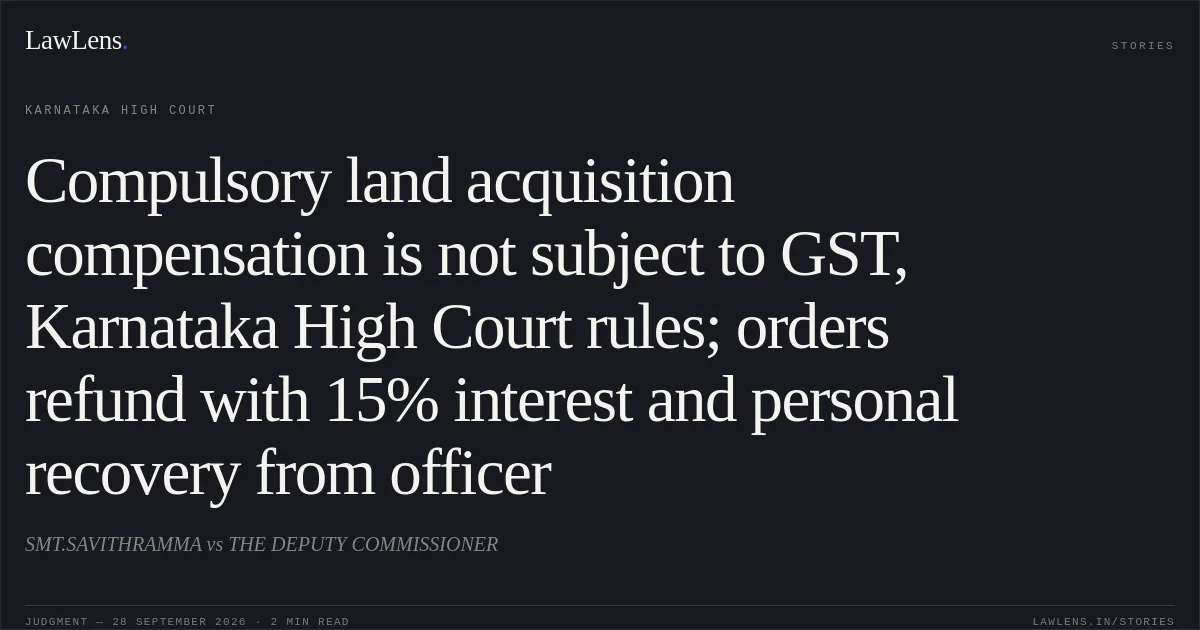
The Court held that GST could not be deducted from the petitioner’s compensation for the acquired property.
It quashed the award notice dated 28 November 2024 insofar as it authorised the deduction and directed respondent No. 2 to refund ₹3,81,136.30 with interest at 15% per annum from the award date until payment; the interest was to be recovered personally from respondent No. 2.
Source reference: pp. 7–8Respondent No. 2 was also directed to pay the petitioner ₹50,000 in costs within one month.
Source reference: pp. 7–8The petition was disposed of on those terms.
Source reference: p. 8Acts & Sections Cited
1 provisions across 1 statute referred to in this judgment. Each provision opens on LawLens.
Transfer of Property Act, 18821
Original Court PDF
SMT.SAVITHRAMMAvsTHE DEPUTY COMMISSIONER
Click to open original judgment
Original judgment, available to read, download and summarize on LawLens.in