Facts
The Petitioner (landlady) filed an eviction petition under Section 14(1)(e) of the Delhi Rent Control Act (DRCA), 1958, against the Respondent (tenant) for a shop in Karol Bagh.
Source reference: p. 1-2She claimed the premises were bona fide required for her daughter, an optometrist, to start a clinic and asserted she had no other suitable alternate accommodation.
Source reference: para. 4The Respondent filed a "leave to defend" application, alleging the Petitioner suppressed material facts regarding several vacant floors and shops in the subject property and another nearby property (No. 68-69/5360).
Source reference: para. 5The Additional Rent Controller (ARC) granted leave to defend on August 1, 2023, finding triable issues regarding the availability of alternate accommodation.
Source reference: para. 2The Petitioner challenged this order via revision.
Source reference: no citationIssues
1. Whether the Respondent raised triable issues regarding the non-availability of alternate suitable accommodation that would disentitle the landlord from seeking summary eviction.
Source reference: para. 20, 272. Whether the Petitioner’s non-disclosure and inconsistent stands regarding her ownership of other properties necessitated a full trial.
Source reference: para. 28, 32Law Applied
Section 14(1)(e) read with Section 25B of the Delhi Rent Control Act, 1958, which governs eviction for bona fide requirement and the summary procedure for contesting such claims.
Source reference: p. 1Inderjeet Kaur v. Nirpal Singh, establishing that at the leave to defend stage, the tenant only needs to make a prima facie case disclosing facts that would disentitle the landlord from an eviction order.
Source reference: para. 32M.M. Quasim v. Manohar Lal Sharma, which mandates that if vacant premises exist, the landlord must establish why they are unsuitable.
Source reference: para. 32Section 25B(8) as defined in Abid-Ul-Islam v. Inder Sain Dua and Sarla Ahuja v. United India Insurance Co. Ltd. regarding the restrictive nature of revisional jurisdiction.
Source reference: para. 34-35Reasoning
The Court observed that while a landlord is generally the best judge of their requirements, they must approach the court with clean hands regarding available space.
Source reference: para. 33The Court found significant contradictions in the Petitioner’s pleadings: while the site plan showed her husband occupying a ground-floor shop, her reply to the leave to defend application claimed he was on the first floor, leaving the status of the ground-floor space unexplained.
Source reference: para. 22, 27The Respondent produced electricity bills in the Petitioner’s name for shops in another property which the Petitioner had initially denied owning or had claimed were sold via an unverified "draft" sale deed.
Source reference: para. 29-30The Court reasoned that these inconsistencies and the lack of transparency regarding the occupancy of upper floors and the second property created material triable issues.
Source reference: para. 31-32Under the limited scope of Section 25B(8), the Court found no jurisdictional error or perversity in the ARC’s decision to allow the tenant to test these claims at trial.
Source reference: para. 36-37Holding
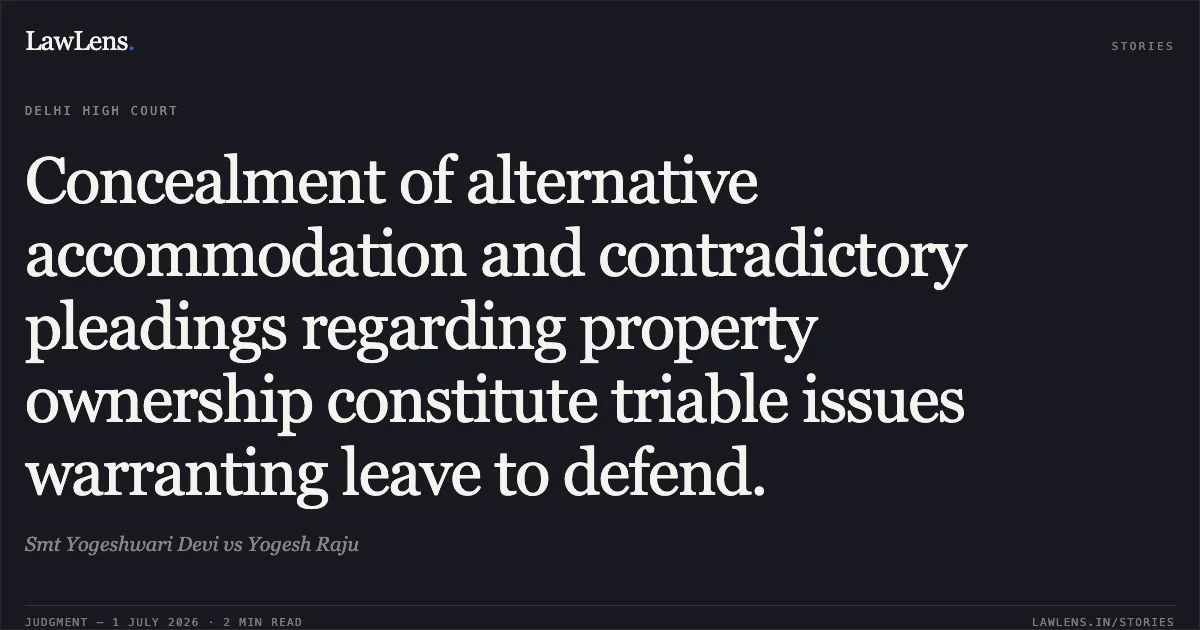
The High Court held that the Respondent successfully raised triable issues concerning the non-disclosure of alternate accommodations, which precluded the summary eviction of the tenant without a full trial.
The High Court dismissed the Revision Petition, upholding the ARC’s order dated August 1, 2023, and the parties were directed to proceed with the trial in the court of the learned Rent Controller.
Source reference: para. 37-38, 40Acts & Sections Cited
1 provisions across 1 statute referred to in this judgment. Each provision opens on LawLens.
delhi rent control act, 19581
Original Court PDF
Smt Yogeshwari DevivsYogesh Raju
Click to open original judgment
Original judgment, available to read, download and summarize on LawLens.in


