01Facts
The applicant, a former Chairperson of Nagar Panchayat Amethi, was summoned on 08.02.2024 in a complaint case under Section 420 IPC regarding the alleged issuance of a forged certificate
¶ 9-10Aggrieved, the applicant filed Criminal Revision No. 91 of 2024 before the Sessions Court on 07.03.2024, where no interim relief was granted
¶ 10While the revision was still pending, the applicant filed the present application under Section 482 Cr.P.C. (now Section 528 BNSS) before the High Court on 18.09.2024, challenging the same summoning order
¶ 11In her supporting affidavit, the applicant failed to disclose the pendency of the lower court revision, leading the High Court to grant an interim stay on 26.09.2024
¶ 2, 11Upon disclosure of the revision by the opposite party via counter-affidavit, the applicant moved to withdraw the 482 application, claiming her counsel filed the revision against her oral instructions
¶ 3, 1402Issues
i.1. Whether the non-disclosure of a pending criminal revision in the lower court challenging the same impugned order constitutes a violation of Rule 3(5), Chapter XVIII, Part-III of the Allahabad High Court Rules
¶ 13, 21ii.2. Whether a litigant who suppresses material facts or makes misstatements is entitled to discretionary relief or allowed to withdraw the petition to avoid consequences
¶ 17, 2203Law Applied
Rule 3(5), Chapter XVIII, Part-III of the Allahabad High Court Rules, 1952, which mandates a specific declaration that no such criminal revision is pending in a lower court and stipulates that any substantial omission or misstatement results in dismissal, costs, and perjury prosecution
¶ 12Doctrine from S.P. Chengalvaraya Naidu v. Jagannath: fraud avoids all judicial acts and a litigant with unclean hands has no right to approach the court
¶ 23Principle from Ramjas Foundation v. Union of India: litigants who attempt to pollute the stream of justice through falsehood or suppression are not entitled to any relief
¶ 24K.D. Sharma v. Steel Authority of India Ltd. regarding the duty of candid disclosure
¶ 25Provisions in the judgment · 10 · Linked ones open on LawLens
Indian Penal Code, 1860 Section 420
Code of Criminal Procedure, 1973 Section 156Section 340Section 397Section 399Section 482
Bharatiya Nagarik Suraksha Sanhita, 2023 Section 215Section 379Section 528
Code of Civil Procedure, 1908 Section 151
04Reasoning
The Court observed that the applicant filed the present 482 application six months after filing the lower court revision, directly violating the mandatory disclosure requirements of Rule 3(5) of the High Court Rules
¶ 21The Court rejected the applicant's plea that the mistake was solely attributable to her counsel (Himalayan Coop. Group Housing Society v. Balwan Singh), noting that the applicant had already engaged with the trial court and the revisional court through the same or associated counsel before filing the High Court petition
¶ 14, 26The Court reasoned that obtaining an interim stay from the High Court while failing to secure one in the lower court—without disclosing the latter's pendency—constituted a deliberate act of deception and fraud upon the court
¶ 22The subsequent withdrawal application was viewed as an attempt to suppress the realized fraud rather than a bona fide corrective measure
¶ 2205Holding
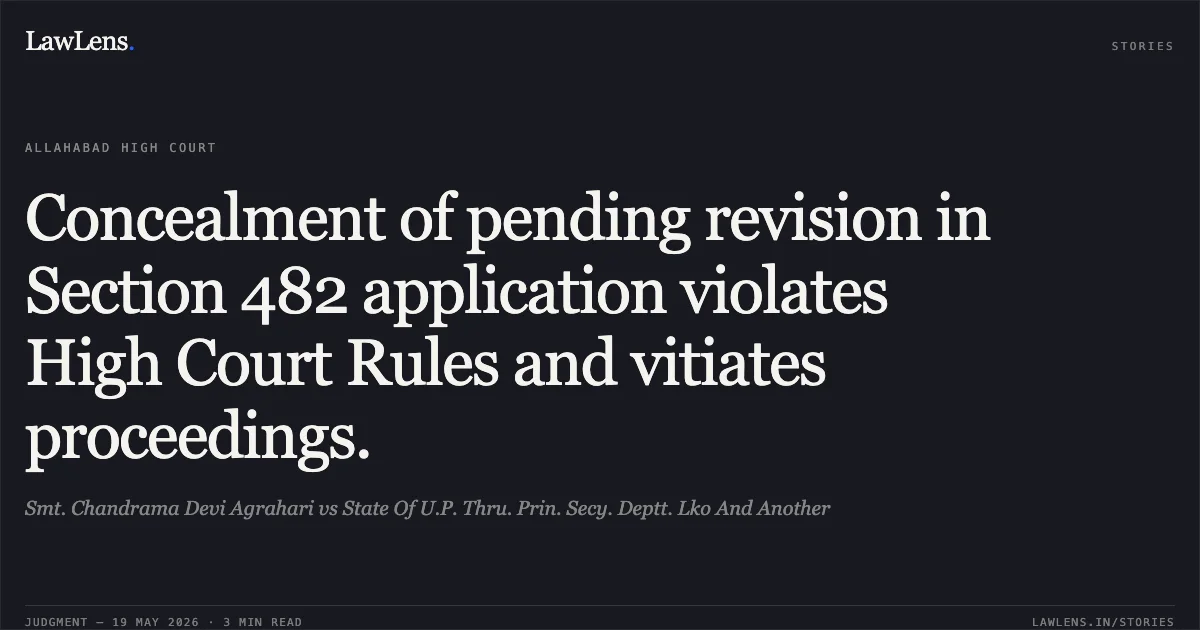
The Court answered the issues in the affirmative, holding that the applicant was guilty of misrepresentation, fraud, and concealment of material facts
¶ 26The application under Section 482 Cr.P.C. was rejected with an exemplary cost of ₹1,00,000/-, part of which (₹30,000/-) was directed to the opposite party and the remainder (₹70,000/-) to the State Legal Services Authority; the Court rejected the withdrawal and Section 340 applications as infructuous and partly allowed the opposite party’s application for prosecution for perjury
¶ 27, 28Original Court PDF
Smt. Chandrama Devi AgraharivsState Of U.P. Thru. Prin. Secy. Deptt. Lko And Another
Click to open original judgment
Original judgment, available to read, download and summarize on LawLens.in