Facts
On 13.01.2020, the appellant allegedly took the nine-year-old victim to a market under the assurance that he would bring her home safely
Source reference: para. 5The victim went missing, and her body was later recovered with signs of sexual assault
Source reference: para. 5, 7The Trial Court convicted the appellant on 22.12.2022 for offences under Section 302 of the IPC (Murder), Section 376(AB) of the IPC (Rape of a woman under 12), and Section 6 of the POCSO Act (Aggravated penetrative sexual assault)
Source reference: para. 4The appellant challenged the conviction, contending that the case rested entirely on circumstantial evidence, the "last seen" theory was not proved, and the conviction was based solely on DNA evidence without corroboration
Source reference: para. 13-15Issues
1. Whether, on the date of the incident, the victim/deceased was a “child” within the meaning of Section 2(1)(d) of the POCSO Act?
Source reference: para. 252. Whether the appellant is the author of the crime and has committed the offences punishable under Sections 376(AB) and 302 of the IPC and Section 6 of the POCSO Act?
Source reference: para. 25Law Applied
The court applied Section 2(1)(d) of the POCSO Act to define a "child" as any person under eighteen years
Source reference: para. 26It followed the hierarchy of age-determination evidence established in Section 94 of the Juvenile Justice Act, 2015 [para. 28] and the principles in Jarnail Singh v. State of Haryana
Source reference: para. 27Regarding circumstantial evidence, the court applied the "five golden principles" (Panchsheel) from Sharad Birdhichand Sarda v. State of Maharashtra, requiring an unbroken chain of evidence pointing exclusively to the guilt of the accused
Source reference: para. 36Reasoning
The Court first established the victim’s age using the Anganwadi admission register (Ex.P/15C) and testimony from an Anganwadi worker (PW-06), concluding she was approximately 9 years and 10 months old
Source reference: para. 29, 33On the merits, the Court acknowledged that the "last seen" theory was not established as multiple witnesses turned hostile
Source reference: para. 47-51However, it held that a conviction could still be sustained if other circumstances formed a complete chain
Source reference: para. 67The Court relied heavily on three factors: (1) Extra-judicial Confession: The testimony of PW-18 was deemed voluntary and trustworthy as there was no motive for false implication
Source reference: para. 53-55(2) Scientific Evidence: DNA profiling (Ex.P/51 and Ex.P/52) matched the appellant's DNA with biological samples from the victim's vaginal swab, which the court termed "clinching" and "unimpeachable"
Source reference: para. 58-61(3) Medical Evidence: The post-mortem report (Ex.P/29) confirmed homicidal death via strangulation and forcible sexual assault
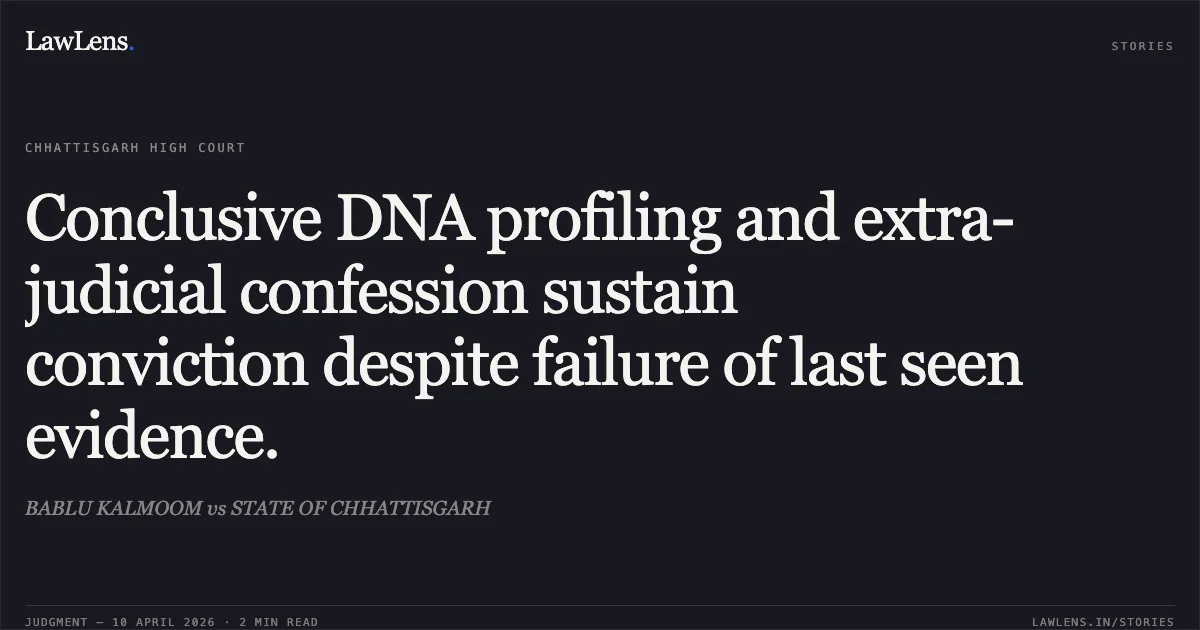
Source reference: para. 62-64The Court concluded that these factors cumulatively bridged the gap left by the failed "last seen" evidence
Source reference: para. 70Holding
The Court answered both issues in the affirmative
It held that the scientific DNA evidence, corroborated by the medical report and extra-judicial confession, proved the appellant's guilt beyond reasonable doubt
Source reference: para. 73, 77The conviction and sentence of life imprisonment (till natural death for the POCSO/Rape charges) were upheld, and the criminal appeal was dismissed
Source reference: para. 4, 77, 80Acts & Sections Cited
9 provisions across 4 statutes referred to in this judgment. Each provision opens on LawLens.
Code of Criminal Procedure, 19734
Indian Penal Code, 18602
Juvenile Justice (Care and Protection of Children) Act, 2015.1
Original Court PDF
BABLU KALMOOMvsSTATE OF CHHATTISGARH
Click to open original judgment
Original judgment, available to read, download and summarize on LawLens.in


