Facts
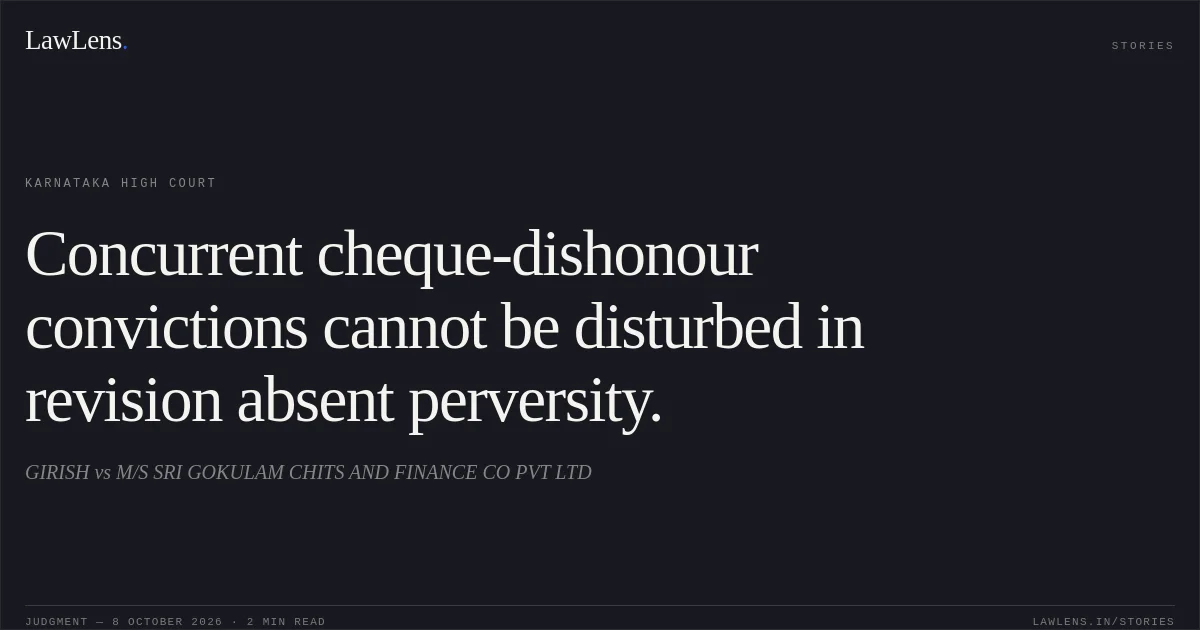
The complainant alleged that the petitioner stood surety for a chit subscriber and issued a cheque for ₹1,59,600 towards the subscriber’s outstanding liability. The cheque was dishonoured with the endorsement “Account closed”; the petitioner did not pay after receiving the demand notice, and the complainant filed a complaint under Section 138 of the Negotiable Instruments Act, 1881 (“NI Act”)
Source reference: paras. 3, 17; pp. 3–4, 13The trial court convicted the petitioner and imposed a fine; the Sessions Court dismissed his appeal and affirmed the conviction
Source reference: paras. 6–7, 22–23; pp. 5, 16–17In revision, the petitioner argued that he had not had a fair opportunity to cross-examine the complainant or to make a statement under Section 313 of the Code of Criminal Procedure, 1973 (“Cr.P.C.”), and relied on illness to explain his non-appearance
Source reference: para. 8; pp. 5–6Issues
1. Whether the concurrent judgments of conviction disclosed perversity, gross error, or another ground warranting interference in revision
Source reference: para. 10; p. 72. Whether the petitioner’s non-examination of the complainant, the dispensation of his Section 313 Cr.P.C. statement, and his claim of illness established a procedural or evidentiary basis to set aside the conviction
Source reference: paras. 8–9, 21–23; pp. 5–7, 15–17Law Applied
Sections 397 and 401 Cr.P.C. confer supervisory revisional jurisdiction, not a second appellate jurisdiction; interference is ordinarily warranted only where the lower court’s finding or order is perverse, grossly erroneous, glaringly unreasonable, legally untenable, based on irrelevant or no material, or reflects arbitrary or capricious discretion
Source reference: paras. 13–14; pp. 8–11The Court relied on State of Maharashtra v. Jagmohan Singh Kuldip Singh Anand, (2004) 7 SCC 659, and State of Kerala v. Puttumana Illath Jathavedan Namboodiri, (1999) 2 SCC 452, for the limits on reappreciating evidence in revision
Source reference: para. 13; pp. 8–10Under Sections 118 and 139 of the NI Act, the Court treated the presumptions that the cheque was issued for consideration and towards a legally enforceable debt or liability as rebuttable
Source reference: paras. 16, 19–20; pp. 12, 14–15The Court also relied on the guidelines in AIR 2014 SC 2528 in considering the trial court’s decision to dispense with the petitioner’s Section 313 Cr.P.C. statement after he failed to appear despite notice and adjournments
Source reference: para. 22; p. 16Reasoning
The Court found that the complainant had produced the cheque, bank endorsement, demand notice, postal acknowledgment, ledger extract, promissory note and bank statement in support of the transaction and the petitioner’s liability as surety
Source reference: para. 18; pp. 13–14The petitioner had not cross-examined the complainant despite opportunities, had not appeared to answer questions under Section 313 Cr.P.C. despite service of notice, and had not adduced evidence to rebut the statutory presumptions
Source reference: paras. 20–22; pp. 14–16The medical material did not credibly establish that illness prevented his participation during the relevant period
Source reference: paras. 21, 23; pp. 15–17Applying the limited revisional standard, the Court held that the concurrent findings disclosed no illegality or perversity warranting interference
Source reference: paras. 14, 23; pp. 10–11, 16–17Holding
The High Court dismissed the revision petition and left undisturbed the conviction and sentence affirmed by the appellate court
Although paragraph 11 states that the point for consideration was answered “in Affirmative,” the ensuing reasons and dismissal order show that the Court rejected the grounds for revisional interference
Source reference: paras. 11, 23; pp. 7, 17Acts & Sections Cited
8 provisions across 2 statutes referred to in this judgment. Each provision opens on LawLens.
Code of Criminal Procedure, 19735
Negotiable Instruments Act, 18813
Original Court PDF
GIRISHvsM/S SRI GOKULAM CHITS AND FINANCE CO PVT LTD
Click to open original judgment
Original judgment, available to read, download and summarize on LawLens.in