01Facts
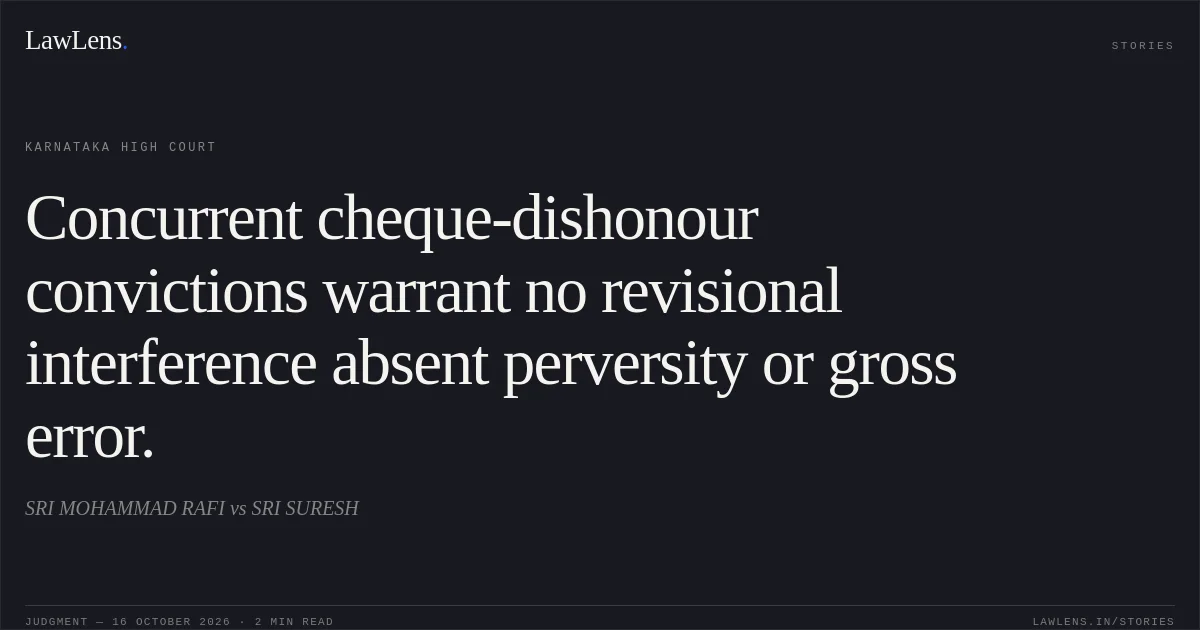
The complainant alleged that he lent the accused ₹2,00,000 on 28 November 2017 and received a post-dated cheque in repayment. The cheque was dishonoured for insufficiency of funds; after notice and non-payment, the complainant brought a prosecution under Section 138 of the Negotiable Instruments Act, 1881 (NI Act).
¶ 4–5The trial court convicted the accused and imposed a fine of ₹2,91,200, with ₹10,000 payable towards State expenses and the balance as compensation. The appellate court affirmed the conviction and sentence.
¶ 7–8In revision, the accused contended that the cheque had been given as security in a chit transaction and was misused.
¶ 1102Issues
i.1. Whether the concurrent findings of conviction and sentence were perverse, grossly erroneous, unreasonable, or otherwise subject to interference in revision.
¶ 13ii.2. Whether the accused rebutted the presumptions under Sections 118 and 139 of the NI Act by establishing that the cheque was issued as security for a chit transaction rather than towards a legally enforceable debt.
¶ 17–19, 23–3003Law Applied
The court applied Sections 138 and 139 of the NI Act: once the statutory requirements for an offence under Section 138 are established and execution of the cheque is admitted or proved, the presumptions under Sections 118 and 139 arise, including the presumption that the cheque was issued towards a legally enforceable debt or liability; those presumptions are rebuttable.
¶ 17–18, 21–23The court also applied Sections 397 and 401 of the Code of Criminal Procedure, 1973, holding that revisional jurisdiction is supervisory and does not permit routine reappreciation of evidence where two courts have reached concurrent findings. Interference is warranted where, among other grounds, the findings are perverse or untenable, rest on irrelevant or no material, omit relevant material, or reflect arbitrary or capricious discretion.
¶ 15–16In stating this standard, the court relied on Kuntegowda v. Thurubaiah, Criminal Appeal No. 3654 of 2026, and the principles quoted from State of Kerala v. Puttumana Illath Jathavedan Namboodiri, (1999) 2 SCC 452.
¶ 15Provisions in the judgment · 8 · Linked ones open on LawLens
Code of Criminal Procedure, 1973 Section 397Section 401Section 200Section 313
Negotiable Instruments Act, 1881 Section 138Section 142Section 139Section 118
04Reasoning
The accused admitted his signature on the cheque and that it was drawn on his bank account; the court also found that the cheque had been dishonoured and the notice and payment-related requirements were met, thereby attracting the statutory presumption.
¶ 20–23The accused’s chit-transaction defence was not supported by reliable evidence: the notebook relied on did not identify a date or participants, was unsigned, and its provenance and entries were unexplained; the defence witnesses gave inconsistent accounts, and one witness was not cross-examined.
¶ 26–30The accused also did not examine the relative whom he said had held the cheque. His financial-capacity arguments did not, in the court’s view, rebut the statutory presumption, and the complainant’s account of the source of the funds was not specifically challenged.
¶ 25, 29, 31–32The concurrent findings disclosed no basis for revisional interference.
¶ 16, 3305Holding
The court answered the revisional-interference issue in the negative and held that the accused had not rebutted the presumptions under Sections 118 and 139 of the NI Act.
¶ 14, 32–33It found no ground to disturb the trial court’s conviction and sentence, as affirmed on appeal, and dismissed the criminal revision petition.
¶ 33–34Original Court PDF
SRI MOHAMMAD RAFIvsSRI SURESH
Click to open original judgment
Original judgment, available to read, download and summarize on LawLens.in