Facts
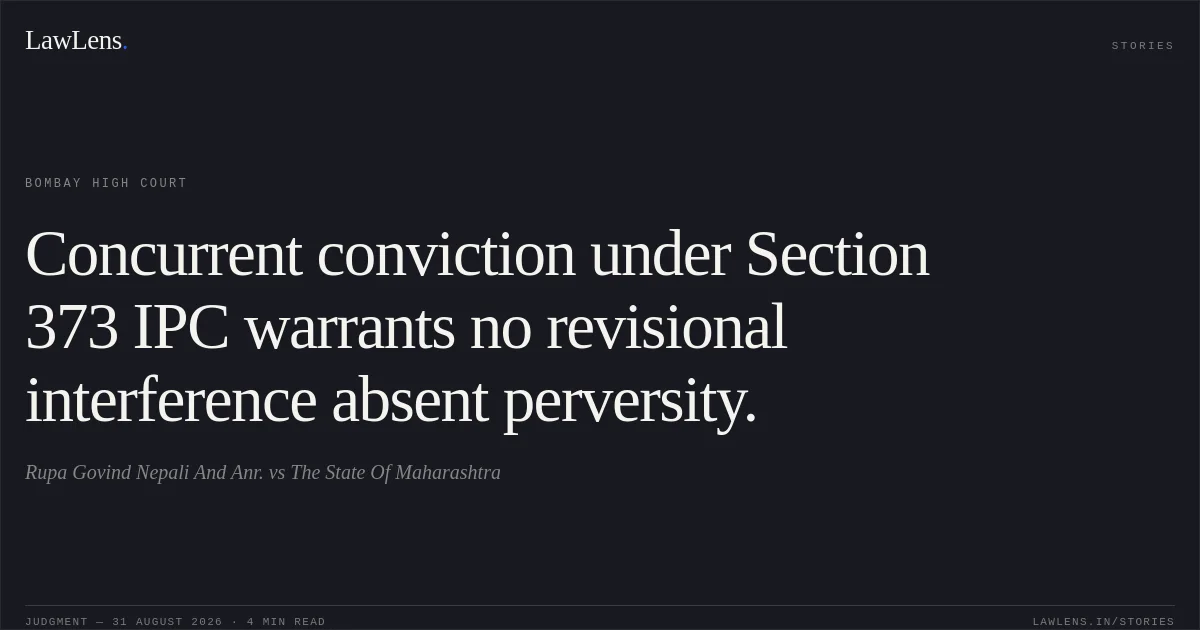
On 12 December 2003, acting on information that a brothel was being operated in Building No. 994, Budhwar Peth, Pune, the police conducted a raid and found Applicant No. 1 in Room No. 14-B and Applicant No. 2 in Room No. 11-B, where several girls were present and wooden compartments with beds had been arranged.
Source reference: p.2, paras. 2–3Some girls were medically assessed as minors, and the prosecution alleged that the Applicants compelled them to engage in prostitution, collected money from customers, and paid part of it to the girls.
Source reference: p.2, paras. 2–3The Applicants were charged under Sections 3, 4 and 5 of the Immoral Traffic (Prevention) Act, 1956 and Section 373 of the IPC.
Source reference: p.3, para. 5The Trial Court acquitted them under the PITA provisions but convicted them under Section 373 IPC and sentenced each to three years’ rigorous imprisonment and a fine of Rs. 500, with six months’ rigorous imprisonment in default.
Source reference: p.3, para. 5The Appellate Court confirmed the conviction and sentence.
Source reference: p.1, para. 1The Applicants thereafter invoked the High Court’s revisional jurisdiction under Sections 397 and 401 CrPC.
Source reference: p.1, para. 1Issues
Whether the concurrent conviction under Section 373 IPC was sustainable despite the hostile panch witness and alleged discrepancies concerning the raid and preparation of the panchnama.
Source reference: pp.3–4, 9–10, paras. 7, 23–27Whether the prosecution had proved that at least one victim was below eighteen years of age on the basis of clinical and radiological examination.
Source reference: pp.5–6, paras. 12–16Whether the absence of a female police officer during the raid or arrest vitiated the prosecution case.
Source reference: pp.7–8, paras. 19–21Whether the absence of photographs of the raid constituted a ground for interference in revision.
Source reference: p.8, para. 22Whether the concurrent findings of conviction and the sentence warranted interference in the limited revisional jurisdiction of the High Court.
Source reference: pp.4, 10–11, paras. 10, 28–30Law Applied
The Court applied Sections 397 and 401 CrPC, reiterating that revisional jurisdiction is limited and does not ordinarily permit re-appreciation of evidence or interference with concurrent factual findings absent perversity, relying on State of Kerala v. Puttumana Illath Jathavedan Namboodiri and State v. Manimaran, (2019) 13 SCC 670.
Source reference: p.4, para. 10Section 373 IPC criminalises buying, hiring or otherwise obtaining possession of a person under eighteen years with the intent that such person be employed or used for prostitution, illicit intercourse, or an unlawful and immoral purpose.
Source reference: p.6, para. 18The Court relied on Vinod Katara v. State of Uttar Pradesh, (2023) 15 SCC 210, for the principle that ossification testing is relevant but not conclusive and must be assessed with the medical evidence as a whole.
Source reference: pp.5–6, paras. 13–14On the presence of a female police officer, the Court applied State of Maharashtra v. Christian Community Welfare Council of India, (2003) 8 SCC 546, holding that the direction to make all efforts to keep a woman constable present was directory, not an inflexible statutory requirement, particularly where circumstances make such presence unavailable or impracticable.
Source reference: p.8, paras. 19–21Reasoning
The Court found that the evidence of the three victim witnesses consistently established that the Applicants compelled the girls to engage in prostitution, threatened or assaulted them upon refusal, collected money from customers, and retained or distributed part of it.
Source reference: p.6, para. 17The evidence of PW-7, a medico-legal expert, supported the conclusion that one victim was aged between thirteen and fifteen years on clinical and radiological examination; even allowing a two-year margin of error, she remained a minor.
Source reference: p.6, paras. 12–16This satisfied the minority and intent requirements of Section 373 IPC.
Source reference: p.6, para. 18The hostile panch witness did not render the prosecution case unreliable because PW-10, who prepared and signed the panchnama, proved it, while the police witnesses consistently testified regarding the raid, the rooms, the compartments and beds, and the presence of the Applicants and victims; the discrepancies concerning a female panch were minor and immaterial.
Source reference: pp.9–10, paras. 23–27The objections regarding the absence of a female police officer and photographs were either directory matters or contentions raised for the first time in revision, and therefore did not justify interference.
Source reference: p.8, paras. 20–22As no perversity was demonstrated in the concurrent findings, the revisional court declined to reassess the evidence.
Source reference: p.10, para. 28Holding
The High Court held that the prosecution had proved all essential ingredients of Section 373 IPC and that the conviction was supported by reliable victim, police and medical evidence.
The hostile panch witness, alleged discrepancies, absence of a female police officer, and non-photographing of the raid were insufficient to invalidate the conviction.
Source reference: pp.6, 8–10, paras. 18, 21–28Finding no perversity or legal infirmity and considering the sentence of three years’ rigorous imprisonment to be lenient in light of the maximum punishment of ten years, the Court rejected the revision application and upheld the conviction and sentence.
Source reference: p.10, paras. 28–30The Applicants’ bail bonds were cancelled, and they were granted four weeks to surrender before the concerned police station.
Source reference: p.11, para. 30Acts & Sections Cited
8 provisions across 3 statutes referred to in this judgment. Each provision opens on LawLens.
Code of Criminal Procedure, 19734
Indian Penal Code, 18601
Original Court PDF
Rupa Govind Nepali And Anr.vsThe State Of Maharashtra
Click to open original judgment
Original judgment, available to read, download and summarize on LawLens.in