Facts
The plaintiff and her mother were recorded owners of agricultural land bearing Survey No. 388/2, Block No. 459, admeasuring 3,440 sq. metres, at Village Khanpur, Taluka Dehgam, District Gandhinagar. They executed a registered sale deed in favour of the defendant on 27 June 1986, following which the defendant took possession and his name was mutated in the revenue records. The plaintiff raised no objection to the mutation until filing the suit in 2002.
Source reference: paras. 5.1–5.3, pp. 2–3The plaintiff instituted Regular Civil Suit No. 161 of 2002, alleging that the sale deed was fraudulently obtained, did not bear her signature or thumb impression, and was executed without payment of consideration. She also sought a permanent injunction concerning possession.
Source reference: para. 5.2, pp. 2–3The Trial Court dismissed the suit on the grounds that fraud and possession were not proved and that the claim was barred by limitation.
Source reference: para. 5.4, p. 4The Principal District Judge, Gandhinagar, dismissed Regular Civil Appeal No. 54 of 2019 and affirmed the Trial Court’s findings on 16 April 2026.
Source reference: para. 5.5, p. 4The plaintiff thereafter filed the present second appeal under Section 100 of the Code of Civil Procedure, 1908, challenging the concurrent findings of fact.
Source reference: paras. 2, 5.6, pp. 2, 4Issues
Whether the plaintiff proved that the registered sale deed dated 27 June 1986 was obtained by fraud or was not executed by her and her mother?
Source reference: paras. 5.2, 6.1–6.4, 8–11, pp. 2–3, 5–10Whether the discrepancy in the survey number mentioned in the sale deed invalidated the transfer of the suit property?
Source reference: paras. 6.3, 8, pp. 6–7Whether the plaintiff’s suit seeking declaration or cancellation of the registered sale deed was barred by limitation under Article 59 of the Limitation Act, 1963?
Source reference: paras. 6.5, 13–14, pp. 6, 10–12Whether the concurrent findings of the Trial Court and First Appellate Court disclosed a substantial question of law warranting interference under Section 100 CPC?
Source reference: paras. 5.6, 8, 11, 15–17, pp. 4, 7–9, 12–13Law Applied
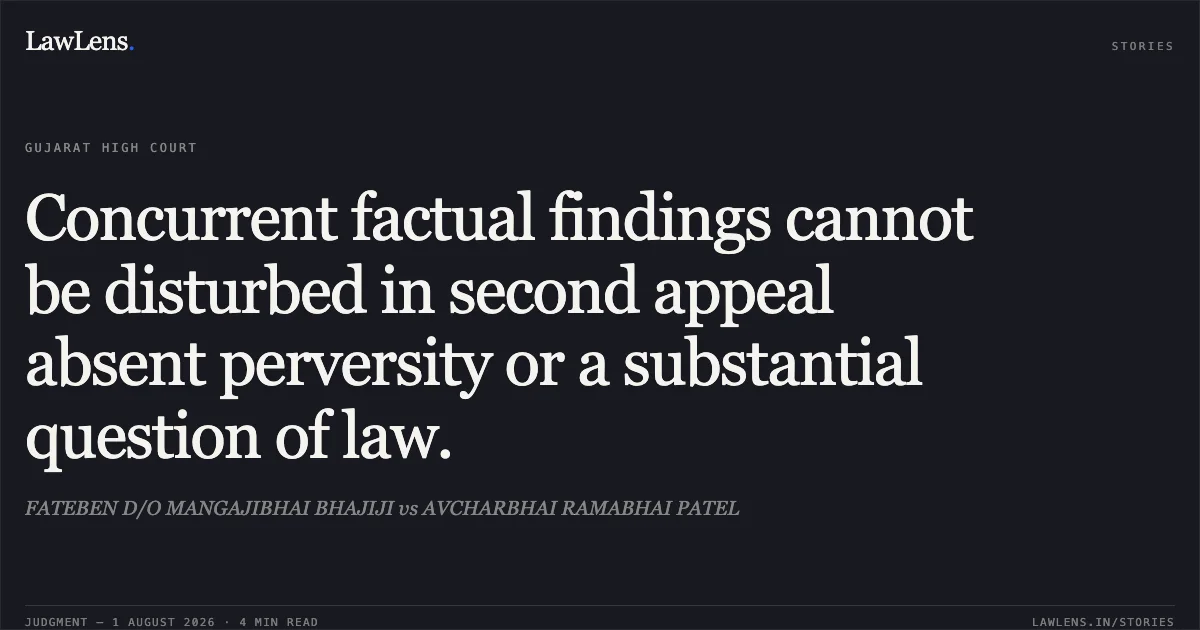
The Court applied Section 100 of the Code of Civil Procedure, 1908, under which a second appeal lies only on a substantial question of law and does not ordinarily permit reappreciation of concurrent findings of fact.
Source reference: paras. 2, 15–17, pp. 2, 12–13It relied on Section 114 of the Evidence Act to recognise the presumption that a registered document has been regularly and validly executed unless rebutted by cogent evidence.
Source reference: para. 10, p. 9Article 59 of the Limitation Act, 1963, was applied to hold that a suit seeking cancellation or declaration against a prima facie valid instrument must be filed within three years from the relevant date, including the date when the facts entitling cancellation become known; the Court held that an executant of a registered document could not ordinarily plead ignorance of its execution.
Source reference: paras. 13–14, pp. 10–12The Court also relied on Madhabhai Dahyabhai Mithapara v. Jivabhai Tapubhai Jadav, Second Appeal No. 256 of 2018, decided on 12 September 2018, and Russi Fisheries (P) Ltd. v. Bhavna Seth, 2026 SCC OnLine SC 555, for the principles governing Article 59 and the limited scope of interference with findings of fact in second appeal.
Source reference: paras. 14, 16, pp. 10–13Reasoning
The Court held that the plaintiff failed to rebut the evidentiary presumption attaching to the registered sale deed. Her two supporting witnesses were not present when the deed was executed; one admitted that he was unaware of its contents, and the other merely supported the plaintiff’s claim of possession as a family member. The plaintiff also failed to produce handwriting or thumb-impression expert evidence to establish that the signatures or impressions on the deed were not hers or her mother’s.
Source reference: paras. 9–11, pp. 8–10The long silence from 1986 until 2002, together with the defendant’s mutation in the revenue records and the absence of any objection to that mutation, further weakened the allegation of fraud.
Source reference: para. 12, p. 10The incorrect reference to Survey No. 384/2 did not invalidate the sale because the deed correctly mentioned Block No. 459, which corresponded to Survey No. 388/2, and also contained correct boundaries identifying the property.
Source reference: para. 8, p. 7Since the plaintiff was an executant of the registered sale deed, the Court held that any challenge to its validity ought to have been brought within three years. The suit filed in 2002, approximately sixteen years after registration, was therefore time-barred under Article 59.
Source reference: paras. 13–14, pp. 10–12The findings of both lower courts were based on the evidence and were neither perverse nor contrary to law; consequently, no substantial question of law arose for consideration under Section 100 CPC.
Source reference: paras. 15–17, pp. 12–13Holding
The Gujarat High Court dismissed the second appeal, holding that the plaintiff had failed to prove fraud, non-execution of the sale deed, or continued possession; the survey-number discrepancy was immaterial; and the suit was barred by limitation under Article 59 of the Limitation Act.
The concurrent judgments dismissing Regular Civil Suit No. 161 of 2002 and Regular Civil Appeal No. 54 of 2019 were therefore affirmed. The appellant was directed to deposit costs of Rs. 25,000 with the District Legal Services Authority, Gandhinagar, within eight weeks, for utilisation in assisting needy litigants. The connected Civil Application was also rejected.
Source reference: paras. 20–23, pp. 14–15Acts & Sections Cited
2 provisions across 2 statutes referred to in this judgment. Each provision opens on LawLens.
Code of Civil Procedure, 19081
Limitation Act, 19631
Original Court PDF
FATEBEN D/O MANGAJIBHAI BHAJIJIvsAVCHARBHAI RAMABHAI PATEL
Click to open original judgment
Original judgment, available to read, download and summarize on LawLens.in