01Facts
The assessee purchased L-1, Ground Floor, L Block, Connaught Place, New Delhi for ₹1,53,00,000 on 22.01.2016.
¶ 3The ITAT remanded the valuation issue to the AO because the DVO valued the property as of 18.12.2018 rather than the purchase date. The assessee did not appeal that part of the order.
¶ 4–5The second issue concerned a ₹2,00,00,000 unsecured loan allegedly received from her brother, Mr. Rakesh Anand, to fund the purchase.
¶ 6The assessee produced a loan confirmation, the brother's statement, and a bank certificate.
¶ 8The AO found that the brother's ITR showed salary and other income of about ₹4.77 lakh, and his bank balances were minimal. The AO also found that the funds originated from Tek Chand HUF, that no confirmation or bank statement from the HUF was produced, and that the assessee was the ultimate beneficiary. The AO added ₹2,00,00,000 under Section 68.
¶ 10–12The CIT(A) dismissed the appeal on 19.08.2025, holding that an uncorroborated relative's confirmation was insufficient and that the brother lacked creditworthiness.
¶ 13–14The ITAT upheld the addition, relying on CIT v. Bitwala Industries Ltd., AIR 1973 SC 284.
¶ 15At the hearing the appellant did not appear; the respondent was represented by senior standing counsel.
02Issues
i.1. Whether a substantial question of law arises under Section 260A of the IT Act regarding the concurrent findings sustaining the ₹2,00,00,000 Section 68 addition on the unsecured loan from the brother.
¶ 18 · ¶ 19ii.2. Whether the ITAT's findings are perverse so as to warrant interference, given the assessee's contention that she discharged her Section 68 onus by proving the creditor's identity, the genuineness of the transaction through banking channels, and that she was not required to prove the source of the source.
¶ 16 · ¶ 1803Law Applied
Section 260A of the IT Act, under which an appeal lies to the High Court only on a substantial question of law. It cannot be used to re-appreciate evidence or to interfere with factual findings absent an explanation of how those findings are perverse.
¶ 18 · ¶ 19Under Section 68, the assessee contended that she must prove the creditor's identity, creditworthiness, and genuineness, and need not prove the source of the source.
¶ 16The ITAT, relying on CIT v. Bitwala Industries Ltd., held that the burden must be discharged with unequivocal supporting material rather than mere assertion, and that a relative's confirmation without independent verification is insufficient.
¶ 15Provisions in the judgment · 2
Income Tax Act, 1961 Section 260ASection 68
04Reasoning
The AO, CIT(A), and ITAT each examined the loan confirmation, the brother's ITR and bank statements, and the absence of HUF-level documentation, and each concluded that the loan was unexplained.
¶ 9–15, 18The assessee's grounds challenged the factual evaluation of creditworthiness and genuineness rather than identifying a question of law. The court found no explanation of perversity in the findings.
¶ 18Because the factual conclusions rested on three concurrent authorities and no legal error was identified, no substantial question of law arose, and any further examination would require re-appreciation of evidence.
¶ 19The court did not address whether the source-of-source requirement is legally correct, because the appellant's contention was not reached as a question of law.
05Holding
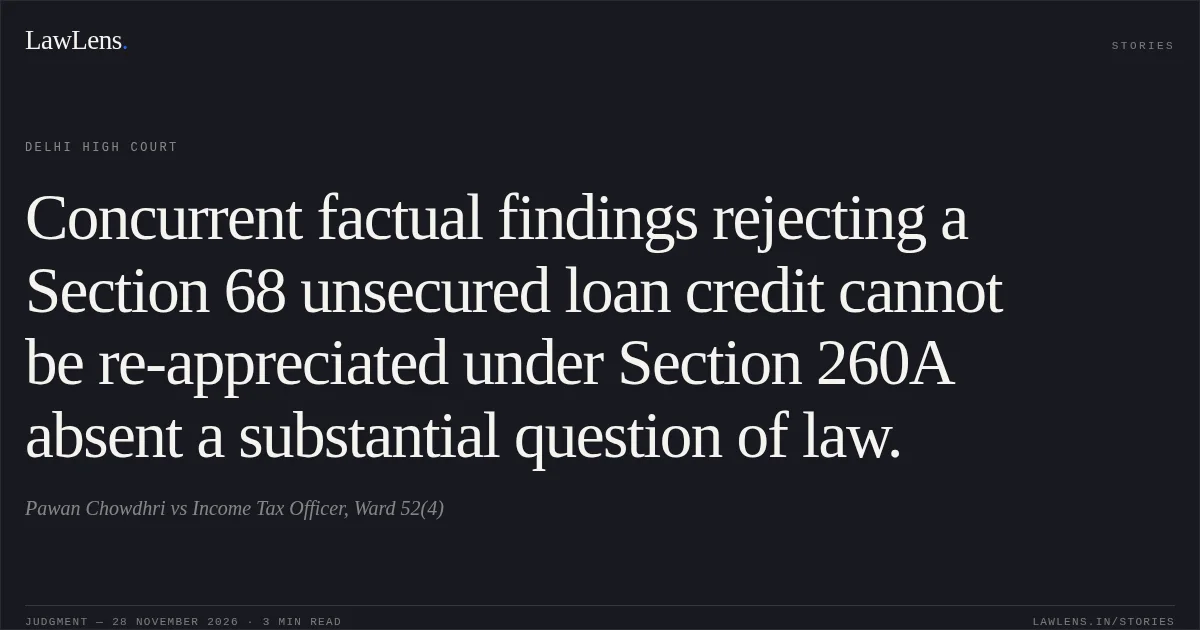
No substantial question of law arises for consideration under Section 260A, and the appeal seeks re-appreciation of evidence that is impermissible at this stage.
¶ 18–19The appeal is dismissed, along with any pending applications. The ₹2,00,00,000 Section 68 addition, as confirmed by the ITAT, stands.
¶ 20The Section 68 legal propositions (identity, creditworthiness, genuineness, and source-of-source) were not authoritatively settled by this judgment.
Original Court PDF
Pawan ChowdhrivsIncome Tax Officer, Ward 52(4)
Click to open original judgment
Original judgment, available to read, download and summarize on LawLens.in