01Facts
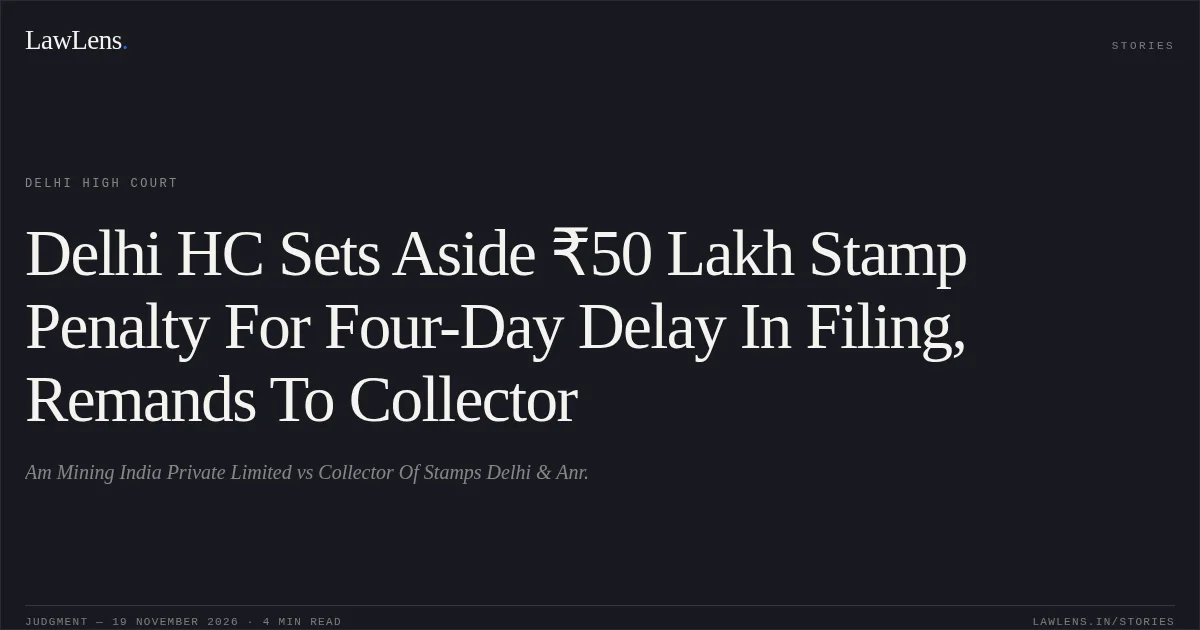
The petitioner passed a board resolution on 03.05.2023 to issue 21,22,00,000 Class A CCPS of ₹10 face value at a premium of ₹32.40 per share, aggregating ₹899.72 crore, in favour of ArcelorMittal Nippon Steel India Ltd. It filed Form PAS-3 on 04.05.2023 and, on its own initiative, applied on 05.06.2023 to the Collector of Stamps, Delhi (Respondent No. 1), under Sections 31(1) and 32(3)(a) of the Indian Stamp Act, 1899 ("Stamp Act") for adjudication.
The application was four days late.
¶ 2Respondent No. 1 passed an order dated 17.03.2026 imposing a ₹50,00,000 penalty under Section 40(1)(b), citing the four-day delay and time value of money.
¶ 3This Court set that order aside in W.P.(C) 4172/2026 on 01.04.2026, granting a fresh hearing on condition that the admitted principal duty of ₹89,97,218 be deposited within 15 days. The petitioner deposited the amount on 23.04.2026.
¶ 4On remand, Respondent No. 1 passed the impugned order dated 02.07.2026, again imposing a ₹50,00,000 penalty, on grounds of delay, time value of money, Government revenue involved, and continued default.
¶ 5–6The impugned order also determined the principal duty at ₹89,97,280 and directed payment of ₹1,39,97,280 in total, without crediting the amount already deposited.
¶ 6Respondents objected to territorial jurisdiction on the ground that the registered office is in Surat and the share issuance occurred in Gujarat.
¶ 802Issues
i.1. Whether this Court has territorial jurisdiction under Article 226(2) of the Constitution to entertain the writ petition, where the registered office and share issuance are in Gujarat but the adjudication and impugned order were made in Delhi.
¶ 12, 13–16ii.2. Whether the penalty of ₹50,00,000 imposed under Section 40(1)(b) of the Stamp Act by the impugned order dated 02.07.2026 is sustainable in law.
¶ 12, 17–3103Law Applied
Article 226(1) and (2) of the Constitution, under which a High Court may act where the cause of action arises wholly or in part within its territory. "Cause of action" comprises material facts with a nexus to the challenge, as explained in State of Goa v. Summit Online Trade Solutions (2023), Alchemist Ltd. v. State Bank of Sikkim (2007), and ONGC v. Utpal Kumar Basu (1994).
¶ 13Section 40(1)(b) of the Stamp Act empowers the Collector, where an instrument is chargeable and not duly stamped, to require the proper duty plus a penalty of five rupees or, "if he thinks fit," up to ten times the deficient duty.
¶ 17–18The quantum of penalty is discretionary, to be exercised judiciously, and the ten-times figure is only an outer limit (Chilakuri Gangulappa v. RDO, 2001).
¶ 19Penalty is not automatic and is generally deterrent, not punitive (Trustees of H.C. Dhanda Trust v. State of M.P., 2020).
¶ 20A penalty is not imposed merely because it is lawful; it requires deliberate defiance, contumacious or dishonest conduct, or conscious disregard of obligation (Hindustan Steel Ltd. v. State of Orissa, 1969).
¶ 21The discretion must be exercised reasonably and in proportion to the default (Galwalia Ispat Udyog Pvt. Ltd. v. Govt. of NCT of Delhi, W.P.(C) 4852/2024).
¶ 22The Guidelines dated 31.01.2024 prescribe a penalty of 16% per annum for voluntary submissions, and departures require recorded reasons (Kranti Associates v. Masood Ahmed Khan, 2010).
¶ 27Provisions in the judgment · 5 · Linked ones open on LawLens
Indian Stamp Act, 1899 Section 31Section 32Section 33Section 38Section 40
04Reasoning
On jurisdiction, the challenge concerns only the legality of the penalty. The material facts (filing, hearings, and both orders) all occurred in Delhi, and the impugned order arose from this Court's remand in the same proceedings.
¶ 14–15The Surat registered office and Gujarat share issuance were merely background facts that gave rise to the duty liability and had no bearing on the penalty. The preliminary objection was therefore rejected.
¶ 15, 16On the merits, the petitioner voluntarily approached the authority four days late, and nothing showed evasion, fraud, or dishonesty.
¶ 23The impugned order did not specify the period of "continued default," and the pendency of proceedings before the authority itself could not be attributed to the petitioner.
¶ 24, 26The order also failed to explain why the ₹50,00,000 quantum was warranted, merely adding factors to the earlier reasoning that had already been set aside.
¶ 25Reliance on time value of money could not justify the penalty, since the delay in adjudication was not the petitioner's conduct.
¶ 26The order ignored the Guidelines' 16% per annum framework without recording reasons for departure and failed to consider the principal duty deposited on 23.04.2026. The discretion was therefore not properly exercised.
¶ 27, 28, 2905Holding
The Delhi High Court has territorial jurisdiction, as the adjudication, hearings, and impugned order occurred in Delhi and the challenge arises from the remand in the same proceedings.
¶ 15–16The penalty of ₹50,00,000 under Section 40(1)(b) was not properly exercised and is not sustainable on the record. The Court declined to fix the quantum itself, since that power vests in the Collector.
¶ 29–30The impugned order is set aside insofar as it imposes the penalty and the matter is remanded to Respondent No. 1. Respondent No. 1 must, within two months of receiving the order and after hearing the petitioner, pass a fresh reasoned order. The order must consider the voluntary approach, four-day delay, pendency period, subsequent deposit, and the Guidelines dated 31.01.2024. Any penalty must be supported by reasons for its quantum.
¶ 30, 31Respondent No. 1 must give due credit for the ₹89,97,218 deposited on 23.04.2026 against any principal duty payable. The petition is disposed of in these terms.
¶ 32, 33Original Court PDF
Am Mining India Private LimitedvsCollector Of Stamps Delhi & Anr.
Click to open original judgment
Original judgment, available to read, download and summarize on LawLens.in