01Facts
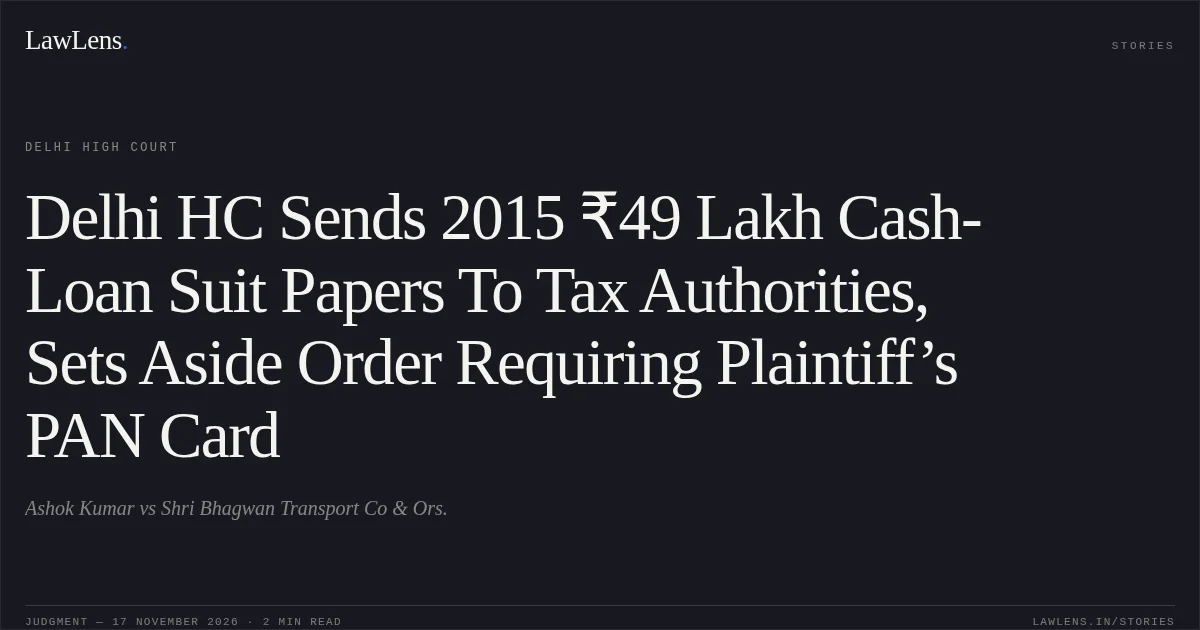
The plaintiff filed a recovery suit alleging that he had advanced a total of ₹49 lakh in cash to the defendants as loans on different dates up to September 2015; the suit sought recovery of ₹35.67 lakh.
pp. 1–2, 4During final arguments, the Trial Court directed the plaintiff to provide his PAN card, and later declined to recall that direction.
p. 1, 10The plaintiff challenged those orders, contending that the Supreme Court’s directions in RBANMS Educational Institution v. B. Gunashekar concerned Section 269ST of the Income Tax Act, 1961, which was introduced in 2017, and therefore did not apply to the earlier transactions.
pp. 1–2, 802Issues
i.1. Whether the alleged cash loan transactions made before Section 269ST was introduced should be reported to the jurisdictional Income Tax authorities under the principles in RBANMS Educational Institution.
pp. 2–4, 8–10ii.2. Whether the Trial Court could require the plaintiff to disclose his PAN card in connection with that reporting.
pp. 10–1103Law Applied
Section 269SS of the Income Tax Act, in force from 1984, restricts taking or accepting loans or deposits of ₹20,000 or more except through specified non-cash modes; Section 269ST, introduced in 2017, restricts receipt of ₹2 lakh or more in specified transactions, but excludes transactions governed by Section 269SS.
pp. 4–7In Assistant Director of Inspection (Investigation) v. A.B. Shanthi, (2002) 6 SCC 259, the Supreme Court upheld Section 269SS and identified its purpose as curbing unaccounted money and false explanations for it.
pp. 7–8The Court read RBANMS Educational Institution v. B. Gunashekar, 2025 INSC 490, as supporting the reporting of substantial cash transactions to tax authorities to address unaccounted or black money, including transactions predating Section 269ST.
pp. 2–4, 9–10The right to privacy recognised in Justice K.S. Puttaswamy (Retd.) v. Union of India, (2017) 10 SCC 1, weighs against compelling disclosure of identifying information without an applicable direction or legal basis.
p. 11Provisions in the judgment · 2 · Linked ones open on LawLens
Companies Act, 2013 Section 2
Banking Regulation Act, 1949 Section 51
04Reasoning
Although the alleged payments preceded Section 269ST, the Court considered that the plaintiff characterised them as loans and that Section 269SS already governed cash loans above the prescribed threshold.
pp. 8–10Consistent with the purpose of the Supreme Court’s directions and decisions concerning earlier cash transactions, the Court held that the suit materials should be sent to the tax authorities for their information and appropriate action; that reporting would not determine whether the plaintiff could prove the loan or recover it.
pp. 9–10, 12However, neither RBANMS Educational Institution nor the cited authorities required disclosure of the plaintiff’s PAN. Given the identifying information contained in a PAN card and the privacy interest involved, the Court found no basis to compel its production.
pp. 10–1105Holding
The petition was partly allowed. The direction requiring the plaintiff to disclose his PAN card was set aside, but a copy of the suit and relevant documents was directed to be sent to the jurisdictional tax authority/Principal Commissioner of Income Tax, Delhi.
p. 12The Court expressed no opinion on the merits of the recovery suit, which was to proceed and be decided independently.
p. 12Original Court PDF
Ashok KumarvsShri Bhagwan Transport Co & Ors.
Click to open original judgment
Original judgment, available to read, download and summarize on LawLens.in