01Facts
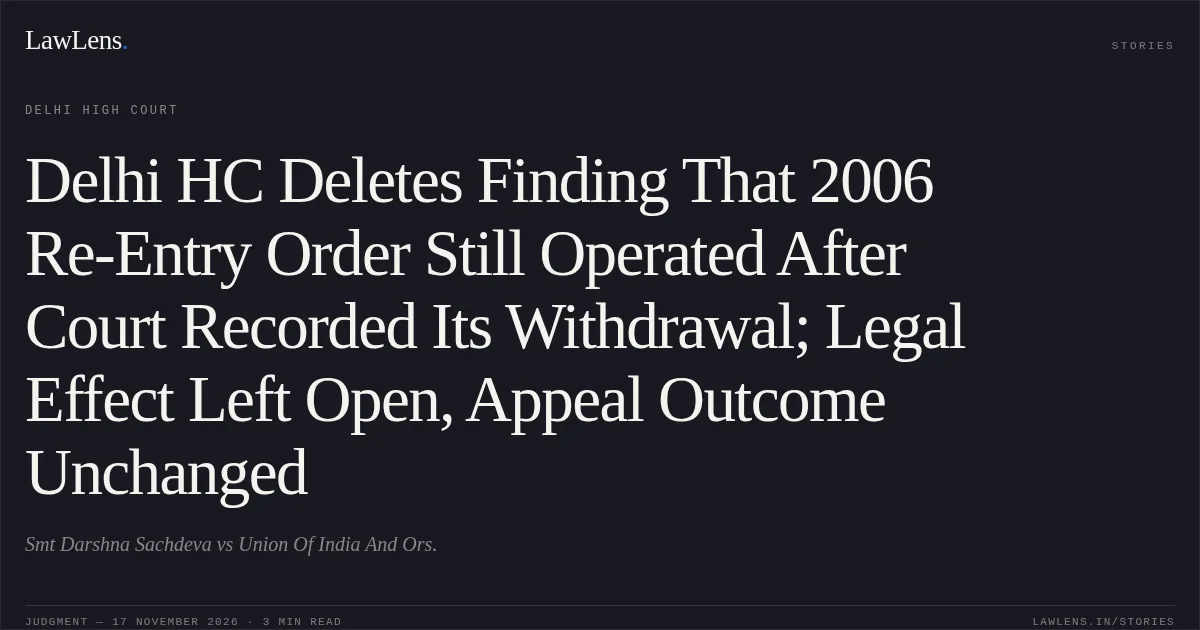
The Review Petitioners, who had instituted W.P.(C) 7452/2019, sought review of the common judgment dated 22 May 2026 allowing connected Letters Patent Appeals and setting aside orders made in that writ petition and subsequent proceedings.
¶ 1–2The principal review ground was that the appellate judgment treated the L&DO’s order dated 6 February 2006 cancelling the lease and ordering re-entry as subsisting, without considering this Court’s order dated 3 March 2006 in W.P.(C) 3182/2006, which recorded that the re-entry order stood withdrawn.
¶ 2–3, 10–14The Petitioners also challenged findings concerning the partition decree, subdivision of the leasehold property, misuse charges, maintainability of LPA 596/2023, estoppel, and the scope of relief granted.
¶ 402Issues
i.Whether failure to consider the 3 March 2006 order, which recorded withdrawal of the re-entry order, was an error apparent warranting review of the judgment dated 22 May 2026.
¶ 10–18ii.Whether the remaining grounds—including those concerning the partition decree, subdivision, misuse charges, maintainability, estoppel and relief—established an error apparent or otherwise warranted review.
¶ 20–3803Law Applied
Review is not an appellate rehearing; an error apparent must be self-evident and not require an elaborate process of reasoning.
¶ 5–8The Court relied on Parsion Devi v. Sumitri Devi, (1997) 8 SCC 715; Lily Thomas v. Union of India, (2000) 6 SCC 224; Kamlesh Verma v. Mayawati, (2013) 8 SCC 320; and High Court of Tripura through Registrar General v. Tirtha Sarathi Mukherjee, (2019) 16 SCC 663, for the limits of review jurisdiction.
¶ 5–8In assessing the underlying issues, the Court also applied Sections 2 and 3 of the Government Grants Act, 1895, under which the terms of a government grant govern according to their tenor; the lease and Clause 4.4.3 of the Master Plan for Delhi, 2021, concerning subdivision; and the principle that Article 226 is not ordinarily a forum for determining fact-intensive private disputes between co-lessees.
revised judgment · ¶ 30–34, 45–56Provisions in the judgment · 2
Government Grants Act, 1895 Section 2Section 3
04Reasoning
The order of 3 March 2006 expressly stated that the “Re-entry Order stands withdrawn.” Because the judgment under review had proceeded on the contrary premise—that the 6 February 2006 order remained unchallenged and operative—omitting the subsequent order was a material error affecting the relevant findings.
review order · ¶ 13–18The Court therefore removed those findings but left open the scope, binding effect and legal consequences of the 3 March order, including its effect on the lease cancellation.
¶ 16–19, 39–40The other grounds sought reconsideration of matters already decided or required further reasoning and did not disclose an apparent error.
¶ 20–31The Court maintained the conclusion that a private partition decree could not compel the lessor to recognise separate leasehold estates, and that inter se liability for misuse charges was not to be conclusively determined in writ proceedings.
¶ 20–31 · revised judgment · ¶ 35–42, 48–5605Holding
The review petitions were partly allowed.
The findings in the original judgment concerning the continued subsistence and finality of the 6 February 2006 re-entry order were deleted, as were specified consequential observations; the legal effect and reach of the 3 March 2006 order were left open for determination by an appropriate forum.
review order · ¶ 39–43The remaining findings were left undisturbed, and the ultimate result of the Letters Patent Appeals remained unchanged.
¶ 41–43The modified judgment was annexed to and made part of the review order.
¶ 42Original Court PDF
Smt Darshna SachdevavsUnion Of India And Ors.
Click to open original judgment
Original judgment, available to read, download and summarize on LawLens.in