01Facts
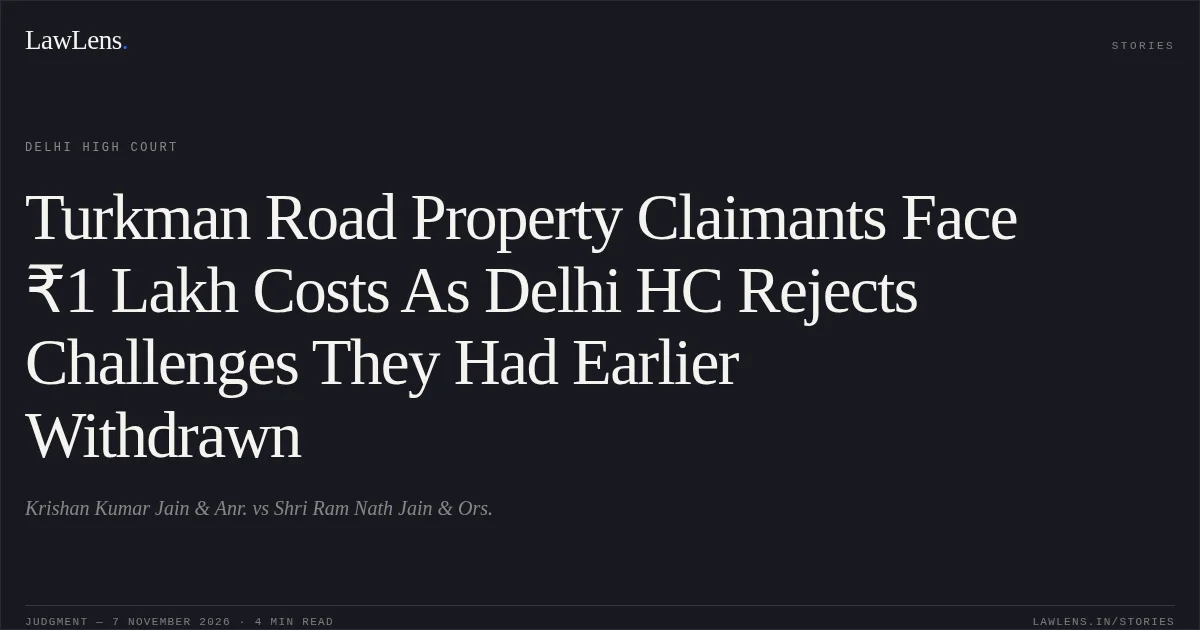
The Petitioners claimed rights in premises at 83-D/7, Turkman Road, as legal heirs of Jai Kumar Jain. They sought impleadment in an appeal under Section 9 of the Public Premises (Eviction of Unauthorised Occupants) Act, 1971 (“PP Act”); the Appellate Court rejected their application on 30 May 2024.
¶ 16–25, 69 · pp. 5–8, 29–30The Petitioners challenged that order under Article 227, but withdrew the challenge on 21 January 2026 with liberty to apply in proceedings challenging the eventual appellate judgment. They later withdrew both their impleadment application in that writ proceeding and their own challenge to the appellate judgment, on 24 July 2026, with liberty to pursue remedies available in law.
¶ 16–25, 69 · pp. 5–8, 29–30They then filed the present Article 227 petition challenging both orders and seeking, among other reliefs, restoration of possession and compensation.
¶ 16–25, 69 · pp. 5–8, 29–30The Petitioners also alleged that no valid Section 4 show-cause notice had been served on them.
¶ 2–5, 5702Issues
i.1. Whether the Petitioners could maintain a fresh challenge to the impleadment order after withdrawing their earlier challenge and the subsequent impleadment application.
¶ 26, 34–38ii.2. Whether the Petitioners could maintain a fresh challenge to the appellate judgment after withdrawing their earlier challenge to it.
¶ 26, 39–49iii.3. Whether the Petitioners were entitled to be impleaded in the Section 9 PP Act appeal, and whether they could challenge the appellate judgment despite not being parties to that appeal.
¶ 51–65iv.4. Whether the Petitioners’ allegation of non-service of a Section 4 notice warranted interference.
¶ 57–6003Law Applied
Order XXIII Rule 1(4) CPC precludes a fresh suit on the same subject matter following withdrawal without the Court’s permission; the Supreme Court has extended the underlying public-policy principle to writ proceedings, barring a fresh challenge on the same cause after withdrawal without liberty to institute afresh (*Sarguja Transport Service v. State Transport Appellate Tribunal*, (1987) 1 SCC 5; *Upadhyay & Co. v. State of U.P.*, (1999) 1 SCC 81; *Satheesh V.K. v. Federal Bank Ltd.*, 2025 SCC OnLine SC 2046).
¶ 27–32Under Order I Rule 10(2) CPC, a person may be added where necessary for effective adjudication, but an independent claim to the subject property does not alone make that person necessary or proper; impleadment may be declined if it would introduce collateral disputes or widen the proceeding (*Kasturi v. Iyyamperumal*, (2005) 6 SCC 733; *Mumbai International Airport (P) Ltd. v. Regency Convention Centre and Hotels (P) Ltd.*, (2010) 7 SCC 417).
¶ 51–55A Section 9 PP Act appeal concerns the legality of the eviction order against the persons proceeded against.
¶ 51, 52Article 227 is supervisory, not appellate, and permits intervention for jurisdictional error, perversity or comparable grave error, not merely because another view is possible (*Garment Craft v. Prakash Chand Goel*, (2022) 4 SCC 181).
¶ 59Courts may impose realistic or exemplary costs to deter abuse of process (*Dnyandeo Sabaji Naik v. Pradnya Prakash Khadekar*, (2017) 5 SCC 496).
¶ 68–71Provisions in the judgment · 4 · Linked ones open on LawLens
Code of Civil Procedure, 1908 Section 151
Public Premises (Eviction of Unauthorised Occupants) Act, 1971 Section 9Section 4Section 5
04Reasoning
The Petitioners had withdrawn their earlier Article 227 challenge to the impleadment order without permission to bring a fresh challenge; the later liberty to pursue remedies available in law did not revive an otherwise abandoned remedy.
¶ 34–49Likewise, they withdrew their challenge to the appellate judgment after submissions had been made, without liberty to institute a fresh petition. Recasting the present challenge under Article 227 did not alter its substance or avoid the bar arising from those withdrawals.
¶ 34–49On the merits of impleadment, the Section 9 appeal concerned whether the persons proceeded against were liable to eviction. The Petitioners’ asserted succession, title or possession claims were collateral to that issue and could not be adjudicated in that appeal; the Appellate Court therefore did not err in finding them neither necessary nor proper parties.
¶ 52–56The Petitioners’ notice argument did not assist them: they were not treated as occupants in the eviction proceedings, and they had not raised non-service in their impleadment application. The Court found no jurisdictional error or other basis for Article 227 intervention.
¶ 57–60It also considered the repeated proceedings and withdrawals an abuse of process warranting costs.
¶ 66–7105Holding
The Court held that the challenge to the impleadment order was not maintainable because it had been abandoned and, in any event, failed on the merits. The challenge to the appellate judgment was barred by the Petitioners’ earlier withdrawal and was also not maintainable because they were not parties to the PP Act appeal; the petition was dismissed.
¶ 72The Petitioners were directed to pay ₹1,00,000 in costs to the Delhi High Court Legal Services Committee within three weeks and file proof of deposit.
¶ 73The Court clarified that it expressed no opinion on the Petitioners’ asserted rights in the premises, which they could pursue if otherwise permissible under law.
¶ 74Original Court PDF
Krishan Kumar Jain & Anr.vsShri Ram Nath Jain & Ors.
Click to open original judgment
Original judgment, available to read, download and summarize on LawLens.in