01Facts
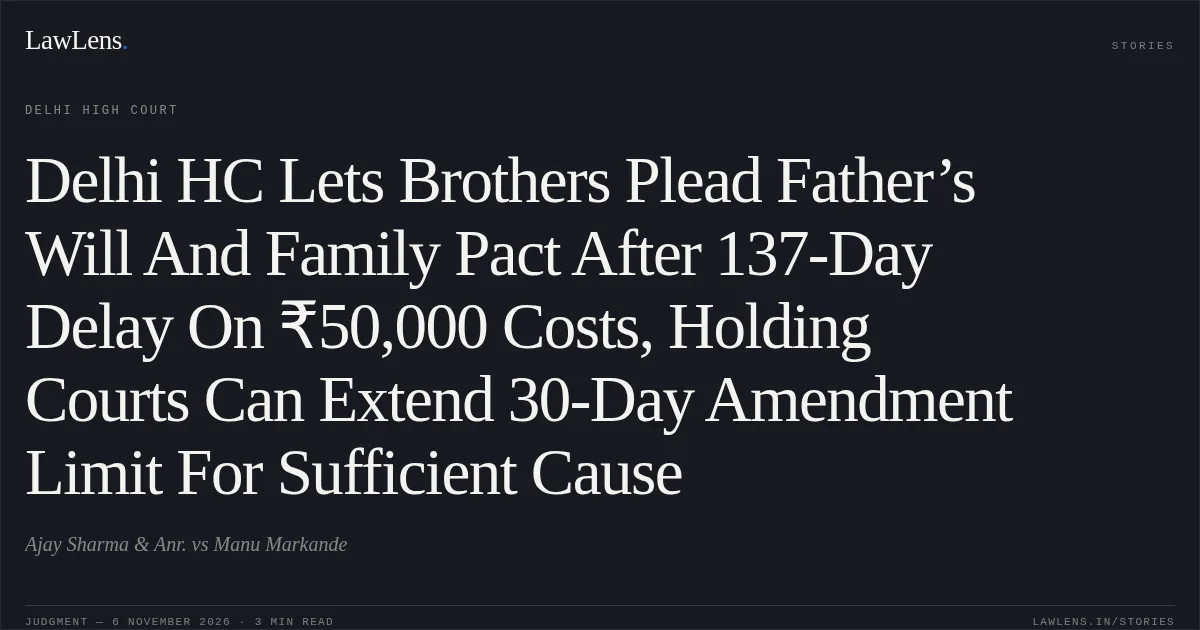
The appellants, respondents in a testamentary case, were granted leave on 14 January 2016 to amend their written statement, with six weeks to do so and subject to costs. The period expired on 25 February 2016. They applied for an extension on 2 June 2016 and filed the amended written statement on 11 July 2016.
pp. 3–10 · ¶ 3–6The learned Single Judge held that the Court had power to extend time beyond thirty days under Order VI Rule 18 CPC, but refused relief, finding the delay insufficiently explained. The appellants appealed.
pp. 3–10 · ¶ 3–6The proposed amendments concerned, among other matters, a family agreement and a Will relating to the estate in dispute.
pp. 3–10 · ¶ 3–602Issues
i.1. Whether the Court may extend the time for filing amended pleadings beyond thirty days after the period fixed in the order granting leave to amend.
p. 18 · ¶ 27(i)ii.2. Whether the learned Single Judge was justified in refusing an extension, and whether that refusal warranted appellate interference.
p. 18 · ¶ 27(ii)iii.3. Whether the respondent’s remaining objections—including objections concerning the pleadings and alleged lack of evidence supporting the defences—barred relief.
p. 18 · ¶ 27(iii)iv.4. If relief were granted, what limits and conditions should apply to the amended written statement.
p. 18, 29 · ¶ 27(iv), 52–5303Law Applied
Order VI Rule 18 CPC permits the Court to extend the time for carrying out an amendment; Section 148 CPC’s thirty-day limit does not extinguish that power, read with the Court’s inherent powers under Section 151 CPC. The power must be exercised on sufficient cause and not routinely.
pp. 19–20 · ¶ 28–33Salem Advocate Bar Association v. Union of India, (2005) 6 SCC 344, recognises that Section 148’s ceiling does not take away inherent power to extend time where the act could not be performed within the period for reasons beyond the party’s control; Kailash v. Nanhku, (2005) 4 SCC 480, holds that procedural time limits do not necessarily bar extension.
pp. 19–20 · ¶ 28–33The Court also relied on the principles that procedure should facilitate, not obstruct, justice and that an appellate court may interfere with discretionary orders where material evidence or relevant considerations have been overlooked.
p. 26 · ¶ 45–46Provisions in the judgment · 6 · Linked ones open on LawLens
Delhi High Court Act, 1966 Section 10
Code of Civil Procedure, 1908 Section 148Section 151
Indian Succession Act, 1925 Section 270Section 278Section 300
04Reasoning
The Court found that the Single Judge’s conclusion that the travel explanation was unsupported contradicted material on record: the copying-agency receipt, passport, arrival stamp and medical certificate supported the appellant’s presence in Delhi, subsequent travel to Canada, return on 3 March 2016, and illness until 15 March 2016.
pp. 20–27 · ¶ 34–46The inconsistent departure dates were attributable to a later passport stamp and did not establish deliberate deception. The Court also considered counsel’s absence and illness, the parties’ conduct while cross-appeals concerning the amendment order were pending, and the respondent’s own refusal to accept costs and substantial delay in replying to the extension application.
pp. 20–27 · ¶ 34–46Weighing these circumstances against the prejudice claimed, the Court held that the delay was not contumacious or grossly negligent, that refusal would foreclose a material defence, and that any prejudice could be compensated by costs.
pp. 20–27 · ¶ 34–46The Court left the status of other respondents’ pleadings open and held that the truth of the proposed defences was a matter for trial, not the extension application.
pp. 27–29 · ¶ 47–5105Holding
The Court held that it had power to extend the filing period beyond thirty days on sufficient cause and that the Single Judge erred in refusing to exercise that power in the circumstances.
pp. 19–20 · ¶ 28–31It allowed the appeal and directed that the amended written statement be confined strictly to the amendments permitted by the order of 14 January 2016, as affirmed on 1 November 2018.
pp. 29–30 · ¶ 53–56The appellants were ordered to pay ₹25,000 each to the respondent within four weeks, in addition to the earlier ₹25,000 costs if unpaid; payment was made a condition precedent to the amended written statement being taken on record. The appeal and pending applications were disposed of accordingly.
pp. 29–30 · ¶ 53–56Original Court PDF
Ajay Sharma & Anr.vsManu Markande
Click to open original judgment
Original judgment, available to read, download and summarize on LawLens.in