01Facts
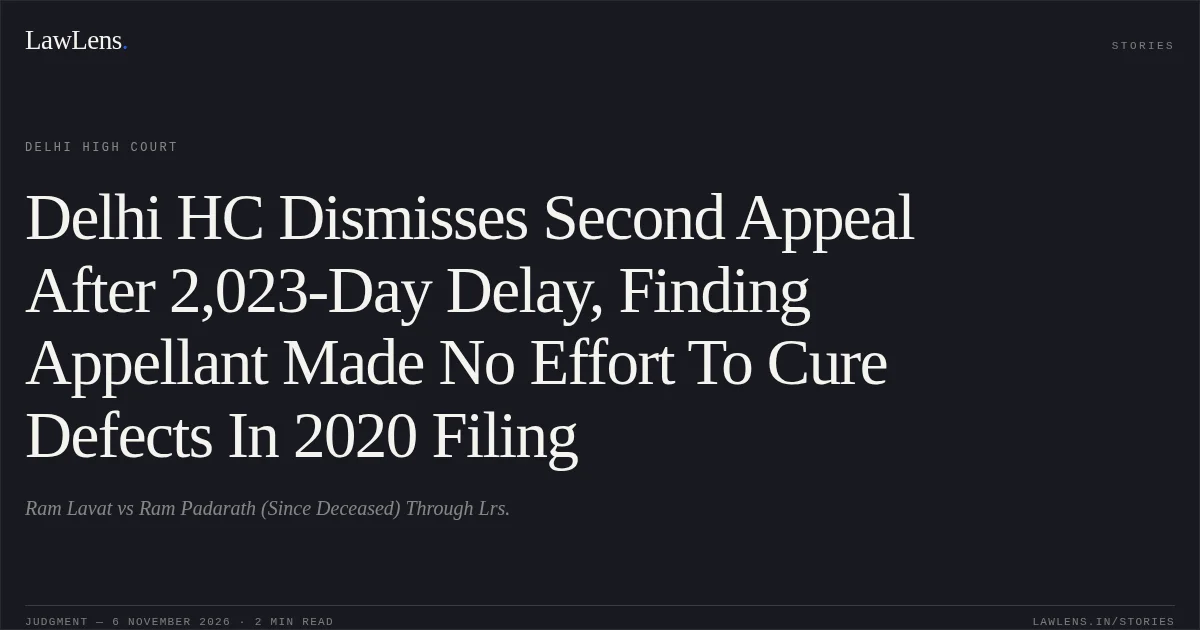
The appellant sought condonation of 2,023 days’ delay in filing a Regular Second Appeal against the judgment and decree dated 15 November 2019 of the Additional District Judge-04, East District, Karkardooma Courts, Delhi.
pp. 1–2 · ¶ 1–3He stated that an appeal had initially been filed on 16 March 2020 but remained defective after the death, during the COVID-19 pandemic, of the lawyer handling the matter; he claimed he learned of its status only after receiving an execution notice dated 5 July 2025.
pp. 1–2 · ¶ 1–3The respondents opposed condonation, arguing that no sufficient cause had been shown.
pp. 1–2 · ¶ 1–302Issues
i.Whether the appellant established sufficient cause under Section 5 of the Limitation Act, 1963, to condone the 2,023-day delay.
p. 2, 5 · ¶ 5, 7ii.Whether the Regular Second Appeal could proceed once the application for condonation of delay was dismissed.
p. 6 · ¶ 803Law Applied
Section 5 of the Limitation Act, 1963 permits the court to condone delay where sufficient cause is established; the applicant must show an adequate reason that prevented timely recourse to court.
pp. 2–5 · ¶ 6The court relied on Pathapati Subba Reddy (Died) by LRs & Ors. v. The Special Deputy Collector (LA), 2024 INSC 286, and the principles quoted from Basawaraj v. Special Land Acquisition Officer: limitation must be applied as prescribed, and negligence, inaction, lack of bona fides, or want of diligence may defeat a request to condone delay.
pp. 2–5 · ¶ 6Although Section 5 is to be applied with a liberal approach to advance substantial justice, that approach cannot override the law of limitation; the discretion to condone delay is not automatic, particularly where delay is inordinate and due diligence is lacking.
pp. 2–5 · ¶ 6Provisions in the judgment · 3 · Linked ones open on LawLens
Limitation Act, 1963 Section 5Section 3
Code of Civil Procedure, 1908 Section 151
04Reasoning
The appellant attributed the failure to pursue the initially filed appeal to miscommunication by previous counsel and the lawyer’s death, but produced no evidence of communications with the law firm or of efforts to check the appeal’s status or cure its defects.
p. 5 · ¶ 7The court held that the appellant remained responsible for monitoring his case and that his prolonged inaction demonstrated negligence and a lack of due diligence.
p. 5 · ¶ 7On that record, he had not shown an adequate reason for the delay, and the court declined to condone it.
p. 5 · ¶ 705Holding
The court dismissed the application for condonation of delay, finding that sufficient cause had not been established.
p. 6 · ¶ 8Consequently, it dismissed the Regular Second Appeal and the pending application(s).
p. 6 · ¶ 8Original Court PDF
Ram LavatvsRam Padarath (Since Deceased) Through Lrs.
Click to open original judgment
Original judgment, available to read, download and summarize on LawLens.in