01Facts
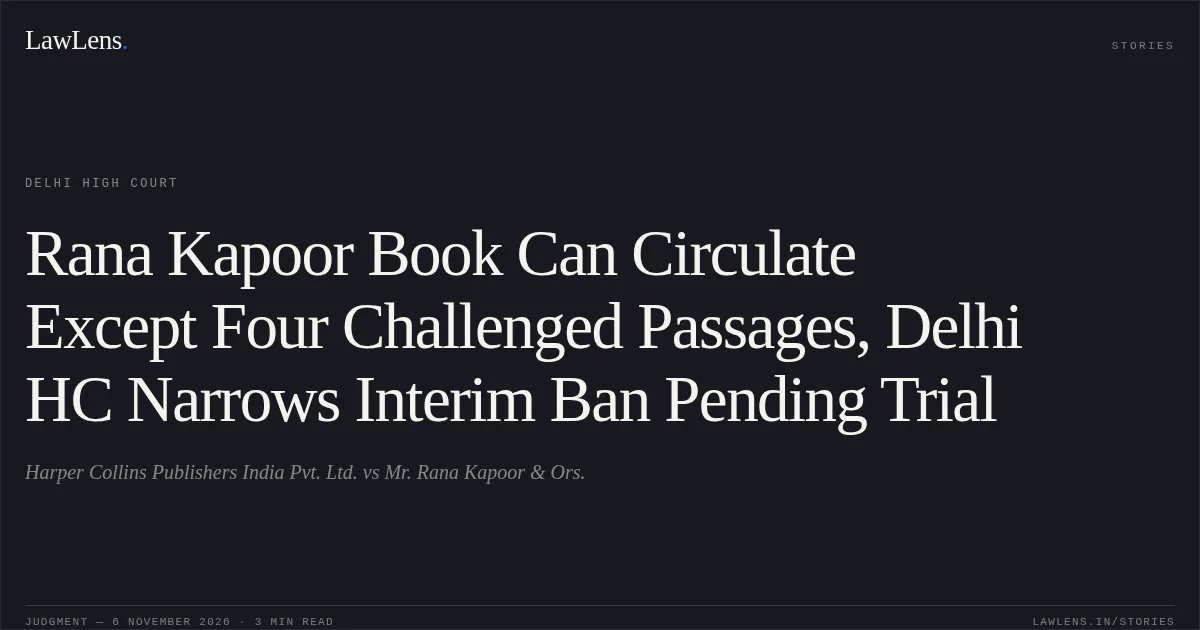
HarperCollins published, and Pavan Chand Lall authored, *Yes Man: The Untold Story of Rana Kapoor*, concerning Kapoor and the rise and crisis of Yes Bank.
¶ 6–17, 64–67Kapoor sued for defamation and related relief, alleging that passages in the book, two articles and an interview harmed his reputation and could prejudice his right to a fair trial.
¶ 6–17, 64–67The Trial Court found three statements in the book prima facie defamatory and another derogatory, but restrained publication, sale, distribution and circulation of the entire book, and also directed removal of the articles and interview.
¶ 6–17, 64–67HarperCollins and Lall appealed under Order XLIII Rule 1(r) CPC. Lall had been proceeded ex parte before the Trial Court.
¶ 1, 15, 6502Issues
i.1. Whether the Trial Court’s findings that the identified statements were prima facie defamatory or derogatory warranted appellate interference
¶ 73–75, 82–92ii.2. Whether, despite those findings, an interim injunction restraining circulation of the entire book was justified, or whether relief should be confined to the specific passages
¶ 93–104iii.3. Whether the appellate court could interfere with the Trial Court’s discretionary order under Order XXXIX Rules 1 and 2 CPC
¶ 54–6303Law Applied
Under Order XXXIX Rules 1 and 2 CPC, interim relief requires a prima facie case, balance of convenience and irreparable injury; those factors must be assessed with particular care where relief restrains publication.
¶ 56–63Under *Wander Ltd. v. Antox India (P) Ltd.*, an appellate court ordinarily does not substitute its discretion for that of the Trial Court unless the order is arbitrary, capricious or perverse, or proceeds on an error of principle.
¶ 56–63*Bloomberg Television Production Services India (P) Ltd. v. Zee Entertainment Enterprises Ltd.* requires caution in granting pre-trial publication injunctions; such restraint should not issue casually, and the defence should be considered, particularly where it is not bound to fail.
¶ 72The court must balance freedom of speech and expression under Article 19(1)(a) against reputation, recognised as part of Article 21, and tailor any restraint no wider than necessary.
¶ 80, 103–106Prior availability of material in the public domain does not, by itself, establish truth or fair comment.
¶ 87–88Provisions in the judgment · 6 · Linked ones open on LawLens
Code of Civil Procedure, 1908 Section 104Section 151Section 9
Indian Penal Code, 1860 Section 499Section 500
Code of Criminal Procedure, 1973 Section 199
04Reasoning
Applying the limited appellate standard, the High Court found no basis to disturb the Trial Court’s assessment of the four passages: Statements (iv), (vii) and (x) were prima facie defamatory, while Statement (ii) was derogatory; whether the statements were true, justified or fair comment remained for trial.
¶ 82–92But those findings did not justify banning the entire book, particularly because the Trial Court had not found all complained-of passages defamatory and the remaining passages were not successfully challenged.
¶ 94–102The book had also been in circulation for a substantial period, and the injunction imposed a broader restraint than necessary to protect Kapoor’s reputation.
¶ 94–102The court therefore held that the competing rights were better protected by limiting the injunction to the identified passages.
¶ 103–11305Holding
The appeals were allowed in part and the Trial Court’s order was modified: the restraint on publication, sale, distribution and circulation of the book applies only to the portions containing Statements (ii), (iv), (vii) and (x), as identified in the Trial Court’s order.
¶ 114–117The rest of the book is not restrained on the basis of those findings.
¶ 114–117The court’s conclusions were interlocutory only and were not to influence the final adjudication of the suit.
¶ 114–117No order as to costs.
¶ 118Original Court PDF
Harper Collins Publishers India Pvt. Ltd.vsMr. Rana Kapoor & Ors.
Click to open original judgment
Original judgment, available to read, download and summarize on LawLens.in