Facts
The appellant, Anil Babbar, was married to respondent no. 1, Upasana Kapoor, on 1 December 2014, and they had a daughter, initially named “Samriddhi Babbar.” Matrimonial disputes arose, and respondent no. 1 left the matrimonial home with the child on 10 June 2016. The appellant alleged that respondent nos. 1 to 3 published defamatory Facebook posts concerning his character, conduct as a husband and father, and professional identity as a lawyer. He also alleged that the respondents attempted to change the child’s name to “Saanvi Kapoor,” thereby severing her connection with him and his family
Source reference: paras. 3–15; pp. 2–5The appellant instituted a suit for ₹1,00,000 in damages, with pendente lite interest at 24% per annum, alleging reputational harm, mental anguish and emotional distress. The respondents denied that the posts were defamatory and stated that “Saanvi” was merely an affectionate name, while the child’s official name remained “Samriddhi Babbar.” The Civil Judge dismissed the suit, holding that the posts did not constitute defamation or establish reputational injury. The District Judge affirmed the dismissal on appeal. The appellant thereafter preferred the present Regular Second Appeal under Section 100 read with Section 151 of the CPC
Source reference: paras. 15–20; pp. 5–6; paras. 21–29; pp. 6–8; paras. 1, 30–38; pp. 2, 8–10Issues
Whether the Facebook posts published by the respondents contained defamatory imputations concerning the appellant and caused injury to his personal or professional reputation?
Source reference: paras. 41–58; pp. 11–20Whether the appellant proved publication of the alleged defamatory imputations to third parties and consequent lowering of his reputation?
Source reference: paras. 59–62; pp. 20–21Whether the complaints and FIR lodged by respondent no. 1 constituted actionable defamation?
Source reference: para. 63; p. 21Whether any substantial question of law arose warranting interference with the concurrent findings of the courts below under Section 100 CPC?
Source reference: paras. 39–40, 64–65; pp. 10–11, 22Law Applied
The Court applied Section 100 CPC, under which a Regular Second Appeal lies only on a substantial question of law; concurrent findings of fact cannot ordinarily be disturbed unless they are perverse, based on no evidence or inadmissible evidence, contrary to mandatory law, or contrary to binding Supreme Court authority
Source reference: paras. 39–40; pp. 10–11Applying the principles underlying Section 499 IPC, the Court held that defamation requires an imputation concerning the claimant, publication to others, and a tendency to lower the claimant’s reputation in the estimation of others; hurt, annoyance or emotional distress alone is insufficient
Source reference: para. 42; p. 11The Court further held that the claimant bears the initial burden of proving the defamatory nature of the statement, its publication and resulting reputational injury
Source reference: paras. 59–62; pp. 20–21Mere lodging of a complaint or registration of an FIR does not constitute defamation unless the allegations are shown to be false and circulated with an intention to harm reputation
Source reference: para. 63; p. 21The Court also considered the principle in Ram Jethmalani v. Subramanian Swamy, but found that it did not assist the appellant on the facts
Source reference: para. 34; p. 9Reasoning
The Court examined the Facebook posts individually and in their factual context. Posts referring to the child as “Saanvi Kapoor,” seeking suggestions for her name, or depicting her with the maternal family were found to reflect familial circumstances and affection, not an imputation lowering the appellant’s reputation; the appellant also failed to prove that the child’s official name had been changed
Source reference: paras. 44–49; pp. 16–18General statements criticising husbands or fathers who failed to respect their wives and children were not specific enough to identify the appellant or constitute defamatory imputations
Source reference: paras. 50–51; pp. 18–19Expressions such as “kick his ass,” “P for Pajama,” “200 gms of brain,” “Happy burning” and “vakil babu” were distasteful and sarcastic, but did not, without more, establish defamation or professional injury
Source reference: paras. 52–55; pp. 19–20Although the appellant’s witnesses supported his version, they could not satisfactorily establish how the posts became visible to them, whether the appellant was identified or tagged, or how his reputation was lowered. Their evidence therefore did not prove publication to third parties or consequential reputational loss
Source reference: paras. 56–62; pp. 19–21The Court also held that the appellant’s emotional pain arising from separation from his daughter could not be equated with actionable loss of reputation
Source reference: para. 49; p. 18As the appeal sought a reappreciation of evidence without raising any substantial question of law, the concurrent findings of the courts below were not open to interference
Source reference: paras. 58, 64; pp. 20, 22Holding
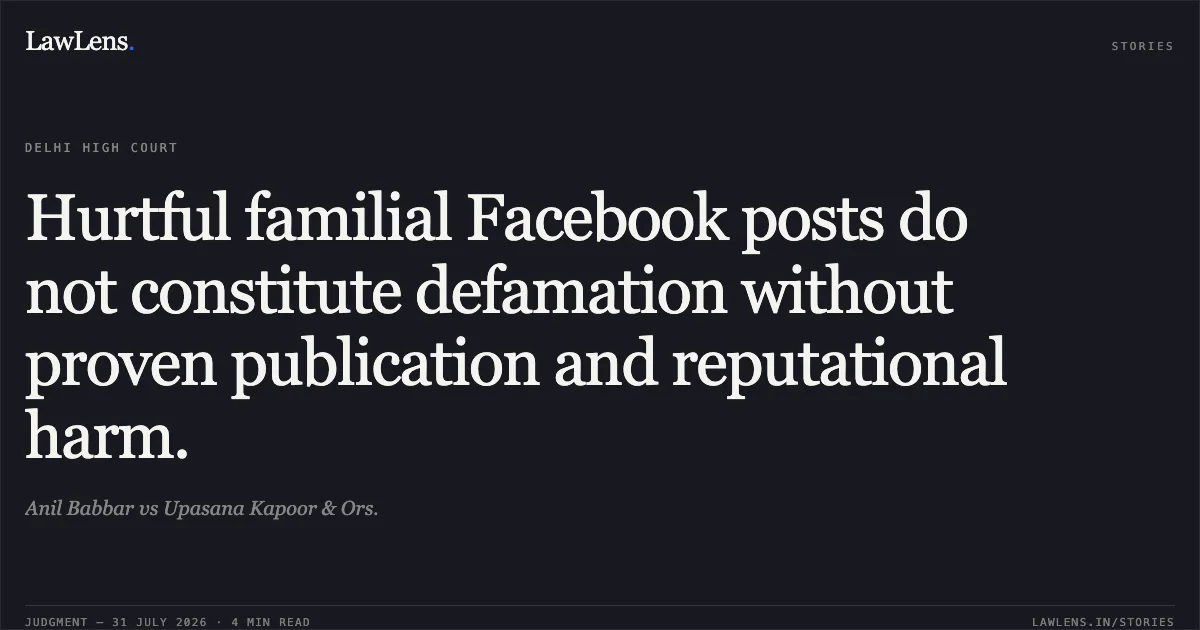
The Court answered the issues against the appellant. It held that the Facebook posts, though some were hurtful, sarcastic or offensive, did not constitute actionable defamation; the appellant failed to prove that they contained defamatory imputations concerning him, were published in a manner identifying him to third parties, or caused any lowering of his personal or professional reputation
The complaints and FIR also did not constitute defamation in the absence of proof that their allegations were false and maliciously circulated
Source reference: para. 63; p. 21No substantial question of law arose under Section 100 CPC. The Regular Second Appeal was dismissed, and all pending applications were disposed of accordingly
Source reference: paras. 64–65; p. 22Original Court PDF
Anil BabbarvsUpasana Kapoor & Ors.
Click to open original judgment
Original judgment, available to read, download and summarize on LawLens.in