Facts
The petitioner, Md. Faiyaz Alam, was married to Opposite Party No. 2, Simmi Khatton, on 3 September 2013 according to Muslim rites and customs.
Source reference: no citationShe alleged that, after the marriage, the petitioner and his relatives subjected her to cruelty and harassment for dowry, including a demand for ₹1,00,000 and a motorcycle.
Source reference: no citationShe further alleged that on 1 May 2016 she was confined in a room and an attempt was made to burn her by pouring kerosene oil.
Source reference: no citationOn the basis of the allegations, Kothi P.S. Case No. 18 of 2016 was registered for offences under Sections 498-A and 379 of the Indian Penal Code and Sections 3 and 4 of the Dowry Prohibition Act
Source reference: p.2, para.3The learned S.D.J.M., Sherghati, took cognizance of the offences against the petitioner and others by order dated 1 December 2017
Source reference: p.2, para.2The petitioner sought quashing of the cognizance order, contending that the allegations against him were general and omnibus, that an earlier complaint on substantially related allegations had not been disclosed, and that no specific material connected him with the alleged offences
Source reference: pp.2–3, paras.4–5During the proceedings, the petitioner also brought on record the subsequent marriage of the informant through a supplementary affidavit
Source reference: p.3, para.6Opposite Party No. 2 did not appear despite service of notice
Source reference: p.4, para.7Issues
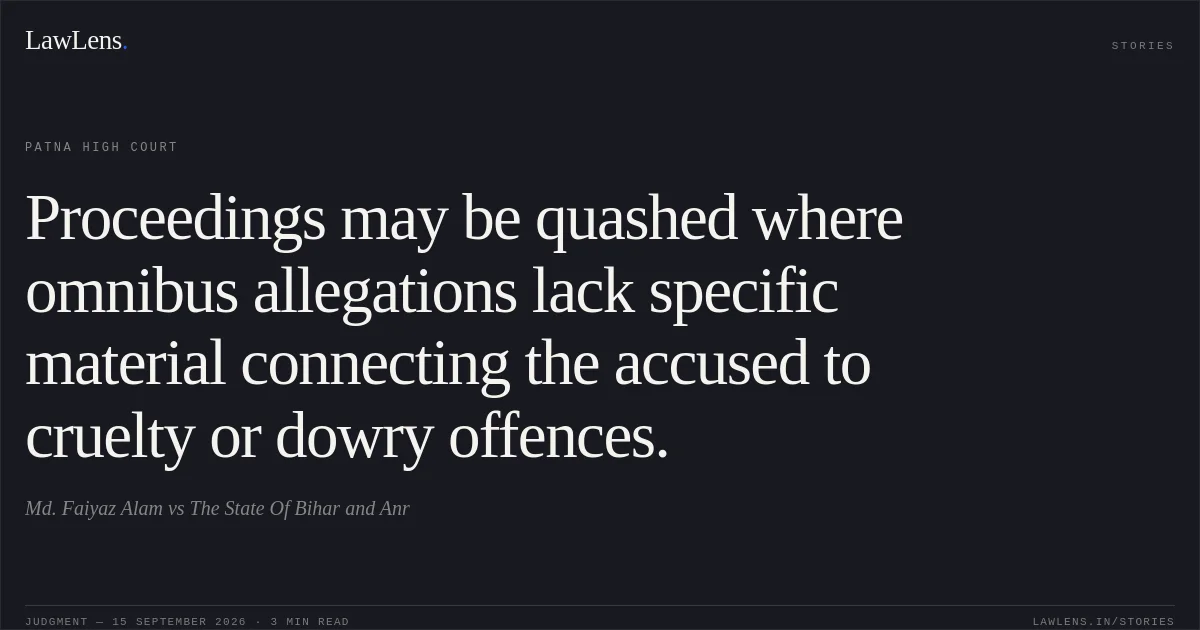
Whether the cognizance order and consequential criminal proceedings against the petitioner should be quashed where the FIR and investigation materials contain only general and omnibus allegations without any specific overt act attributable to him
Source reference: pp.4–5, paras.9–11Whether the earlier complaint instituted by the informant, its non-disclosure in the subsequent FIR, and the informant’s subsequent marriage were relevant circumstances in determining whether continuation of the prosecution would amount to abuse of the process of law
Source reference: pp.4–6, paras.10–13Law Applied
The Court applied Sections 498-A and 379 of the Indian Penal Code and Sections 3 and 4 of the Dowry Prohibition Act, which respectively concern cruelty by the husband or his relatives, theft, and giving, taking, or demanding dowry.
Source reference: no citationIt exercised the High Court’s inherent jurisdiction under Section 482 of the Code of Criminal Procedure to prevent abuse of the process of court and secure the ends of justice.
Source reference: no citationThe Court reiterated that, although detailed appreciation of evidence is inappropriate at the stage of cognizance, criminal proceedings may be quashed where the allegations, even if taken at face value, are general and omnibus, do not attribute any specific overt act to the accused, and the investigation materials do not disclose the essential ingredients of the alleged offences
Source reference: p.5, para.11; p.6, para.13No specific judicial precedent was cited in the judgment.
Source reference: no citationReasoning
The Court examined the FIR and the investigation materials and found that no specific act of dowry demand, assault, cruelty, or torture had been attributed to the petitioner; the allegations against him were general in nature
Source reference: p.4, para.9It also considered the informant’s earlier Complaint Case No. 75 of 2015 alleging offences under Sections 498-A and 379/34 IPC and Sections 3 and 4 of the Dowry Prohibition Act, noting that the earlier proceeding had not been disclosed in the subsequent FIR
Source reference: pp.4–5, para.10While acknowledging that a detailed evidentiary assessment was impermissible at the cognizance stage, the Court held that the absence of specific allegations and supporting material justified intervention under the inherent jurisdiction
Source reference: p.5, para.11The Court further took into account the informant’s subsequent marriage, as brought on record by the supplementary affidavit, and concluded that continuation of the proceedings against the petitioner would not serve the ends of justice
Source reference: pp.5–6, para.12Holding
The Court held that the allegations, even if accepted at face value, did not disclose sufficient material constituting the offences against the petitioner.
It therefore found that continuation of the criminal proceedings would amount to an abuse of the process of law
Source reference: p.6, para.13The order dated 1 December 2017 passed by the learned S.D.J.M., Sherghati, taking cognizance in Kothi P.S. Case No. 18 of 2016, along with all consequential proceedings, was quashed qua the petitioner
Source reference: p.6, para.14The petition was accordingly allowed, and a copy of the judgment was directed to be communicated to the trial court
Source reference: p.6, paras.15–16Acts & Sections Cited
4 provisions across 2 statutes referred to in this judgment. Each provision opens on LawLens.
Indian Penal Code, 18602
Original Court PDF
Md. Faiyaz AlamvsThe State Of Bihar and Anr
Click to open original judgment
Original judgment, available to read, download and summarize on LawLens.in