Facts
The respondent was posted as Assistant Jailer at Sub-Jail, Sherghati. During the night of 29–30 July 2005, three prisoners escaped from the jail.
Source reference: p.2, para. 2More than ten years later, the Inspector General of Prisons initiated departmental proceedings against him by charge-sheet dated 3 February 2016, alleging negligence, dereliction of duty, complicity in the escape, and receipt of bribes from the prisoners.
Source reference: p.2, para. 2The respondent denied the charges, asserting that he was at his government quarters when the escape occurred and that the jailers on duty were responsible for jail security; he also relied on the report of the District Magistrate and Superintendent of Police implicating other jail officials.
Source reference: p.2–3, para. 3The Inquiry Officer found the allegations of negligence and failure to discharge official duties proved, but did not establish the allegation that the respondent accepted bribes to facilitate the escape.
Source reference: p.3, para. 3No witness was examined and no documentary evidence was proved during the inquiry.
Source reference: p.5–6, para. 6Despite this, the disciplinary authority imposed the punishment of stoppage of two annual increments with cumulative effect on 24 April 2017, and the appellate authority dismissed the respondent’s appeal on 13 September 2017.
Source reference: p.4, para. 4The learned Single Judge quashed both orders on 29 July 2022. The State challenged that decision in the present Letters Patent Appeal.
Source reference: p.1, para. 1; p.4, para. 4Issues
1. Whether the departmental inquiry and the Inquiry Officer’s report could sustain a finding of misconduct when no oral evidence was examined, no documentary evidence was proved, and the finding of negligence was unsupported by identified material on record?
Source reference: p.5–6, paras. 6–8; p.19, para. 122. Whether the disciplinary and appellate orders could be sustained when they were based on an inquiry report founded on no evidence and unsupported by adequate reasons?
Source reference: p.7–8, para. 7; p.19–20, paras. 12–133. Whether the learned Single Judge impermissibly exceeded the limits of judicial review by interfering with the departmental findings?
Source reference: p.4–5, para. 5; p.9–11, paras. 6–10 of Kuldeep Singh reproduced in the judgmentLaw Applied
The Court applied the Bihar Government Servants (Classification, Control and Appeal) Rules, 2005, together with the principles of natural justice and the reasonable opportunity requirement under Article 311(2) of the Constitution.
Source reference: p.3–4, para. 4; p.15–18, paras. 28–30 and 37–39 of State of U.P. v. Saroj Kumar Sinha reproducedA departmental inquiry is quasi-judicial, and the Inquiry Officer must reach findings on the basis of evidence and material properly brought on record; suspicion, conjecture, or an unsupported ipse dixit cannot substitute for proof.
Source reference: no citationThe Court relied on Roop Singh Negi v. Punjab National Bank, (2009) 2 SCC 570, holding that documents and an FIR cannot ordinarily be treated as evidence unless properly proved and that findings based on surmises are unsustainable.
Source reference: p.6–8, paras. 7–8It further relied on Kuldeep Singh v. Commissioner of Police, (1999) 2 SCC 10, for the principle that judicial review may intervene where findings are based on no evidence, unreliable evidence, or are perverse—namely, findings that no reasonable person could reach.
Source reference: p.8–15, para. 9State of U.P. v. Saroj Kumar Sinha, (2010) 2 SCC 772, was relied upon for the rule that the Inquiry Officer must act as an independent adjudicator, the department must produce evidence even in an ex parte inquiry, and unproved documents cannot establish the charge.
Source reference: p.15–18, para. 10Reasoning
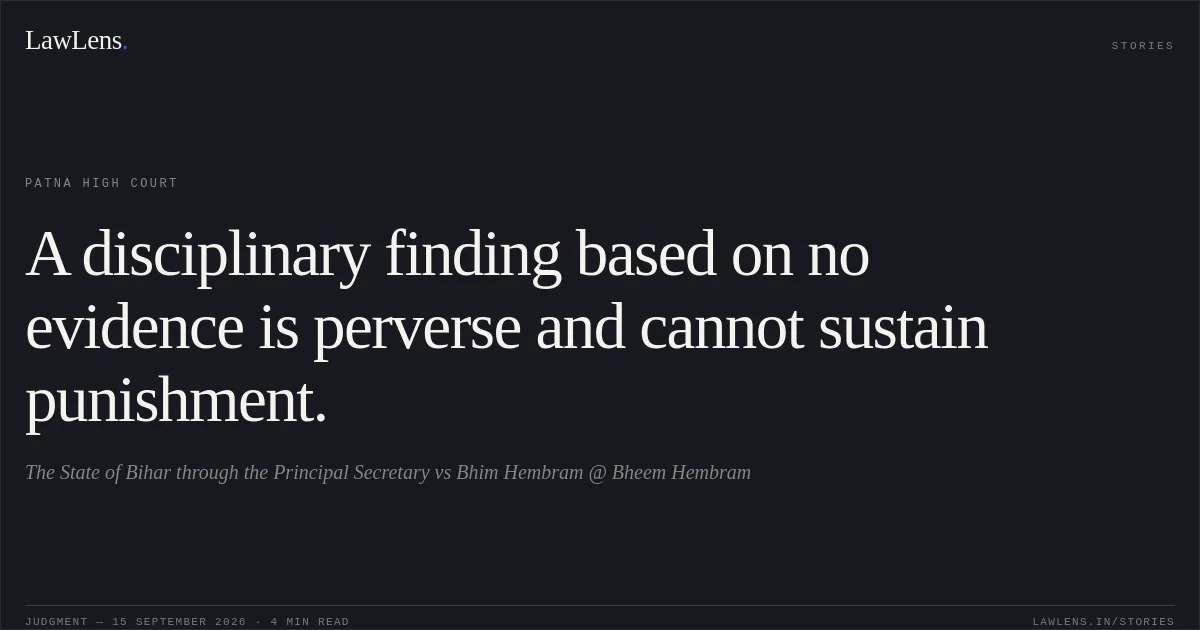
The Court found that the prosecution had examined no witness and had adduced no proved documentary evidence.
Source reference: p.5–6, para. 6Although the Inquiry Officer held the charge of negligence and failure to discharge official duties proved, the report did not identify or assess any evidence supporting that conclusion.
Source reference: p.5–6, para. 6The allegation of accepting bribes to facilitate the escape was not proved at all.
Source reference: p.3, para. 3Applying Roop Singh Negi, Kuldeep Singh, and Saroj Kumar Sinha, the Court held that the Inquiry Officer could not base a finding of guilt on mere allegations, suspicion, or unproved material.
Source reference: p.6–8, paras. 7–8; p.9–11, para. 9; p.19, para. 12The absence of evidence rendered the finding perverse and brought the matter within the permissible scope of judicial review; the Single Judge had therefore not acted as an appellate authority but had reviewed the legality of the decision-making process.
Source reference: p.6–8, paras. 7–8; p.9–11, para. 9; p.19, para. 12Since the punishment order rested entirely on the defective inquiry report, and the appellate order provided no independent basis capable of curing that defect, both orders were unsustainable.
Source reference: p.7–8, para. 7; p.19–20, para. 12Holding
The Division Bench held that the inquiry report dated 8 August 2016 was non est, void, and based on no evidence, particularly because the finding of negligence was unsupported by any witness or proved material.
Consequently, the punishment order dated 24 April 2017 and the appellate order dated 13 September 2017 were invalid.
Source reference: p.19–20, paras. 12–13Finding no illegality or perversity in the Single Judge’s judgment dated 29 July 2022, the Court dismissed the State’s Letters Patent Appeal as meritless.
Source reference: p.19–20, paras. 12–13Acts & Sections Cited
2 provisions across 1 statute referred to in this judgment. Linked provisions open on LawLens.
Indian Evidence Act, 18722
Original Court PDF
The State of Bihar through the Principal SecretaryvsBhim Hembram @ Bheem Hembram
Click to open original judgment
Original judgment, available to read, download and summarize on LawLens.in