01Facts
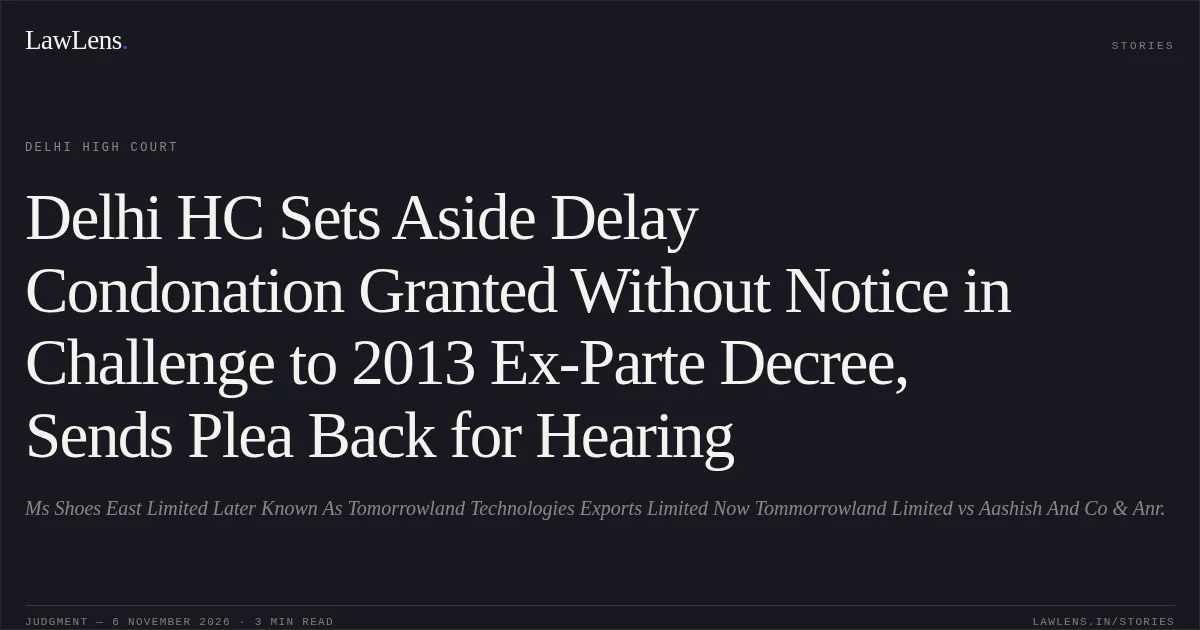
The appellant obtained an ex parte decree dated 25 November 2013, with an addendum dated 17 December 2014, making an arbitral award a rule of the Court.
¶ 2–3In January 2022, respondent no. 2 applied under Order IX Rule 13 CPC to set aside the decree and sought condonation of a stated “about 180 days” delay, pleading lack of knowledge of the proceedings until 17 August 2019 and unsuccessful requests for certified copies.
¶ 3On 28 January 2022, the Single Judge allowed the condonation application on the first date of listing, without notice to the decree holder or recorded reasons.
¶ 1, 3The decree holder appealed, arguing that the delay was over eight years and that the application did not adequately explain it.
¶ 402Issues
i.1. Whether an appeal under Section 10 of the Delhi High Court Act was maintainable against the order condoning delay in filing the Order IX Rule 13 application.
¶ 9ii.2. Whether the order condoning delay could stand when made without notice to the decree holder and without reasons.
¶ 9–10iii.3. Whether the appellate court should itself determine the condonation application or remit it to the Single Judge.
¶ 1103Law Applied
Section 10 of the Delhi High Court Act permits an appeal from an order that has the trappings of a judgment; under Shah Babulal Khimji v. Jayaben D. Kania, an order determining a valuable right may qualify.
¶ 9Article 123 of the Limitation Act, 1963 prescribes thirty days for an Order IX Rule 13 CPC application, running from the decree or, where summons was not duly served, from knowledge of the decree.
¶ 9Under Section 5 of the Limitation Act, the applicant bears the burden of satisfying the Court that sufficient cause prevented a timely application; the discretion must be exercised judicially, with consideration of the explanation and the right accrued to the opposing party.
¶ 9A party whose accrued right is affected must have an opportunity to be heard, and judicial orders must give reasons demonstrating application of mind.
¶ 9–10Provisions in the judgment · 4 · Linked ones open on LawLens
Delhi High Court Act, 1966 Section 10
Limitation Act, 1963 Section 5Section 123
Code of Civil Procedure, 1908 Section 151
04Reasoning
The order was appealable because condoning delay removed the limitation bar and reopened a decree that had stood for years, affecting the decree holder’s accrued right.
¶ 9The Single Judge issued notice on the underlying Order IX Rule 13 and stay applications but decided the threshold limitation issue without hearing the decree holder, thereby causing prejudice on a question involving disputed facts.
¶ 10The order also gave no meaningful reasons: the reference to “the reasons mentioned in the application” did not identify the period of delay or establish sufficient cause, particularly when the application itself did not compute the delay.
¶ 10The appellate court declined to determine the delay or sufficiency of cause itself because the Single Judge should consider the application first, after receiving the decree holder’s response.
¶ 1105Holding
The appeal was allowed.
¶ 12The order dated 28 January 2022 was set aside insofar as it condoned the delay, and the condonation application was restored for fresh determination by the Single Judge after hearing the decree holder.
¶ 12The court expressed no view on the merits of the applications and requested an expeditious decision; the connected applications and review petition were disposed of as infructuous, with no order as to costs.
¶ 12–13Original Court PDF
Ms Shoes East Limited Later Known As Tomorrowland Technologies Exports Limited Now Tommorrowland LimitedvsAashish And Co & Anr.
Click to open original judgment
Original judgment, available to read, download and summarize on LawLens.in