01Facts
The petitioner instituted a petition under Section 276 of the Indian Succession Act, 1925, seeking probate of an alleged Will dated 18 December 2010.
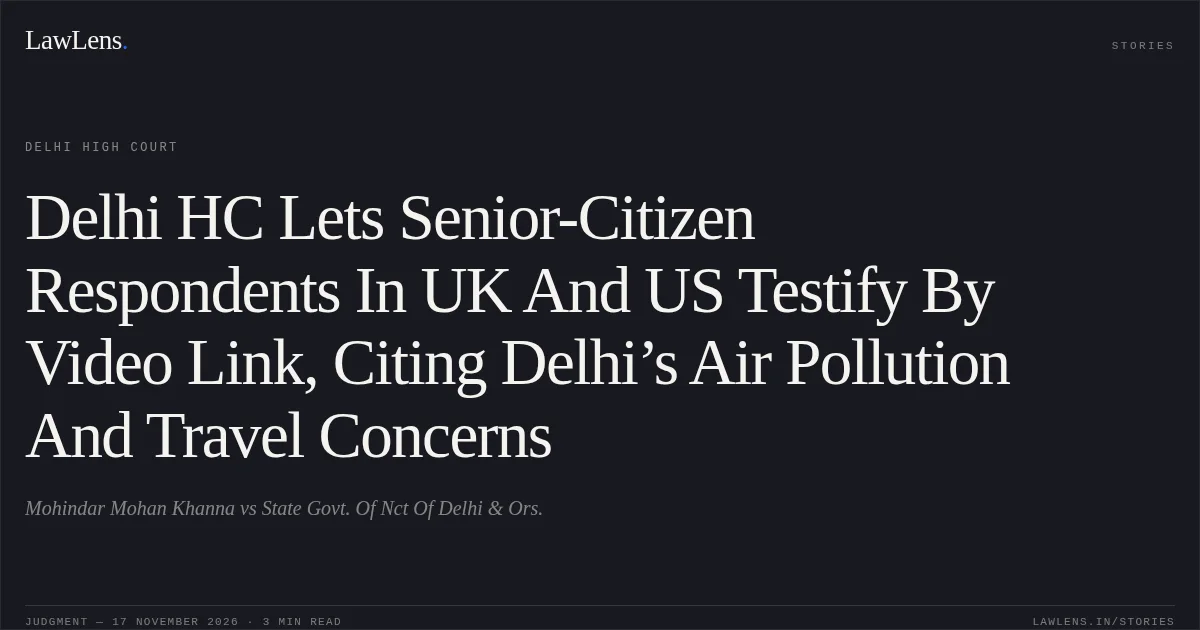
¶ 2–4Respondent Nos. 2 and 5, who had filed objections, applied to have their evidence recorded by video conference. They were senior citizens residing in the United Kingdom and the United States and cited the burdens of international travel and health concerns during Delhi’s winter pollution period.
¶ 2–4The petitioner opposed the application, raising concerns about witness tutoring, documents, signatures, time zones and delay. The Court had appointed a Local Commissioner, and the petitioner’s evidence had already been recorded.
¶ 2–402Issues
i.Whether the evidence of Respondent Nos. 2 and 5, residing abroad, should be recorded by video conference in the circumstances of the case
¶ 8–9ii.Whether the procedural safeguards available under the applicable rules would protect the petitioner’s right to a fair and effective cross-examination
¶ 8, 11–1503Law Applied
Order XVIII of the Code of Civil Procedure, 1908, the Delhi High Court (Original Side) Rules, 2018, and the Delhi High Court Electronic Evidence and Video Conferencing Rules, 2025 governed the request.
¶ 1Rule 10 of the VC Rules, 2025 provides safeguards against prompting or tutoring and addresses the transmission and use of relevant documents; Rule 14 regulates the presentation or exhibition of documents to a remote witness; and Rule 13 provides for signatures on the transcript and its transmission to the Court Point.
¶ 11–12In Phillips 66 Company v. Raaj Unocal Lubricants Limited, 2022 SCC OnLine Del 3268, the Court recognised that evidence of witnesses abroad may be recorded by video conference, provided the process preserves the rigour of examination and cross-examination and the fairness of the trial.
¶ 10Provisions in the judgment · 1 · Linked ones open on LawLens
Indian Succession Act, 1925 Section 276
04Reasoning
The applicants’ age, overseas residence, travel burden and stated health concerns were relevant factors favouring video-conference evidence, while the petitioner’s right to test their testimony remained essential.
¶ 9The Court held that the objections concerning tutoring, documents and transcript signatures could be addressed through strict observance of Rules 10, 13 and 14, the presence and duties of coordinators, and the Local Commissioner’s supervision.
¶ 11–12, 15The time-zone difference was not an insurmountable obstacle because the Local Commissioner could set suitable dates and times in consultation with the parties and coordinators.
¶ 13Recording evidence remotely would also avoid postponing the examination until the applicants’ proposed visit to India in February or March 2027.
¶ 1405Holding
The Court allowed the application and directed that Respondent Nos. 2 and 5 be examined by video conference, with the Court Point at the Delhi High Court, Respondent No. 2’s Remote Point at the High Commission of India in London, and Respondent No. 5’s Remote Point at the Consulate General of India in New York.
¶ 17(i)–(iii)The Court further directed arrangements for IT support and remote-point officials, advance payment of the specified fees and expenses, scheduling by the Local Commissioner, and strict compliance with safeguards concerning identification, tutoring, documents, oath, evidence, transcripts and electronic records. The petitioner was to receive a full and effective opportunity to cross-examine both respondents.
¶ 17(iv)–(x)The alternative request for physical appearance in India did not require separate consideration, and the application was disposed of.
¶ 18–19Original Court PDF
Mohindar Mohan KhannavsState Govt. Of Nct Of Delhi & Ors.
Click to open original judgment
Original judgment, available to read, download and summarize on LawLens.in