01Facts
The plaintiffs, the State of Karnataka and Karnataka Neeravari Nigam Ltd. (KNNL), sued in O.S. No. 242/2003 to recover ₹1,01,838.94 from defendant No. 1 (son of the late Store Superintendent) and ₹33,946.25 from defendant No. 2 (the Executive Engineer), with 18% future interest and costs, for store shortages at MRBCC Division No. 1, Naragund.
¶ 5–6A Chief Engineer's enquiry held defendant No. 1 liable for 75% and defendant No. 2 for 25% of losses totalling ₹1,35,784.99.
¶ 7The defendants denied liability, contending no shortage occurred during their tenure and that the Karnataka Administrative Tribunal (KAT) had set aside the charges.
¶ 8The trial court dismissed the suit on 19.04.2008 after considering the evidence of PW1 and DW1–DW2.
¶ 9The First Appellate Court dismissed R.A. No. 56/2009 on 17.01.2013.
¶ 10The plaintiffs then filed this second appeal under Section 100 CPC.
¶ 3, 1102Issues
i.1. Whether the grounds urged in the second appeal raise any substantial question of law warranting admission under Section 100 CPC.
¶ 11(c), 14ii.2. Whether the concurrent findings of the trial and First Appellate Courts dismissing the suit, which relied on the evidentiary admissions of PW1 and PW2 and on the KAT's exoneration of the defendants, are perverse, illegal, or erroneous in law.
¶ 11(a)–(c), 12–1303Law Applied
The Court applied Section 100 of the Code of Civil Procedure, 1908, under which a second appeal lies only on a substantial question of law.
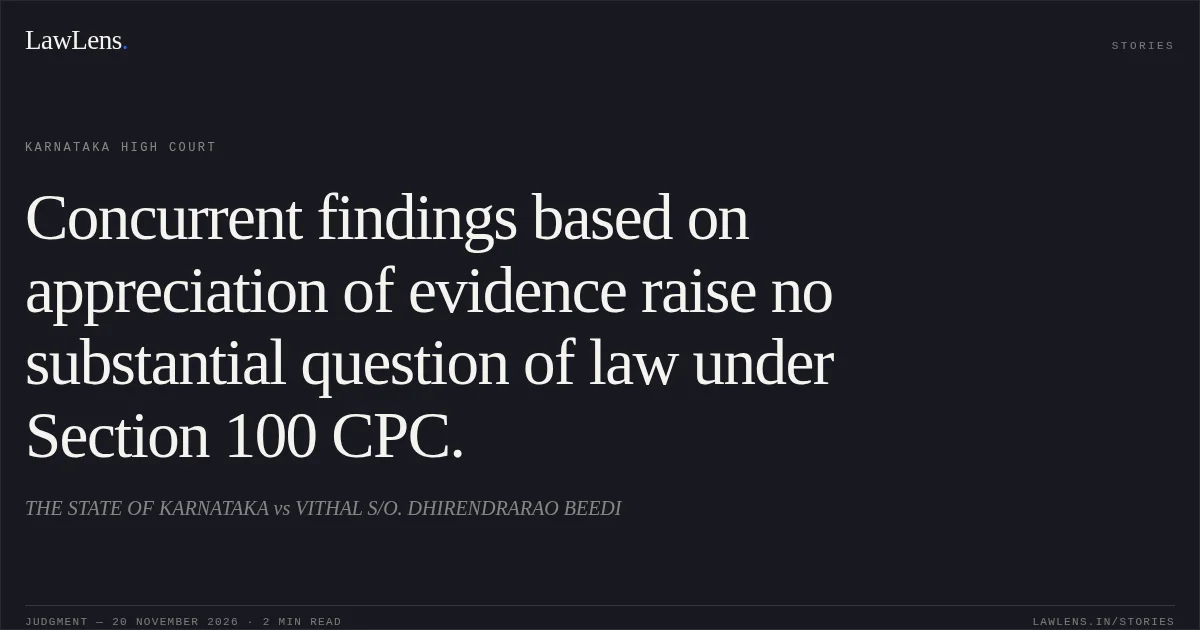
¶ 14Findings of fact based on the appreciation of pleadings and evidence are not open to interference absent perversity, illegality, or error of law.
¶ 14An unchallenged order attains finality; the KAT's order dated 30.07.1996 in Application No. 5687/1995, which quashed the enquiry-based charges, is treated as final because the plaintiffs had not challenged it.
¶ 13Provisions in the judgment · 1 · Linked ones open on LawLens
Code of Civil Procedure, 1908 Section 100
04Reasoning
The trial court found that PW1 and PW2 admitted, on cross-examination, that the defendant No. 1 took over all charge documents on assumption of duty, and that they had neither periodically checked the stock nor arranged periodic audits.
¶ 12The trial court held the plaintiffs had failed to prove their case.
¶ 12The First Appellate Court re-appreciated the evidence and noted that the enquiry's findings on liability (75%/25%) had been quashed by the KAT's order of 30.07.1996, which was unchallenged and final; it held that this supported dismissal of the appeal.
¶ 13The High Court held that the grounds raised were essentially re-appreciation of evidence, which Section 100 CPC does not permit in second appeal.
¶ 14The High Court found no perversity or misreading of evidence, and no question of law, justifying interference.
¶ 14Because the enquiry's findings had been set aside by a final order and the evidence on stock control was unfavourable to the plaintiffs, the concurrent findings stood.
¶ 12–1305Holding
No substantial question of law arises and the concurrent findings are not perverse or illegal.
¶ 14The Regular Second Appeal is dismissed at the admission stage.
¶ 15Pending interlocutory applications stand disposed of as not surviving.
¶ 16No order as to costs is made.
¶ 17Original Court PDF
THE STATE OF KARNATAKAvsVITHAL S/O. DHIRENDRARAO BEEDI
Click to open original judgment
Original judgment, available to read, download and summarize on LawLens.in