Facts
The petitioner (plaintiff) filed a civil suit for declaration of title and permanent injunction regarding property at Village Sarangarh, claiming it was joint Hindu family property acquired through joint resources while he served as Karta
Source reference: para. 3He alleged that after the death of his brother, Janak Ram, the respondents (defendants No. 1–3) mutated the property in their names and were attempting to alienate it
Source reference: para. 5The respondents contended the land was Janak Ram’s self-acquired property
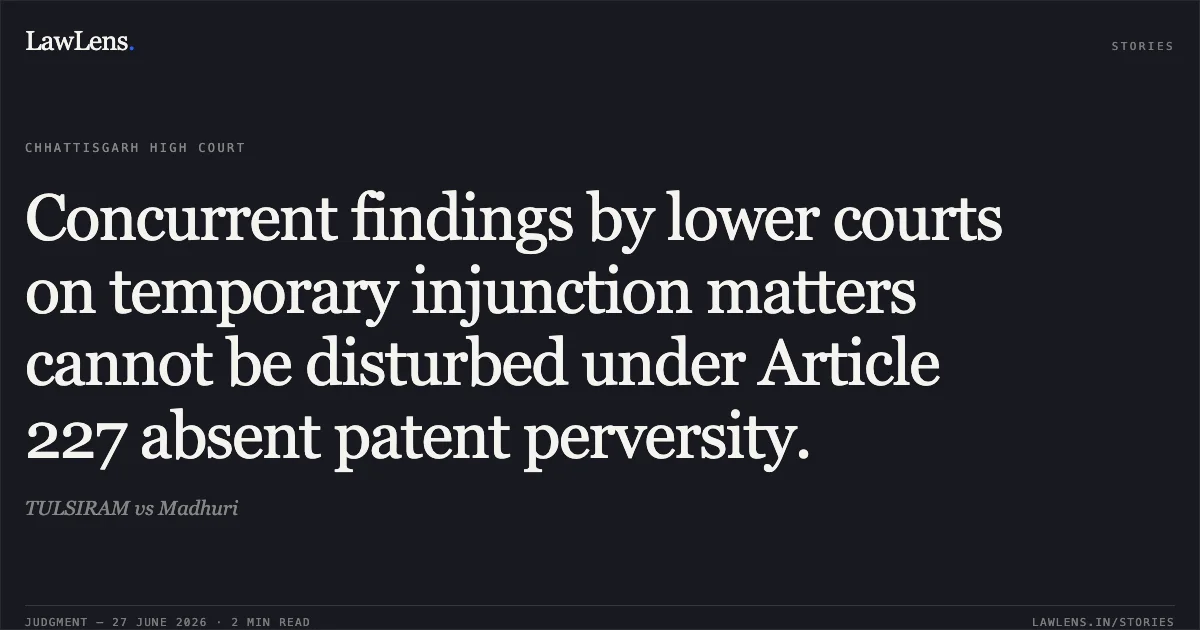
Source reference: para. 8The Trial Court rejected the petitioner’s application for temporary injunction on 31.07.2025, a decision subsequently affirmed by the Additional District Judge, Sarangarh, in Miscellaneous Civil Appeal No. 03/2026 on 27.02.2026
Source reference: para. 2The petitioner challenged these concurrent findings under Article 227 of the Constitution of India.
Source reference: no citationIssues
1. Whether the concurrent orders of the lower courts refusing a temporary injunction suffer from patent perversity or jurisdictional error warranting interference under Article 227
Source reference: para. 11, 132. Whether the petitioner established the three essential ingredients (prima facie case, balance of convenience, and irreparable injury) required for the grant of an injunction
Source reference: para. 9Law Applied
The Court applied the principles governing supervisory jurisdiction under Article 227 of the Constitution of India as settled in Shalini Shyam Shetty v. Rajendra Shankar Patil (2010) 8 SCC 329, which establishes that the High Court acts as a supervisor of subordinate courts, not as a court of appeal
Source reference: para. 11It further relied on Garment Craft v. Prakash Chand Goel (2022) 4 SCC 181, which mandates that the High Court should not re-appreciate evidence or substitute its own decision unless the lower court’s finding is perverse, lacks any evidence, or results in a manifest miscarriage of justice
Source reference: para. 12Regarding injunctions, the court upheld the necessity of proving a triable prima facie case, the balance of convenience, and irreparable loss
Source reference: para. 9Reasoning
The High Court observed that the petitioner failed to provide material documents beyond the lower court orders and the appeal memorandum to substantiate his claims
Source reference: para. 7The Trial Court had specifically found that the respondents were in possession of the property and that their names were duly recorded in the revenue records, leading to the conclusion that the petitioner failed to establish the three pillars of temporary injunction
Source reference: para. 9The High Court emphasized that under Article 227, it cannot act as a court of first appeal to re-evaluate facts
Source reference: para. 12Since both the Trial Court and the First Appellate Court concurrently found against the petitioner based on the record, and the petitioner could not demonstrate any "patent perversity" or "flagrant violation of law," the High Court determined there was no basis to exercise its limited supervisory jurisdiction
Source reference: para. 13-14Holding
The High Court answered the issues in the negative, holding that the concurrent findings of the lower courts were stable and did not warrant interference as they did not exceed their jurisdiction or result in a travesty of justice
The Court dismissed the writ petition, finding it devoid of substance and merit
Source reference: para. 14Acts & Sections Cited
1 provisions across 1 statute referred to in this judgment. Each provision opens on LawLens.
Code of Civil Procedure, 19081
Original Court PDF
TULSIRAMvsMadhuri
Click to open original judgment
Original judgment, available to read, download and summarize on LawLens.in