Facts
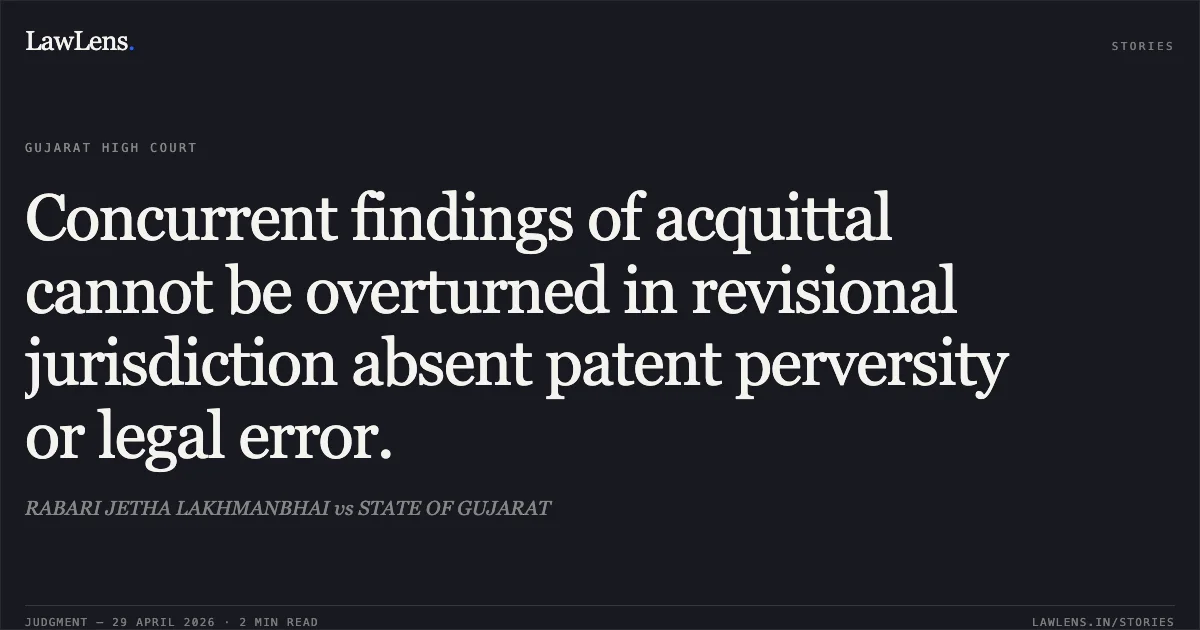
The applicant sought to challenge the judgment dated 15.09.2012 passed by the Sessions Judge, Patan, which upheld the acquittal of respondent Nos. 2 to 4 by the JMFC, Radhanpur, in Criminal Case No. 322/1990
Source reference: p. 2The respondents were originally charged under Sections 147, 148, 149, 323, 324, 325, 452, 427, and 504 of the IPC and Section 135 of the Bombay Police Act
Source reference: p. 2The trial court acquitted the accused due to a lack of reliable evidence, specifically the prosecution's failure to produce the Medical Officer and Investigating Officer as witnesses despite 29 years having elapsed at the time of the appeal
Source reference: p. 2Neither the applicant nor their advocate appeared for the High Court proceedings
Source reference: p. 1Issues
1. Whether the High Court can decide a revision application on merits in the absence of the applicant or their counsel.
Source reference: p. 12. Whether the concurrent findings of acquittal by the lower courts suffered from perversity or infirmity warranting interference under revisional jurisdiction.
Source reference: p. 3Law Applied
The Court applied the principles established in Taj Mohammad v. State of Uttar Pradesh (2023), allowing the court to decide a matter based on available records in the absence of the applicant
Source reference: p. 1Regarding revisional jurisdiction, it relied on Section 397/401 of the CrPC and the principles in Amit Kapoor v. Ramesh Chander & Anr. (2012) and Malkeet Singh Gill v. State of Chhatisgarh (2022), which restrict the Revisional Court from re-appreciating evidence or overturning concurrent findings of fact unless the decision is perverse, arbitrary, or suffers from a patent defect in law
Source reference: p. 3-4Section 401(3) CrPC was also noted as a bar to converting a finding of acquittal into one of conviction in revision
Source reference: p. 3Reasoning
The Court observed that the prosecution failed in its fundamental duty to procure key witnesses (Medical and Investigating Officers) to prove its case over a span of nearly three decades
Source reference: p. 2It found that the Sessions Court had properly re-appreciated the evidence and correctly concluded that the Magistrate's acquittal was justified due to the lack of corroborative medical evidence
Source reference: p. 2The High Court reasoned that since 36 years had passed since the FIR (1990), and as both lower courts provided reasoned findings without any palpable error of law, there was no ground to exercise discretionary revisional powers to substitute its own view for that of the trial courts
Source reference: p. 3Holding
The Court held that there was no perversity or infirmity in the concurrent findings of the lower courts
Consequently, the revision application was dismissed, and the rule was discharged
Source reference: p. 4The Court confirmed that the scope of revision does not extend to re-evaluating facts unless the lower court's discretion was exercised arbitrarily
Source reference: p. 3Acts & Sections Cited
11 provisions across 2 statutes referred to in this judgment. Each provision opens on LawLens.
Indian Penal Code, 1860
Code of Criminal Procedure, 19732
Original Court PDF
RABARI JETHA LAKHMANBHAIvsSTATE OF GUJARAT
Click to open original judgment
Original judgment, available to read, download and summarize on LawLens.in